Spice shops, halal butchers, Indian grocers, Caribbean markets, African food stores — the ordering platform built for a generic supermarket almost always breaks when it meets a catalog of 2,000 imported SKUs sold by weight, jar, bag, and case. This guide breaks down what an online ordering platform for international food shops actually needs and which builds fit which store type.
- General commerce builders choke on bulk, multi-unit, and dietary-tagged catalogs common in international food shops.
- Halal and Middle Eastern grocers need certification filtering built into search, not bolted on as a plugin.
- Indian and Caribbean grocers need multi-unit SKUs (250g, 1kg, 5kg bag) on one product page, not five duplicate listings.
- Marketplace-only listings hand customer data and 15-30% of every order to a third party — owning the storefront keeps both.
- African grocery retailers get more repeat orders from a branded mobile app than from a generic web cart in 2026.
Why this matters
International and specialty food retail runs on inventory logic that mainstream grocery ecommerce tools were never built for: variable weights, multiple unit sizes per SKU, dietary and religious certification tags, and a customer base that searches in more than one language. A platform built for a big-box grocer treats a 1kg bag of basmati rice and a 5kg bag as two separate, unrelated products instead of one SKU with two buying options — and that mismatch shows up as abandoned carts.
The stakes are also margin, not just convenience. Every order routed through a third-party delivery marketplace instead of a store's own online ordering platform for international food shops hands over a commission and the customer's contact data. In 2026, the independent grocers gaining share are the ones who own their storefront, their app, and their order history — not the ones renting a listing on somebody else's app.
Who this is for
This guide is for owners and operators of spice shops, halal and Middle Eastern grocers, Indian and South Asian markets, Caribbean food stores, African grocery retailers, and other specialty import shops who currently take orders by phone, DM, or a bolted-on marketplace listing and want a storefront that actually reflects their catalog and their customer base.
What to look for in an online ordering platform for international food shops
Multi-unit and bulk SKU handling
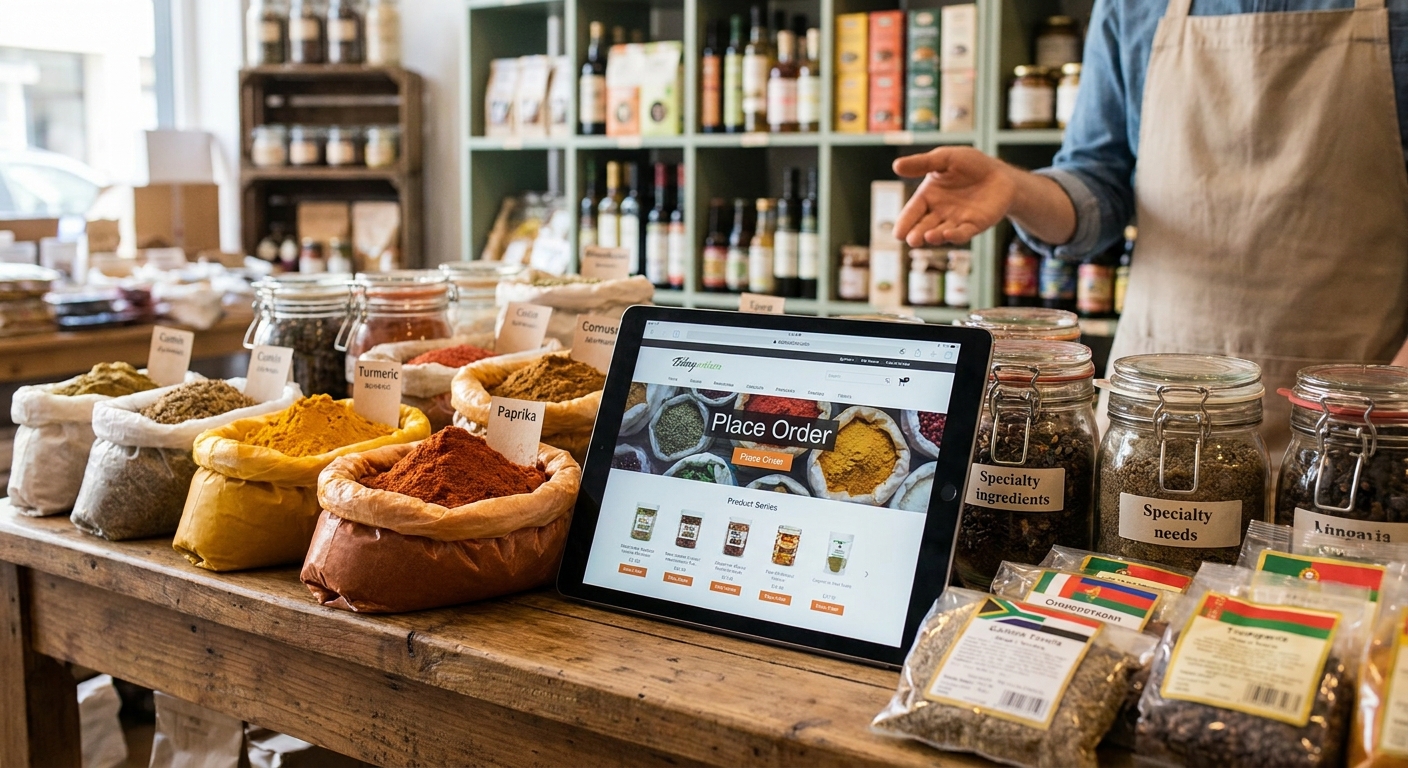
Spice and grain retailers sell the same product in 100g, 500g, 1kg, and 5kg formats, often at different per-unit pricing. A platform that forces one price and one unit per product page means duplicating listings for every size — a maintenance headache and a search-ranking mess on your own site.
Dietary and certification tagging
Halal, kosher, vegan, and gluten-free tags need to be searchable and filterable, not just text in a product description. Shoppers hunting for zabiha halal meat or kosher-certified pantry staples abandon a cart the moment they can't filter for it.
Multilingual storefront and product names
A customer base that searches for both "turmeric" and "haldi" needs a catalog that matches both terms. Platforms without multilingual product naming and search lose that traffic entirely, especially on mobile.
Delivery zones built for dense, mixed neighborhoods
International food shops cluster in dense urban corridors with tight, overlapping delivery zones. A platform needs granular zone control and real-time driver assignment, not a generic radius-based delivery map built for suburban supermarkets.
Retail media and margin control
Owning your own ordering platform means you keep the ad inventory, the loyalty data, and the margin that a marketplace listing would otherwise take a cut of. This matters more every year — commission-based marketplaces get more expensive, not less.
Branded mobile app for repeat community customers
Ethnic and specialty grocery shoppers are repeat, habitual buyers — a branded app with push notifications for restock and holiday-specific inventory (Ramadan, Diwali, Lunar New Year) drives more repeat orders than a bookmarked website.
See the platform behind these builds
White-labeled ecommerce, apps, and delivery for specialty grocers.
Top picks by store type
The certification-first pick: Halal and Middle Eastern grocers The standout feature here is dietary filtering built into product search, not a workaround. Halal certification tags surface directly in the search bar, cutting the clicks a shopper needs to find zabiha meat or halal-certified snacks. Verdict: Buy if certification search is currently missing from your storefront — check the online ordering platform for halal and Middle Eastern grocers.
The multi-unit pick: Indian grocery stores The key spec is one product page holding multiple pack sizes — a 500g and 5kg bag of atta on the same listing instead of duplicated SKUs. That single change removes the biggest catalog headache South Asian grocers report when moving online. Verdict: Buy for any store carrying rice, lentils, flour, or spice in three or more sizes — see the white-label ecommerce for Indian grocery stores.
The community-loyalty pick: Caribbean grocery stores The standout here is delivery zone precision for the dense, mixed neighborhoods where Caribbean grocers typically operate, paired with a catalog structure built for imported staples and frozen goods. Verdict: Consider if your current delivery radius is a flat suburban-style zone that doesn't match your actual customer footprint — review the grocery ecommerce platform for Caribbean grocery stores.
The repeat-order pick: African grocery retailers A fully branded mobile app is the standout spec, since African grocery shoppers tend to be habitual, high-frequency buyers who respond to push notifications for restock alerts more than email. Verdict: Buy if more than a third of your customer base orders weekly or biweekly — see the branded mobile apps for African grocery retailers.
What to avoid
- Generic ecommerce builders with no bulk/weight pricing. They look fine on a demo call, then fall apart the moment you try to list a spice sold by the gram and by the kilo on the same page.
- Marketplace-only listings. They get you online fast in 2026 but hand over customer contact data and 15-30% of order value with every sale — you never own the relationship.
- Single-language search. A platform that only indexes English product names loses every shopper searching in the language they actually use at home.
“If your catalog has more than three pack sizes per SKU, a general-purpose commerce builder starts breaking at checkout.”
Verdict comparison
| Store type | Standout feature | Best for | Verdict |
|---|---|---|---|
| Halal / Middle Eastern | Certification-tagged search | Zabiha halal, kosher-adjacent stores | Buy |
| Indian grocery | Multi-unit SKUs on one page | Bulk rice, lentils, spice retailers | Buy |
| Caribbean grocery | Dense-zone delivery precision | Urban mixed-neighborhood footprints | Consider |
| African grocery | Branded repeat-order app | High-frequency habitual shoppers | Buy |
FAQ
What's the best online ordering platform for international food shops in 2026?
The best fit depends on your specialty: halal and Middle Eastern grocers need certification-tagged search, Indian and spice retailers need multi-unit SKU handling, and Caribbean or African grocers benefit most from precise delivery zones and branded mobile apps. There is no single universal answer — match the platform to your catalog structure.
Is a white-label platform better than a marketplace listing for a spice shop?
Yes, for margin and data ownership. Marketplace listings typically take a commission on every order and give you no access to customer contact history, while a white-label storefront keeps both with you.
How much does an online ordering platform cost for a small international grocery store?
Pricing varies by vendor and by whether you need a website only, a branded app, or delivery logistics bundled in — check current pricing directly with the platform rather than relying on a flat industry number.
Can international food shops sell products by weight online?
Yes, platforms built for specialty grocery support multi-unit and bulk pricing so a single SKU can be sold by the gram, the bag, or the case without duplicate listings.
Do I need a mobile app or is a website enough for a spice shop?
A website covers new customer discovery, but a branded mobile app drives more repeat orders from habitual shoppers through push notifications for restock and seasonal inventory.
How do halal grocers filter for certification online?
Certification filtering needs to be built into the storefront's search and category structure, tagging products as halal, zabiha, or kosher so shoppers can filter results directly instead of reading every product description.
What delivery radius works best for dense ethnic grocery neighborhoods?
Dense urban food corridors need granular, overlapping delivery zones rather than one flat radius, since customer density and driver routing differ block by block in these areas.
Should a Caribbean or African grocery store use its own delivery or a third-party courier?
Owning last-mile delivery through the store's own platform preserves margin and customer data, while third-party couriers add convenience at the cost of a per-order commission.
One last thing
Most international food shops don't lose online sales to a competitor down the street — they lose them to a search bar that doesn't recognize the second language their own customers use every day. Fixing multilingual product search is often the single highest-leverage change on the entire list, ahead of app branding or delivery zones, because it's the first thing a shopper hits before any of the rest matters.