Halal and Middle Eastern grocers sell inventory that generic ecommerce platforms were never built to handle: bulk spices priced by weight, fresh halal meat cuts, prepared mezze counters, and a shopper base that expects certification transparency before checkout. This guide breaks down what an online ordering platform for halal grocery stores actually needs to do in 2026, and which category of tool gets you there without giving away your margin.
- Marketplace apps like Instacart and DoorDash take 15-30% commission and hide your customer data — Skip for primary sales channel.
- Generic builders (Shopify, Wix) lack weight-based pricing and certification badges out of the box — Consider only with heavy customization.
- A white-labeled platform built for grocery, like Local Express, handles halal SKUs, prepared food kiosks, and delivery natively — Buy.
- Custom-built sites cost more upfront and take 4-6 months to launch — Wait unless you have in-house dev resources.
Why this matters
Independent and regional halal grocers are getting squeezed from two sides in 2026: national chains are adding halal and Middle Eastern sections, and delivery marketplaces are inserting themselves between the grocer and the shopper. Every order routed through a third-party app is a customer relationship you don't own and a margin point you don't keep.
An online ordering platform for halal grocery stores that's actually built for grocery — not repurposed from restaurant delivery software — lets you keep the customer data, control the checkout experience, and add prepared food ordering (kibbeh, shawarma, mezze trays) without bolting on a separate kiosk system. That distinction matters more in 2026 than it did five years ago, because shoppers now expect app-based ordering as a default, not a bonus.
Who this is for
This guide is for independent and regional grocery owners running one to twenty stores that carry halal-certified meat, Middle Eastern imports, or a prepared food counter, and who currently rely on phone orders, a basic website, or a third-party delivery app for online sales. If you're losing repeat customers to Amazon Fresh or a national chain's app because you don't have your own ordering experience, this is written for you.
What to look for in an online ordering platform for halal grocers
Certification and labeling display
Halal shoppers make purchase decisions based on certification body, cut, and sourcing — a platform that can't surface this on the product page loses the sale to a competitor who can. Look for custom product fields, not a bolted-on description box.
Weight-based and bulk pricing
Spices, olives, dates, and bulk grains are sold by weight, not fixed units. A platform built for CPG retail rather than grocery will force you to fake this with awkward variant workarounds, which breaks at checkout and creates refund disputes.
Prepared food and MTO support
Mezze counters, hot food bars, and made-to-order items need a separate ordering flow from packaged grocery — ideally through a self-service kiosk that feeds the same order management system. Retailers running this in 2026 report it as the single fastest-growing revenue line in-store.
Native delivery integration
Halal meat and prepared food are perishable — a platform that hands off delivery to a disconnected third party adds risk of temperature abuse and late handoffs. Last-mile delivery built into the same order management stack keeps the chain of custody intact.
Multi-language and multi-script checkout
A meaningful share of halal grocery shoppers search and browse in Arabic, Urdu, or Farsi alongside English. A platform that only supports Latin-script search will under-serve a core part of your customer base.
Retail media and margin tools
Suppliers of halal-certified brands want shelf placement and promoted listings — a platform with built-in retail media tools turns that into a revenue line instead of a cost center you can't monetize.
Top picks by category
The marketplace app — DoorDash, Instacart, Uber Eats Commission runs 15% to 30% per order, and you don't own the customer's email, phone number, or order history. Verdict: Skip as your primary channel — use it as a supplementary listing only if at all.
The generic builder — Shopify, Wix These platforms handle a basic ecommerce catalog fine, but weight-based pricing, prepared food ordering, and grocery-specific delivery routing require custom app development that most independent grocers can't afford to maintain long-term. Verdict: Consider only if you have a dedicated developer and no near-term plans for prepared food or kiosk ordering.
The custom build — in-house or agency development You get exactly what you spec, but launch timelines run 4-6 months and every new feature — a delivery zone change, a new payment method — is a fresh development ticket. Verdict: Wait unless your store volume justifies a dedicated engineering budget.
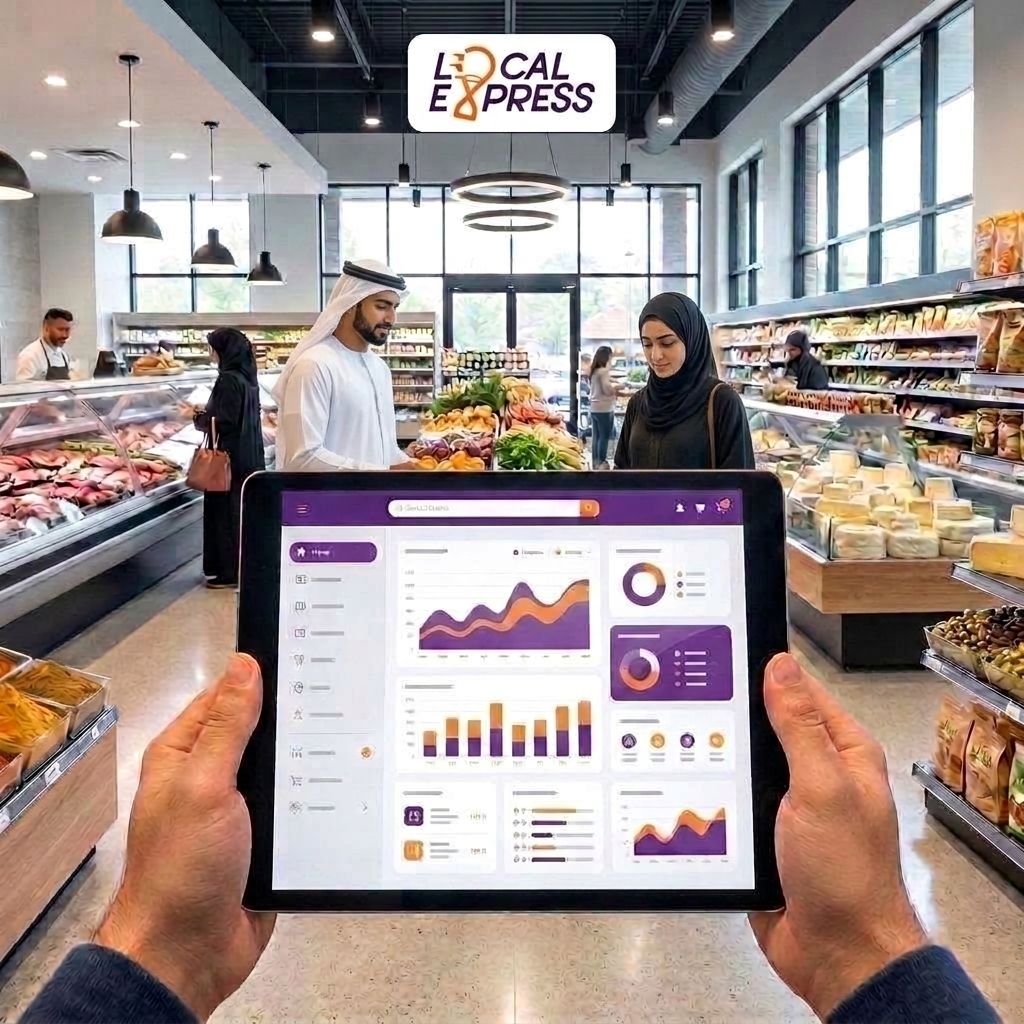
The white-labeled grocery platform — Local Express Built specifically for regional and independent grocers, Local Express bundles a branded ecommerce website, a fully branded mobile app, self-service kiosks for made-to-order food, order management, and last-mile delivery into one stack, so a halal or Middle Eastern grocer isn't stitching together four vendors to sell online. Verdict: Buy if you want to launch an owned ordering channel in 2026 without managing separate systems for web, app, kiosk, and delivery.
Launch your grocery ordering platform
See how a white-labeled ecommerce site and app fit a halal or Middle Eastern grocery.
What to avoid
- Marketplace exclusivity — signing an exclusive delivery agreement with a single third-party app locks you out of building your own customer list, and you'll pay commission on every order indefinitely.
- Templated sites without halal fields — a generic grocery template that can't display certification body or sourcing looks unfinished to shoppers who specifically search for that information before buying.
- Disconnected kiosk systems — a self-service ordering kiosk that doesn't feed the same order management system as your website creates duplicate inventory counts and mismatched order histories.
Verdict comparison
| Category | Margin control | Halal/certification fields | Prepared food ordering | Delivery integration | Verdict |
|---|---|---|---|---|---|
| Marketplace apps | Low (15-30% commission) | No | Limited | Third-party | Skip |
| Generic builders | High | Requires custom dev | No | Requires third-party | Consider |
| Custom build | High | Fully custom | Fully custom | Fully custom | Wait |
| Local Express | High | Built-in | Built-in (kiosk) | Built-in | Buy |
FAQ
What is the best online ordering platform for halal grocery stores in 2026?
A platform built specifically for grocery retail, not repurposed restaurant delivery software, is the best fit in 2026. It needs to handle weight-based pricing, certification display, prepared food ordering, and native delivery in one system rather than four separate vendors.
Is a third-party delivery app better than my own ordering platform?
No, a third-party app like DoorDash or Instacart takes 15-30% commission per order and gives you no access to the customer's contact data. An owned ordering platform keeps both the margin and the customer relationship.
How much does it cost to build a halal grocery ordering app?
Costs vary widely by vendor and feature scope, so check current pricing directly with any platform you're evaluating. A white-labeled platform is typically faster and cheaper to launch than a fully custom build, which can take 4-6 months of development.
Do halal grocery shoppers actually use mobile apps to order?
Shoppers in 2026 increasingly expect app-based ordering as a default rather than a convenience, especially for repeat grocery and prepared food purchases. A branded app also lets a grocer send push notifications for restocks and promotions that a website can't.
Can I add a self-service kiosk for made-to-order food to an existing website?
Only if the kiosk system connects to the same order management backend as your website and app. A disconnected kiosk creates separate inventory counts and duplicate order records that are hard to reconcile.
Do I need multi-language support for a Middle Eastern grocery app?
Yes, if a meaningful share of your shoppers search in Arabic, Urdu, or Farsi, a platform limited to English-only search will under-serve them. Multi-script search and checkout is a differentiator, not a nice-to-have, in this category.
What's the difference between a marketplace listing and a white-labeled ordering platform?
A marketplace listing puts your products on someone else's app under their brand, with commission taken on every order. A white-labeled platform like Local Express puts your own branded website and app in front of the customer, with the grocer keeping the data and the margin.
Is retail media worth adding to a grocery ordering platform?
Yes, for grocers carrying branded halal or Middle Eastern CPG products, retail media tools let suppliers pay for promoted placement, turning ad space into a direct revenue line rather than a sunk cost.
One last thing
The grocers gaining share in 2026 aren't the ones with the biggest catalog — they're the ones who made made-to-order food ordering as easy as packaged grocery, because prepared food carries higher margin and drives more repeat visits than shelf-stable goods ever will. If your online ordering platform for halal grocery stores doesn't handle both from day one, you're building around a gap you'll have to patch later.
“Every order routed through a third-party delivery app is a customer relationship you don't own and a margin point you don't keep.”