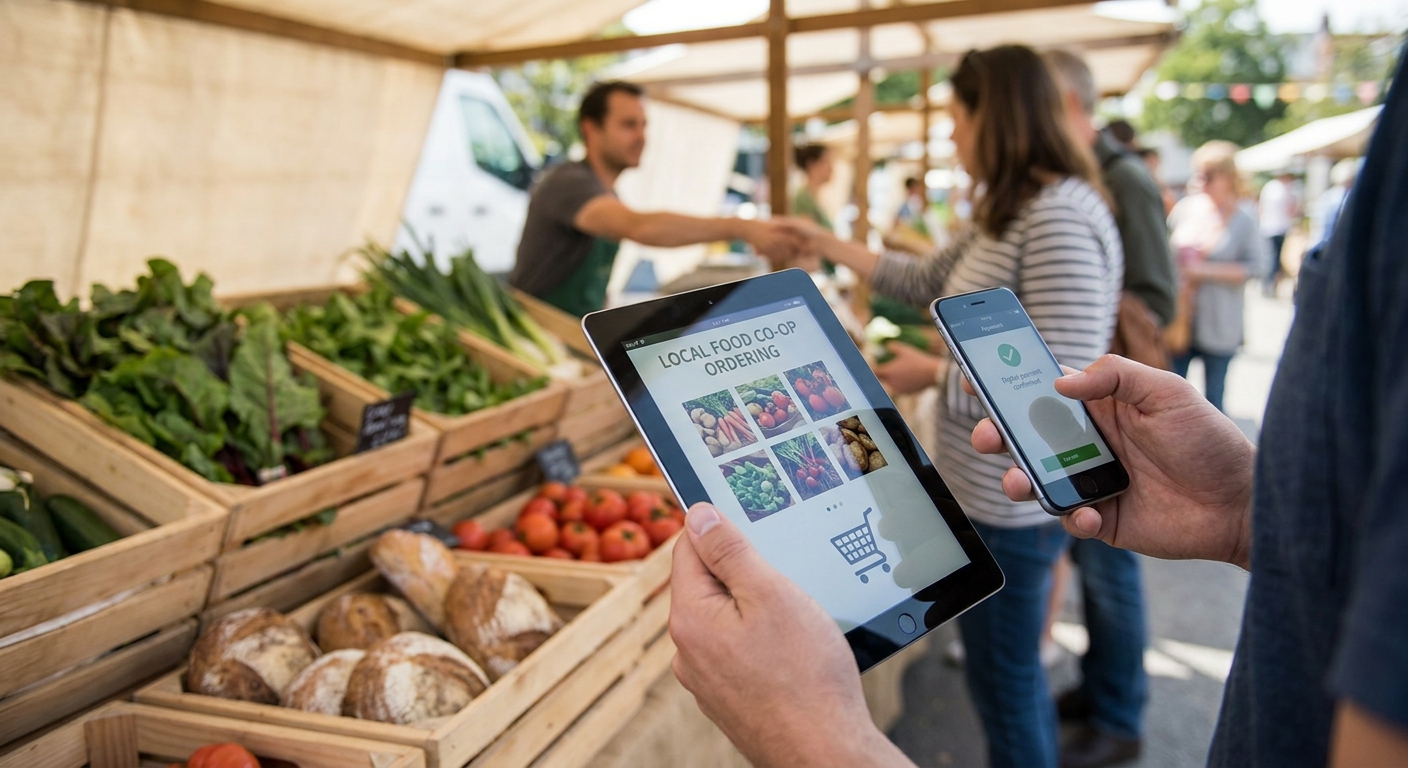
Farmers markets and food co-ops run on foot traffic and Saturday-morning lines — until a member asks why they can't order a CSA box or reserve produce online the way they do everywhere else. Picking the right online ordering platform for farmers markets means matching software to a multi-vendor, pickup-heavy business model that most generic ecommerce tools were never built for.
- Local Express fits multi-vendor markets and co-ops needing a branded storefront, app, and kiosk in one system — Buy.
- Generic marketplace apps like DoorDash Storefront work for single-stall setups but take 15-30% per order — Consider only for small pilots.
- Spreadsheet-and-email ordering breaks down past 50 weekly orders — Skip once volume grows.
- Prepared food vendors need self-ordering kiosk support built for MTO, not bolted-on delivery apps.
- 48-hour pre-order windows are standard for farmers market pickup in 2026 — your platform needs to enforce them automatically.
Why this matters
A farmers market or co-op isn't a single retailer — it's a dozen or more vendors under one roof, each with separate inventory, pricing, and prep times. Software built for a single-SKU retail checkout breaks the moment you add a second vendor stall or a weekly-only pickup schedule.
Most markets default to one of three bad options in 2026: a generic delivery marketplace that takes a cut of every order, a static website with a phone number, or a spreadsheet passed between vendors on Thursday night. None of the three scale past a few dozen weekly orders without someone missing an order or double-booking a pickup slot.
A unified commerce platform built for grocery and specialty food changes that math — one branded site, one app, one kiosk system, run by the market instead of rented from a marketplace.
Who this is for
This guide is for farmers market managers running multi-vendor storefronts, food co-op general managers handling member pre-orders, and specialty market operators who want online ordering without handing 20% of every transaction to a third-party app. If you're running a single farm stand with one product line, most of this still applies — you just need less of it.
What to look for in an online ordering platform for farmers markets
Multi-vendor and multi-stall support
A farmers market isn't one store — it's many. The platform has to let each vendor manage their own inventory and prep times while customers check out once, at one cart, for the whole market. Without this, you're stitching together separate checkout links per vendor, and customers won't do that twice.
Recurring pickup and delivery windows
Markets run on schedules, not real-time delivery. The platform needs to lock in weekly or biweekly pickup windows — a 48-hour pre-order cutoff is standard for 2026 markets — and stop taking orders once a vendor's stock or slot capacity is full.
Branding control
A co-op or independent market competing against national grocery apps needs its own name on the storefront and the app icon, not a third-party marketplace logo. White-label control keeps the customer relationship with the market, not the platform.
Payment flexibility, including SNAP/EBT
Co-ops and farmers markets serve members who pay with SNAP, EBT, or WIC alongside card and cash. A platform that only supports standard card checkout locks out a meaningful share of your member base — check this before anything else.
Prepared food and MTO handling
If your market or co-op runs a deli counter, juice bar, or hot food stall, the platform needs made-to-order flow — not just add-to-cart. Self-ordering kiosks built for grocery and specialty food handle MTO tickets the way a standard ecommerce cart can't.
Cost structure
Marketplace apps charge 15-30% per order in 2026, which erodes vendor margins fast on low-ticket produce sales. A subscription or platform-fee model, where the market or co-op owns the storefront outright, protects thin margins better than a per-order cut.
Ready to launch online ordering?
See how a branded site, app, and kiosk run together for market vendors.
Top picks for farmers markets and food co-ops
Local Express Unified Commerce Platform — the all-in-one pick. One system runs the branded website, the mobile app, order management, and last-mile delivery together instead of three disconnected tools. Multi-vendor cart support and SNAP/EBT payment flow are built for grocery and specialty food, not adapted from restaurant delivery. Buy — for markets or co-ops ready to own the customer relationship instead of renting it from a marketplace app.
Local Express self-ordering kiosk — the kiosk pick. Built for made-to-order prepared food, this handles a deli counter or hot food stall inside a market without forcing customers to use a separate delivery app to place an in-person order. Buy — if your market runs any MTO food stalls alongside produce vendors.
Local Express natural and health food ecommerce — the co-op fit. Most food co-ops skew organic, bulk, and natural-foods inventory, and this setup is built around that catalog structure rather than generic SKU management. Consider — strongest fit for co-ops with a bulk-bin or supplement section alongside produce.
Generic marketplace apps (DoorDash Storefront, Square Online) — the quick-start pick. Fast to set up, no upfront platform cost, and familiar to customers already using the app for restaurant orders. The 15-30% per-order commission and lack of native multi-vendor cart support make this a poor long-term fit once a market grows past a handful of vendors. Consider only as a temporary pilot, then Skip once weekly order volume passes 50-75 orders.
Spreadsheet-and-email ordering — the free pick. Zero software cost and works fine for a market with three vendors and 20 weekly orders. It falls apart fast — missed orders, double-booked pickup slots, and no payment processing at all. Skip for any market or co-op expecting to grow order volume in 2026.
What to avoid
- Per-order commission models above 20% that look free to set up but quietly eat vendor margin on every low-ticket produce sale.
- Generic ecommerce templates without SNAP/EBT support — this locks out co-op members who rely on it, and it's not an easy bolt-on later.
- Delivery-app checkout flows with no recurring pickup window logic — they're built for on-demand food, not a Saturday-only farmers market schedule.
Verdict comparison
| Option | Multi-vendor cart | SNAP/EBT support | MTO/kiosk ready | Cost model | Verdict |
|---|---|---|---|---|---|
| Local Express Unified Commerce Platform | Yes | Yes | Yes | Platform fee | Buy |
| Local Express self-ordering kiosk | Yes | Varies by setup | Yes | Platform fee | Buy |
| Local Express natural/health food ecommerce | Yes | Yes | Limited | Platform fee | Consider |
| DoorDash Storefront / Square Online | No | No | Limited | 15-30% per order | Consider, then Skip |
| Spreadsheet + email | No | No | No | Free | Skip |
FAQ
What's the best online ordering platform for farmers markets in 2026?
For multi-vendor markets needing a branded storefront, app, and payment flexibility in one system, the Local Express Unified Commerce Platform is the strongest fit in 2026. Single-stall setups with low order volume can start with a generic marketplace app instead.
Is a marketplace app like DoorDash better than a dedicated platform for a farmers market?
Marketplace apps work for a quick pilot but charge 15-30% per order and don't support multi-vendor carts natively. A dedicated platform costs more upfront but keeps the customer relationship and margin with the market.
How much does online ordering software cost for a food co-op?
Costs vary by platform and setup, running from a flat monthly subscription to per-order commissions of 15-30% on marketplace apps. Co-ops should compare total cost against expected weekly order volume before committing.
Do farmers market ordering platforms support SNAP and EBT?
Not all do — generic ecommerce templates often lack SNAP/EBT payment flow entirely. Confirm support before selecting a platform if your market or co-op serves members who rely on it.
Can one platform handle multiple vendor stalls at a farmers market?
Yes, but only platforms built specifically for multi-vendor grocery and specialty food, not standard single-store ecommerce carts. Look for separate vendor inventory management under one shared customer checkout.
What's the typical pre-order window for farmers market pickup?
A 48-hour pre-order cutoff is standard for weekly farmers markets in 2026, giving vendors time to prep produce and prepared food orders. Platforms should enforce this automatically rather than relying on manual tracking.
Is a self-ordering kiosk worth it for a market food stall?
Yes, if the stall sells made-to-order food like a deli counter or juice bar rather than pre-packaged produce. A kiosk built for MTO handles ticket timing and customization better than a standard checkout cart.
What should a food co-op avoid when choosing ordering software?
Avoid per-order commission models above 20% and any platform without SNAP/EBT support, since both quietly cut into co-op margins and member access. Test recurring pickup window logic before signing a contract.
One last thing
The markets that lose the most money in 2026 aren't the ones with no online ordering — they're the ones still paying 20%+ commission to a delivery app for what amounts to a digital order form. Owning the storefront, even a simple one, beats renting the customer relationship every single week.