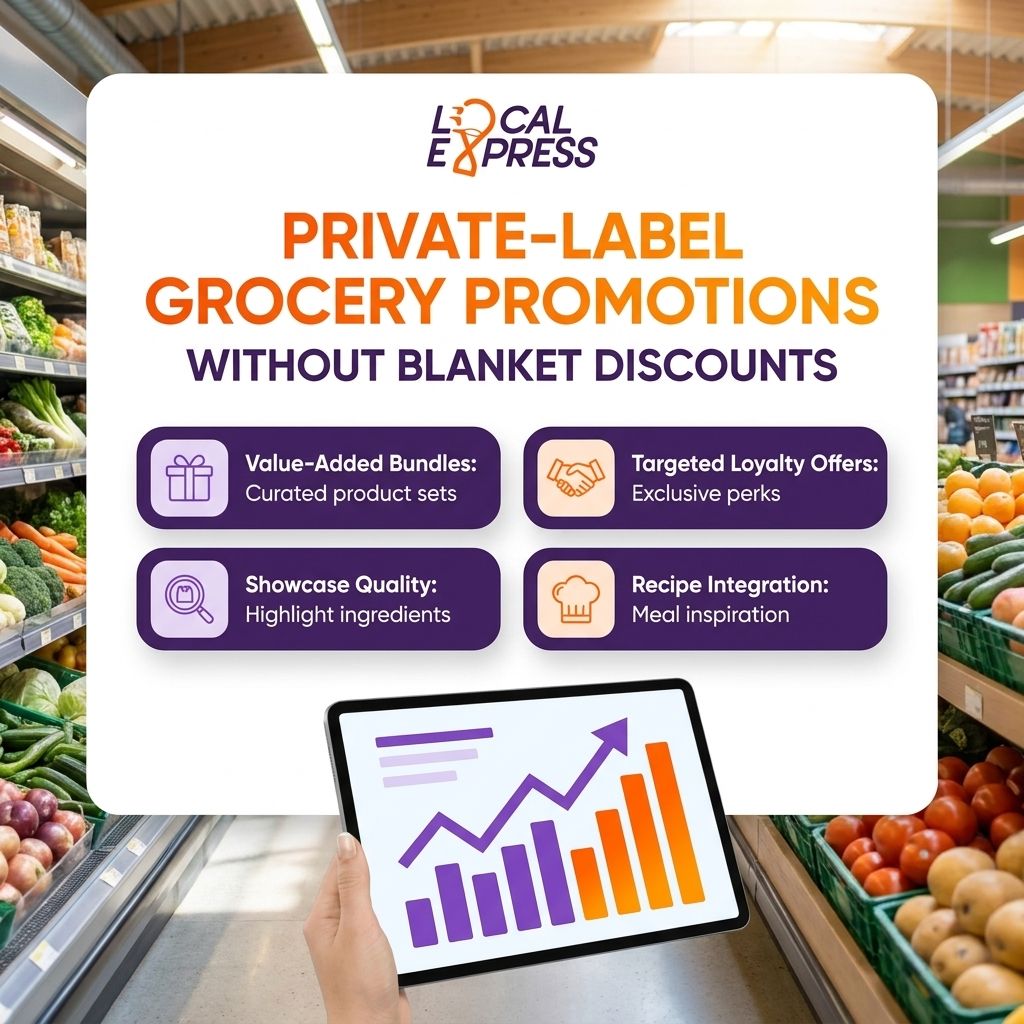
Private label margins erode fast when the only promotional lever is price. This guide gives regional and independent grocers a way to run private label grocery promotions in 2026 that lift attach rate and basket share without slashing every store-brand SKU to match the national brand sale.
- Private label grocery promotions work best through loyalty targeting, not storewide percent-off signage.
- Push and SMS offers built on purchase history outperform blanket private label markdowns in 2026 grocery programs.
- Featured in-app placement protects private label margin that a 20% off banner erases in one cycle.
- Track margin per SKU weekly, not monthly, or a losing promotion runs for a month before anyone catches it.
Why this matters
Private label already captures roughly 20% of U.S. grocery dollars, and industry tracking from Circana and PLMA consistently shows store-brand margins running 25 to 30 percentage points higher than national brand equivalents. Every dollar you discount off a private label SKU comes straight out of that advantage.
Loyalty card integration on your point-of-sale system already knows which households buy your store-brand pasta sauce, your store-brand diapers, your store-brand cold brew. Target that list instead of pushing a storewide "20% off private label" banner to every shopper who opens your app. Local Express customers running segmented private label promotions in 2026 see the same pattern repeatedly: loyalty-based placement holds margin, blanket discounts give it away.
Blanket discounts also train shoppers to wait. Once a household learns your store brand goes on sale every six weeks, full-price sales on that SKU stall between promotions, and you've taught your most loyal, most profitable segment to buy less often at the price that actually protects margin.
What you'll need
- Loyalty data tied to your POS or ecommerce platform, broken down by household purchase history, not just a points balance
- A digital circular or weekly ad tool that can feature specific SKUs without touching price
- Push notification or SMS capability segmented by past purchase behavior
- In-app or on-site placement inventory you control: banners, featured shelves, search result slots
- At least 90 days of private label sales and margin history by SKU
- A margin floor per category, set before the promotion starts, not adjusted after
The steps
1. Pull your private label margin baseline
Every private label promotion decision starts with your real per-unit margin, not the number from the last price sheet. Pull 90 days of sales and margin data by SKU across your top private label categories; dairy, bakery, frozen, and household usually drive the most volume for regional grocers. Flag any private label item currently priced within 10% of its national brand equivalent, since that's the SKU most likely to get discounted reflexively instead of strategically. The outcome should be a short list of 15 to 25 SKUs where a targeted promotion protects margin instead of eroding it. The common mistake here is treating "private label" as one category instead of pulling margin by product line, since a store-brand olive oil and a store-brand paper towel don't carry the same discount tolerance.
2. Segment shoppers who already buy private label, and those who don't
Split your loyalty file into three groups: households already buying store brand in a category, households buying national brand exclusively, and households buying neither. Existing store-brand buyers get a "featured" nudge, not a discount, because they've already made the switch and a price cut just trains them to wait for the next one. National-brand-only households are the real conversion target, which is where a first-purchase incentive earns its cost. This split alone usually cuts the size of any discount-eligible audience by half or more, since your most loyal shoppers no longer need price to buy the SKU they already prefer.
3. Replace storewide markdowns with targeted push and SMS
A blanket "private label week" banner reaches every shopper at the same discount depth regardless of whether they need one. Push notification and SMS marketing tools built into your grocery app let you send a "try our brand" message only to national-brand-only households, and a discount-free "you're already saving" reminder to existing store-brand buyers. Cap sends to once a week per household, since open rates drop fast past that point. Expected outcome: conversion messaging reaches the households that need it, and your existing private label buyers never see a discount they didn't need.
4. Give private label prime digital shelf space instead of a price tag
Shelf placement moves private label units without moving price. Feature store-brand items in in-app sponsored product placements at the top of category search results and on your homepage carousel, the same real estate national brands pay retail media dollars to occupy. Rotate which SKUs get featured every two weeks so the placement reads as merchandising, not a permanent markdown. Grocers on a unified commerce platform can rotate this placement without a developer ticket, which matters when you're testing a new SKU every cycle. The common mistake is leaving a "sale" badge on a featured private label item, which resets shopper expectations straight back to price.
Build a retail media program for private label
See how independent grocers structure sponsored and featured placement without a national network.
5. Bundle private label into meal solutions, not price comparisons
Pair a store-brand pasta with a national-brand sauce and a produce item in a "weeknight dinner" bundle featured on your ecommerce homepage or weekly circular. The private label item rides the bundle's convenience value instead of competing on a per-unit price comparison a shopper can check in five seconds. This works especially well heading into back-to-school season and the winter holiday stretch of 2026, when shoppers are buying for occasions, not single SKUs. Skip comparison signage like "our brand vs. theirs, save $2," since it invites the exact price conversation you're trying to avoid.
6. Track margin per promotion weekly and cut what isn't holding
Pull margin and unit velocity for every featured private label SKU weekly, not monthly. A promotion bleeding margin for four weeks before anyone notices costs four times what a one-week correction would. If a featured SKU's unit velocity doesn't move within two weeks of a placement change, rotate it out rather than defaulting to a discount to force the number up. The goal for the rest of 2026 is a rotating list of proven private label promotions, not a single evergreen markdown you run out of habit.
Troubleshooting
Private label sales spike during the promotion, then crash after it ends. That's the signature of a price-driven promo. Switch the SKU to a placement-based feature instead of a discount and the sales curve flattens out, because shoppers aren't being trained to wait for the next markdown.
Loyalty segments are too small to justify a campaign. Combine adjacent categories, since store-brand dairy buyers and store-brand bakery buyers behave similarly enough to target together, or extend the lookback window from 90 to 180 days to capture more households.
Store staff still slap "sale" stickers on featured private label items. Retrain the end-cap and shelf-tag process around "featured" and "new" language instead of percent-off language; the visual habit undoes the strategy faster than any pricing decision does.
Push notifications get ignored. Over-sending is the usual cause. Cap at one private label message per household per week and personalize the copy to what that household already buys, not a generic storewide blast.
Margin data lags so far behind that you don't know a promotion is failing until it's over. Pull reports weekly through a centralized order management system instead of waiting on a monthly P&L; by the time a monthly report flags a problem, the promotion has already finished losing money.
Tools and resources
- Loyalty data integration on your POS system to segment private label buyers from national-brand-only households
- A digital circular tool that can feature SKUs without changing price
- Push and SMS tools segmented by household purchase history
- In-app placement inventory for rotating featured private label items
- Guidance on pricing sponsored product placements in a grocery retail media program if you plan to sell some of that featured real estate to CPG partners alongside your own private label rotation
Local Express builds the loyalty, placement, and order management pieces into one grocery ecommerce platform, so segmentation and featured placement run off the same purchase data instead of three disconnected tools.
What to do next
Start with one category, dairy or bakery usually has the cleanest private label margin data, and run the loyalty segment, feature placement, and weekly margin check for a full four-week cycle before expanding. Compare the margin held against your last blanket private label discount from earlier in 2026; that comparison is the number that actually tells you whether this approach is working. Whether you run this on Local Express or another platform, the sequence, margin baseline, segment, placement, track, holds regardless of the tool.
FAQ
What are private label grocery promotions?
Private label grocery promotions are campaigns that drive sales of store-brand items without a national-brand-style storewide discount. In 2026 the strongest versions use loyalty segmentation and featured digital placement instead of a blanket percent-off.
Is it better to discount private label items or just feature them?
Featuring private label items in search results, app banners, and circulars protects margin better than discounting, since store-brand margins already run 25 to 30 percentage points above national brands. A discount gives that advantage away for shoppers who would have bought at full price anyway.
How much margin advantage does private label carry over national brands in 2026?
Store-brand items typically carry 25 to 30 percentage points more margin than national brand equivalents, based on Circana and PLMA industry tracking. That gap is the reason blanket discounting on private label costs more than it looks like on paper.
Can a grocer target private label promotions without a storewide discount?
Yes, by segmenting loyalty data into existing store-brand buyers versus national-brand-only households and sending different messages to each. Existing buyers get featured placement; only the households who've never tried the store brand get an actual incentive.
How often should featured private label placement rotate?
Rotate featured private label SKUs roughly every two weeks so the placement reads as ongoing merchandising rather than a fixed markdown. Rotating too slowly makes the feature feel like wallpaper; shoppers stop noticing it.
What's the biggest mistake grocers make with private label promotions?
The biggest mistake is running a storewide percent-off on private label instead of targeting the households who haven't switched yet. That approach discounts sales you would have gotten at full price and trains loyal store-brand buyers to wait for the next markdown.
Do private label promotions work without a loyalty program?
They're far weaker without one, since you lose the ability to tell existing store-brand buyers from national-brand-only households. Featured placement still helps, but targeted messaging and discount-free nudges depend on loyalty purchase history.
One last thing
The grocers holding the most private label margin in 2026 aren't running fewer promotions, they're running narrower ones. A featured placement reaching 400 loyal store-brand households converts better than a 20%-off banner reaching your entire loyalty file, because the households who already buy the category don't need a price cut to keep buying it. Save the actual discount budget for the shoppers who've never tried your store brand at all.