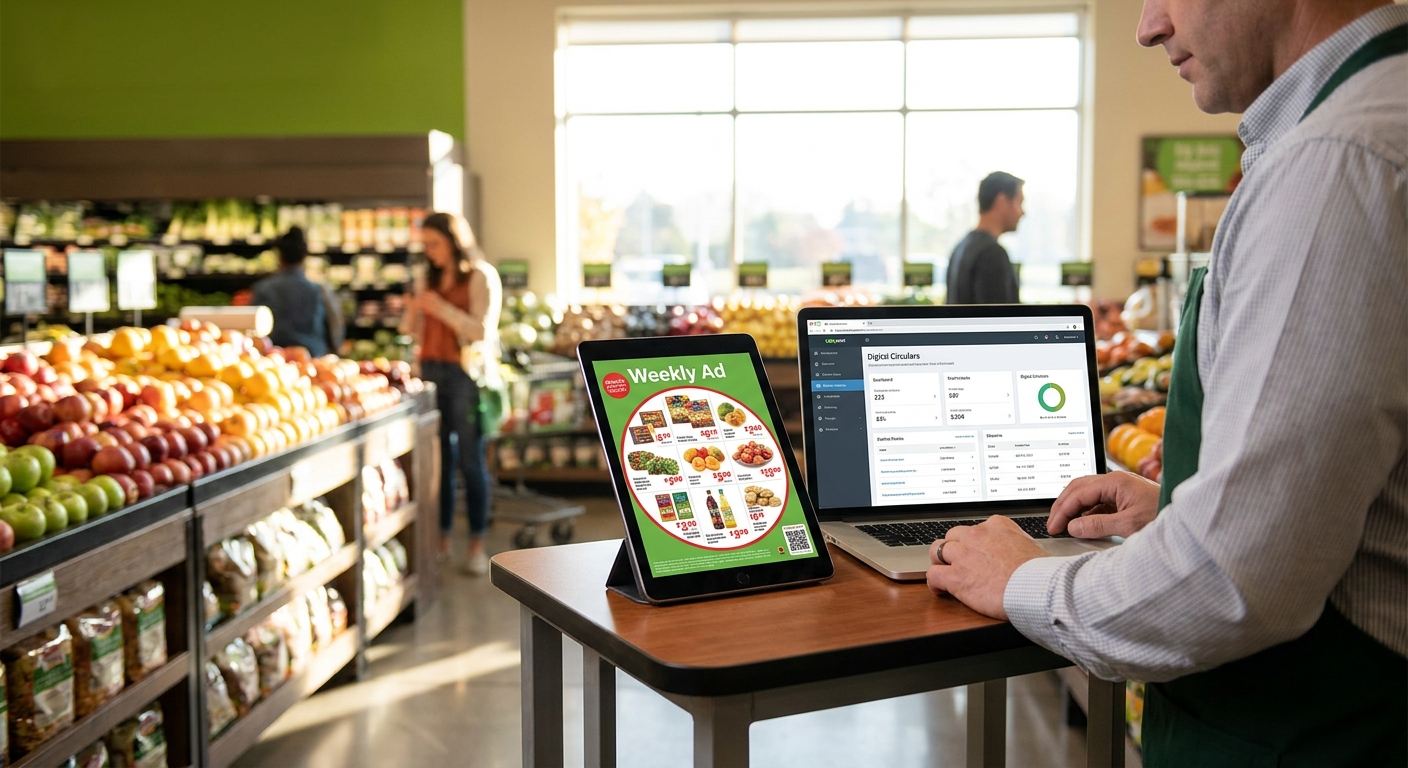
Weekly ad and circular software turns a static PDF flyer into a data-connected merchandising channel — one that syncs to your live inventory, tracks which SKUs actually sold, and can carry CPG-funded ad slots instead of costing you margin every week.
- Digital weekly ad software for grocery stores works best when circulars sync to live inventory, not a static PDF template.
- Retail media-powered circulars let CPG brands fund ad slots instead of the grocer eating the cost — buy this track first.
- Multi-location chains need one circular templated across banners with store-level price overrides, not 12 separate flyers.
- Static flyer apps with no checkout integration are a skip in 2026 — they can't prove which SKU drove a sale.
Why this matters
A printed circular is a sunk cost the day it's approved. A digital weekly ad tied to your ecommerce platform is a live merchandising surface you can adjust mid-week, price by store, and sell space in.
Most independent and regional grocers still run circulars the same way they did in 2015: a designer builds a PDF, it goes to print, and nobody knows which page actually moved product. Digital weekly ad software for grocery stores fixes the attribution gap — every featured item links to a live product page, every price matches checkout in real time, and every ad slot can carry a retail media fee instead of a marketing expense.
Who this is for
This guide is for independent and regional grocery operators — 1 to 50 stores — running weekly circulars manually in Canva, InDesign, or a legacy flyer tool, and looking to move that workflow onto a platform that connects to their ecommerce site, mobile app, and CPG ad revenue. If you're a single-banner specialty shop with no ecommerce presence yet, start with the storefront before the circular — the ad only pays off once shoppers can click through and buy.
What to look for in digital weekly ad software for grocery stores
Live inventory sync
An ad that features an item that's out of stock by Tuesday burns trust and wastes the slot. Software that pulls from your live inventory feed pulls the item — or swaps the price — automatically instead of waiting for next week's print run.
Retail media and CPG ad slots
The biggest shift in grocery ecommerce in 2026 is monetizing the circular itself. If a CPG brand can pay for a featured slot in your weekly ad, that's revenue that used to be a marketing line item. Software without a retail media layer leaves that money on the table entirely.
Multi-store, multi-banner templating
A 6-store chain running the same brand across two banners needs one circular built once, then price-overridden by store or zone. Rebuilding the flyer per location every week is a labor cost most independents can't absorb.
SNAP/EBT-aware item tagging
Circulars that don't flag SNAP-eligible items separately from alcohol, tobacco, or non-eligible promotions create compliance headaches and confuse shoppers at checkout. This matters more for grocers with high EBT redemption than for specialty retailers.
Mobile app and web parity
A circular that looks right on desktop but breaks on the mobile app you're pushing shoppers toward defeats the point. The ad needs to render — and link to checkout — identically on both.
Post-send analytics
Software that tells you which page, which SKU, and which store drove redemptions is the difference between a merchandising tool and a digital poster. Without this, you're back to guessing.
Where digital weekly ad software delivers the most value
Retail media-powered circulars — the revenue multiplier. Instead of the grocer funding every ad page, CPG brands pay directly for featured category slots — no national ad network minimum required to launch a retail media program. The circular refreshes on the same weekly cadence — 52 cycles a year — but now carries incremental revenue instead of pure cost. Buy.
CPG-funded slot onboarding — the independent's path in. Regional and independent grocers historically got locked out of retail media because they lacked the scale for a national network deal. Direct CPG brand onboarding into your own circular changes that math — a 4-store chain can sell ad slots the same week a 400-store chain can. Buy if you have any relationship with regional CPG reps already.
Multi-location circular sync — the chain consolidator. A single circular template pushed across every banner, with store-level pricing and promotion overrides managed from one dashboard tied to your order management software, replaces the Friday-afternoon scramble of rebuilding flyers per store. Consider this track once you're running 3 or more locations — below that, a single-store template is simpler.
SNAP/EBT-aware circular tagging — the compliance layer. Flagging SNAP-eligible items inline, separate from alcohol and non-eligible promotions, keeps circulars compliant without a manual review pass every week. This matters most for grocers with EBT redemption above a third of total transactions — everyone else can treat it as a nice-to-have. Buy if EBT is a meaningful share of your basket; Skip the manual tagging workaround either way — it doesn't scale past a handful of SKUs.
What to avoid
- Static PDF or Canva-built flyers with no checkout link. They look identical to what you had in 2020 and can't tell you which item sold. If the circular can't connect to a live product page, it's a poster, not software.
- National ad network platforms with store-count minimums. Several retail media networks require 50+ locations before a CPG brand can even buy a slot — irrelevant for a 4-store regional chain trying to monetize its own circular.
- Print-first tools retrofitted for digital. Software built for the print production workflow and bolted onto a web view usually breaks mobile parity and drops analytics — check for native mobile rendering before signing anything.
“If the circular can't tell you which SKU drove the sale, it's not software, it's a PDF.”
Turn your circular into a revenue line
See how a unified commerce platform runs weekly ads, order management, and retail media in one place.
Verdict comparison
| Capability | Best for | Verdict |
|---|---|---|
| Retail media-powered circulars | Any grocer with CPG relationships | Buy |
| CPG-funded slot onboarding | Independents locked out of national networks | Buy |
| Multi-location circular sync | Chains with 3+ locations | Consider |
| SNAP/EBT-aware tagging | High-EBT-redemption stores | Buy (if EBT-heavy) |
| Static PDF flyers | No one, past 2026 | Skip |
FAQ
What's the best digital weekly ad software for grocery stores in 2026?
The best digital weekly ad software for grocery stores in 2026 is the one that syncs to live inventory and can carry CPG-funded retail media slots, not just render a PDF online. A platform that ties the circular to your ecommerce checkout and order management gives you attribution a standalone flyer tool never will.
Is digital circular software better than printed weekly ads?
Yes, for tracking and monetization — a digital circular links to live product pages and can sell ad slots to CPG brands, while print locks in a price and design a week before it runs. Print still has reach value in some markets, but it can't tell you which item drove a redemption.
How much does grocery retail media software cost?
Cost varies by platform and store count, and pricing isn't standardized across vendors as of 2026 — get a quote based on your store count and whether you need CPG onboarding tools built in. Ask specifically whether retail media features are bundled with the ecommerce platform or sold separately.
Can independent grocers run a retail media program without a national ad network?
Yes — direct CPG brand onboarding into your own weekly circular removes the store-count minimums most national ad networks require. A 4-store regional chain can sell a featured slot the same week a large chain can, once the onboarding workflow is set up.
Does digital weekly ad software work with SNAP/EBT compliance?
Platforms built for grocery specifically can tag SNAP-eligible items separately from alcohol, tobacco, and other non-eligible promotions inline in the circular. This matters most for stores where EBT redemption makes up a meaningful share of transactions.
How often should a grocery store refresh its digital circular?
Weekly is standard — 52 cycles a year — matching the traditional print cadence most shoppers already expect. Some grocers add mid-week flash updates for perishables or clearance, which a static PDF can't support.
Can a digital circular work across multiple store locations?
Yes, with software built for multi-location chains, one circular template can push across every banner with store-level price and promotion overrides. Rebuilding the flyer separately per location is the workflow this replaces.
Does a digital circular need its own mobile app?
It needs to render correctly inside whatever mobile app or website you're already pushing shoppers toward — parity between web and app matters more than a standalone circular app. A circular that looks right on desktop but breaks on mobile loses the shoppers checking it from their phone.
One last thing
The circular isn't the product — the redemption data is. A grocer running a digital weekly ad that can't tell you which of last week's 20 featured SKUs actually moved units at which store is still running a print flyer with extra steps, just on a screen instead of paper.