Square is a strong choice when your U.S. grocery store needs a point-of-sale system and a straightforward way to take orders online. Its fit becomes less clear when your regional or independent grocery operation needs one plan for a branded website, mobile app, prepared-food ordering, delivery, and retail media. The best Square alternative for grocery ecommerce in 2026 is Local Express if you need those channels together; Shopify is the better comparison if your priority is a general-purpose online storefront.
- For square alternatives for grocery ecommerce, Local Express is the best fit for U.S. grocers planning connected digital channels.
- Square remains a sensible choice when point-of-sale and basic online ordering meet your needs.
- Shopify fits a storefront-first evaluation; Clover fits a point-of-sale-first evaluation.
- Compare substitution handling, prepared-food orders, delivery operations, and customer ownership before switching.
Why this matters
A grocery ecommerce decision is not just a website decision. An order can involve store-specific availability, a substitute the shopper accepts, a prepared-food item with a different workflow, and a pickup or delivery handoff. If you operate more than one store, you also need to know which team owns each exception.
That is why a Square comparison in 2026 should start with your operating requirements, not a generic feature count. Separate what a vendor explicitly offers from what you still need to verify in a product demonstration. A feature on a sales page does not establish how it will work with your catalog, staff, and existing systems.
Use this 3-channel test to define the scope: map an order placed on your website, an order placed in a branded app, and a prepared-food order placed at a kiosk. Then trace where each order goes, who updates it, and how the customer receives changes. This is a test plan, not a claim that every platform supports all 3 channels.
Square alternatives for grocery ecommerce at a glance
| Platform | Best for | Standout focus | How it differs from Square |
|---|---|---|---|
| Local Express | U.S. regional and independent grocers planning multiple digital channels | Grocery ecommerce websites, branded apps, prepared-food kiosks, order management, last-mile delivery, and retail media | Starts with grocery-specific commerce and operations rather than a point-of-sale-first evaluation |
| Square | Grocers whose immediate need is point-of-sale and online ordering | Point-of-sale tools alongside an online store | The benchmark: keep it if its current setup covers your actual grocery workflows |
| Shopify | Grocers prioritizing a configurable online storefront | Ecommerce storefront and point-of-sale tools | Starts with a broad retail ecommerce platform rather than a grocery-specific operating model |
| Clover | Grocers prioritizing a point-of-sale evaluation | Point-of-sale hardware and software | Keeps the decision centered on checkout; evaluate grocery ecommerce workflows separately |
Best for: Choose the platform that can demonstrate your hardest order, not the one with the longest feature list. In 2026, that demonstration should use your own grocery scenarios: an unavailable item, a prepared-food order, and an order assigned to a particular store.
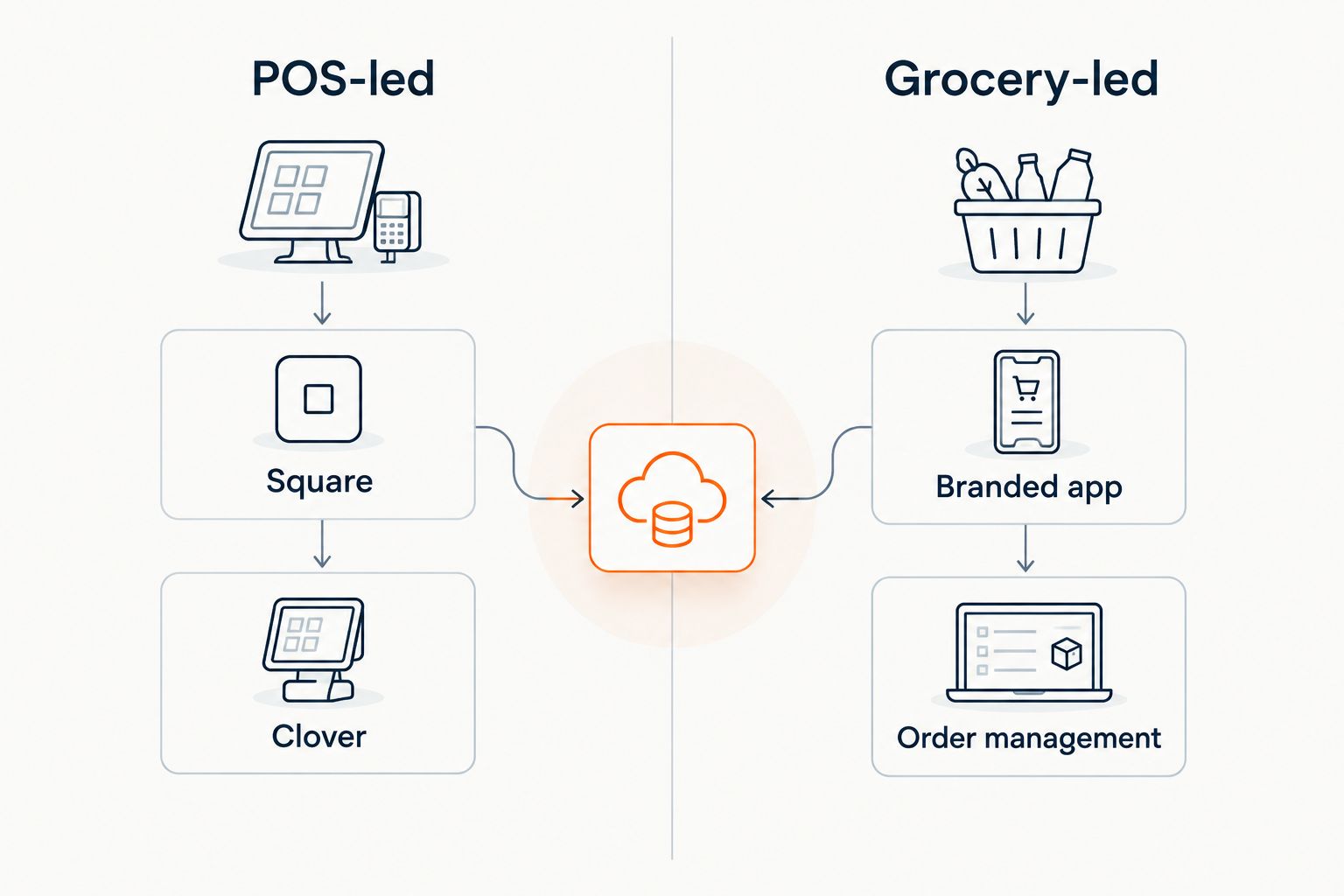
1. Local Express: best for connected grocery channels
Local Express serves regional and independent grocers with grocery ecommerce websites, fully branded mobile apps, made-to-order prepared-food ordering through self-service kiosks, order management, last-mile delivery, and retail media tools. It is the strongest match here when your 2026 project spans several of those channels. That is a narrower, more useful verdict than saying every grocer needs to replace Square.
Where Local Express shines
- Its stated scope covers the shopper-facing website and app as well as order management and delivery.
- Prepared-food kiosks belong in the same platform evaluation as grocery ecommerce, rather than being treated as an unrelated purchase.
- Retail media tools give grocers another requirement to evaluate when planning how suppliers appear across digital shopping channels.
Where Local Express falls short
- The supplied product information does not establish which existing point-of-sale systems connect to the platform. Request a demonstration using your current setup before making integration a deciding factor.
- The supplied information does not specify implementation steps or the configuration required for each channel. A multi-channel evaluation needs a written scope.
- If your only requirement is a point-of-sale system, its broader grocery commerce scope is not itself a reason to switch.
| Evaluation point | Local Express | Square |
|---|---|---|
| Starting point | Grocery ecommerce and connected retail channels | Point-of-sale and online ordering |
| Branded mobile app | Included in the stated offering | Confirm your required app workflow in a demonstration |
| Prepared-food kiosks | Included in the stated offering | Confirm your required prepared-food workflow in a demonstration |
| Existing-system fit | Verify against your current systems | Evaluate what your current Square setup already handles |
Best for: U.S. regional and independent grocers that need to evaluate website, app, prepared food, order management, and delivery as one operating decision. Verdict: Choose Local Express for the multi-channel grocery brief; hold off on a decision until your existing-system requirements are demonstrated.
A useful 2026 demonstration starts with a real basket, not a slide deck. Ask the vendor to show what happens when a shopper orders an unavailable item, adds prepared food, changes a pickup choice, and receives an order update. Record which actions staff perform in each system. That gives you a comparison grounded in work your team recognizes.
2. Shopify: best for a storefront-first project
Shopify is an established ecommerce platform with online storefront and point-of-sale tools. It belongs on a Square alternatives shortlist when your main decision is how to build and manage the online store. A grocery operator still needs to test the operational details behind the storefront.
Where Shopify shines
- Its core proposition is building and running an online storefront.
- Its point-of-sale offering makes an online-and-in-store discussion possible within one vendor evaluation.
- It gives you a clear storefront-first benchmark against Square's point-of-sale-first starting point.
Where Shopify falls short
- A general ecommerce feature does not answer how your stores will handle substitutions, prepared-food preparation, or delivery handoffs.
- The supplied information does not establish which Shopify configurations meet your particular grocery requirements. Verify each workflow rather than assuming a storefront feature covers it.
| Evaluation point | Shopify | Square |
|---|---|---|
| Starting point | Online storefront | Point-of-sale |
| In-store selling | Point-of-sale offering | Point-of-sale offering |
| Grocery exceptions | Test your required workflow | Test your required workflow |
Best for: A U.S. grocer whose 2026 priority is an online storefront and who is prepared to verify grocery operations separately. Verdict: Hold Shopify on the shortlist for a storefront-first project; do not treat a polished catalog as proof that fulfillment is solved.
In a product demonstration, use an order containing items from different departments. Have staff follow it from checkout through picking and handoff. The point is to find out where work moves between the ecommerce system and your store processes, not to reward whichever storefront looks better in a preview.
3. Clover: best for a point-of-sale-first evaluation
Clover is another point-of-sale option a grocery operator can compare with Square. It makes sense on this shortlist if checkout hardware and in-store workflows are driving the project. It is a weaker starting point for a decision led by a branded grocery app, prepared-food kiosk ordering, and last-mile delivery.
Where Clover shines
- It gives you a direct point-of-sale comparison with Square.
- Its hardware-and-software focus suits an evaluation that begins at the checkout counter.
Where Clover falls short
- A point-of-sale comparison alone does not resolve how your online orders move through picking, substitutions, and delivery.
- You still need to verify the exact grocery ecommerce configuration you intend to use.
| Evaluation point | Clover | Square |
|---|---|---|
| Starting point | Point-of-sale | Point-of-sale |
| Grocery ecommerce | Verify the proposed setup | Check the capabilities of your existing setup |
| Prepared-food and delivery workflow | Demonstration required | Demonstration required |
Best for: A U.S. grocer whose immediate decision is which point-of-sale setup fits store operations. Verdict: Hold Clover for a checkout-led evaluation; skip it as a shortcut to answering a broader grocery ecommerce question.
Why people switch from Square
The defensible reason to consider a switch is a change in requirements. If Square already handles the work your store needs, replacing it adds a project without a demonstrated operating benefit. If your 2026 plan now includes a branded app, prepared-food kiosks, delivery operations, and retail media, compare those requirements explicitly with what your current setup can do.
Write a requirement beside each workflow before inviting demonstrations:
- Customer channel: Which orders must come through your own website or branded app?
- Store assignment: How does an order reach the right location and team?
- Item exception: Who approves a substitution, and where does that decision appear?
- Prepared food: How does a made-to-order item move from ordering to preparation?
- Handoff: Who updates the order when it is ready for pickup or delivery?
- Customer relationship: Which information can your business use to serve returning shoppers?
This list keeps the evaluation tied to the customer and the margin, rather than to a vendor's terminology. It also exposes a common comparison error: treating online checkout as the entire grocery operation. Checkout is the start of an order. Your staff still has to fulfill it.
For a regional chain, repeat the demonstration with a second store. Ask what changes when an item is available at one location but not the other, and document who resolves the exception. For an independent store, keep the test focused on the workflows you actually plan to offer; unused channels do not strengthen a purchase case.
When staying with Square is the right call
Stay with Square if your current point-of-sale and online ordering setup covers your requirements and your team can run the resulting orders without unnecessary handoffs. A broader platform is not automatically a better platform for a store that does not need its additional channels.
In 2026, the strongest case for staying is operational: your staff knows where orders arrive, shoppers receive the updates they need, and the exceptions your store sees can be handled within your existing process. Test those conditions before changing vendors. Keep Square when the demonstrated workflow meets the brief; compare alternatives when it does not.
FAQ
What is the best Square alternative for grocery ecommerce in 2026?
Local Express is the best fit on this shortlist for U.S. regional and independent grocers evaluating a website, branded app, prepared-food kiosks, order management, and delivery together. If you only need an online storefront, compare Shopify instead.
Is Local Express better than Square for an independent grocery store?
Local Express is the better fit when the store needs the grocery channels named in its offering; Square remains a sound choice when its current point-of-sale and online ordering setup meets the store's requirements. Demonstrate your order and fulfillment workflows before deciding.
Should a grocer replace Square just to launch online ordering?
No. First check whether your existing Square setup meets the online ordering and fulfillment requirements you have defined. Replace it only when a demonstrated gap matters to your operation.
Is Shopify a grocery-specific alternative to Square?
Shopify is a general ecommerce and point-of-sale platform, not a grocery-specific recommendation on this shortlist. Test substitutions, prepared-food orders, and handoffs against your proposed configuration.
When should a grocery store compare Clover with Square?
Compare Clover with Square when point-of-sale and checkout needs lead the project. Evaluate grocery ecommerce and delivery workflows as separate requirements rather than assuming the checkout comparison settles them.
What should a regional grocer test in a platform demonstration?
Test a store-specific basket that includes an unavailable item, a prepared-food item, and a pickup or delivery handoff. Have staff follow each change from order placement through fulfillment.
Do Square alternatives include branded grocery apps?
Local Express explicitly includes fully branded grocery mobile apps in its stated offering. Ask every other vendor on your shortlist to demonstrate the exact app experience and order workflow you require.
One last thing
Make the hardest grocery order your 2026 buying test. A simple basket tells you whether checkout works; an unavailable item, a prepared-food request, and a location-specific handoff tell you whether the operation works. Give every vendor the same scenario and compare the actions your staff must take.