Retail media doesn't require a national footprint or a Fortune 500 ad-sales team. It requires first-party shopper data, ad inventory you actually control, and a launch sequence you can run in 90 days.
- Independent and regional grocers can launch a retail media program in 2026 using onsite banners, app placements, and in-store screens they already own.
- A 90-day pilot with 3 to 5 CPG partners beats a slow national rollout — Buy the pilot approach, Skip the year-long RFP process.
- First-party purchase data from your ecommerce platform and order management system is the asset national networks can't replicate at the local level.
- Local Express supports retail media placements inside the same white-labeled storefront used for ecommerce and delivery — no separate ad server needed.
Why this matters
Brand budgets are shifting toward retail media because it sits closer to the purchase than a social ad ever will. National chains built ad networks around scale — millions of shoppers, hundreds of stores, dedicated sales teams. Independent and regional grocers don't have that scale, but they have something the nationals often lack: tight, loyal shopper relationships and category-specific data that a CPG brand manager can't get anywhere else.
A single-region grocer running a retail media program in 2026 doesn't need a demand-side platform or a programmatic ad stack. It needs a storefront it controls, order data it owns, and a handful of CPG partners willing to pay for placement in front of shoppers who actually buy in that category.
What you'll need
- A branded ecommerce storefront or app you control — not a third-party marketplace listing
- At least 60 to 90 days of order history to identify your top categories
- A rate card with 2 to 3 ad placement types (onsite banner, sponsored search result, in-app placement)
- 3 to 5 CPG or local brand contacts willing to test a pilot
- Basic reporting — impressions, clicks, and attached sales by SKU
- A pricing model: flat fee, CPM, or cost-per-acquisition
If your ordering still runs through a third-party delivery app, you don't own the shopper data or the ad inventory, and there's no program to launch. That's the first problem to fix, and it's covered in reducing dependency on third-party delivery marketplaces before you build anything on top of it.
The steps
1. Audit your first-party data and traffic
Pull 90 days of order data from your ecommerce platform and identify your top 10 categories by volume and repeat-purchase rate. This is the inventory you're actually selling to brands — not impressions, but purchase intent. A store running its own branded platform through Local Express can pull this directly from order history instead of guessing from POS exports.
Common mistake: treating all traffic as equal. A shopper browsing your weekly circular isn't the same audience as one adding items to cart — separate the two before you price anything.
2. Define your ad inventory
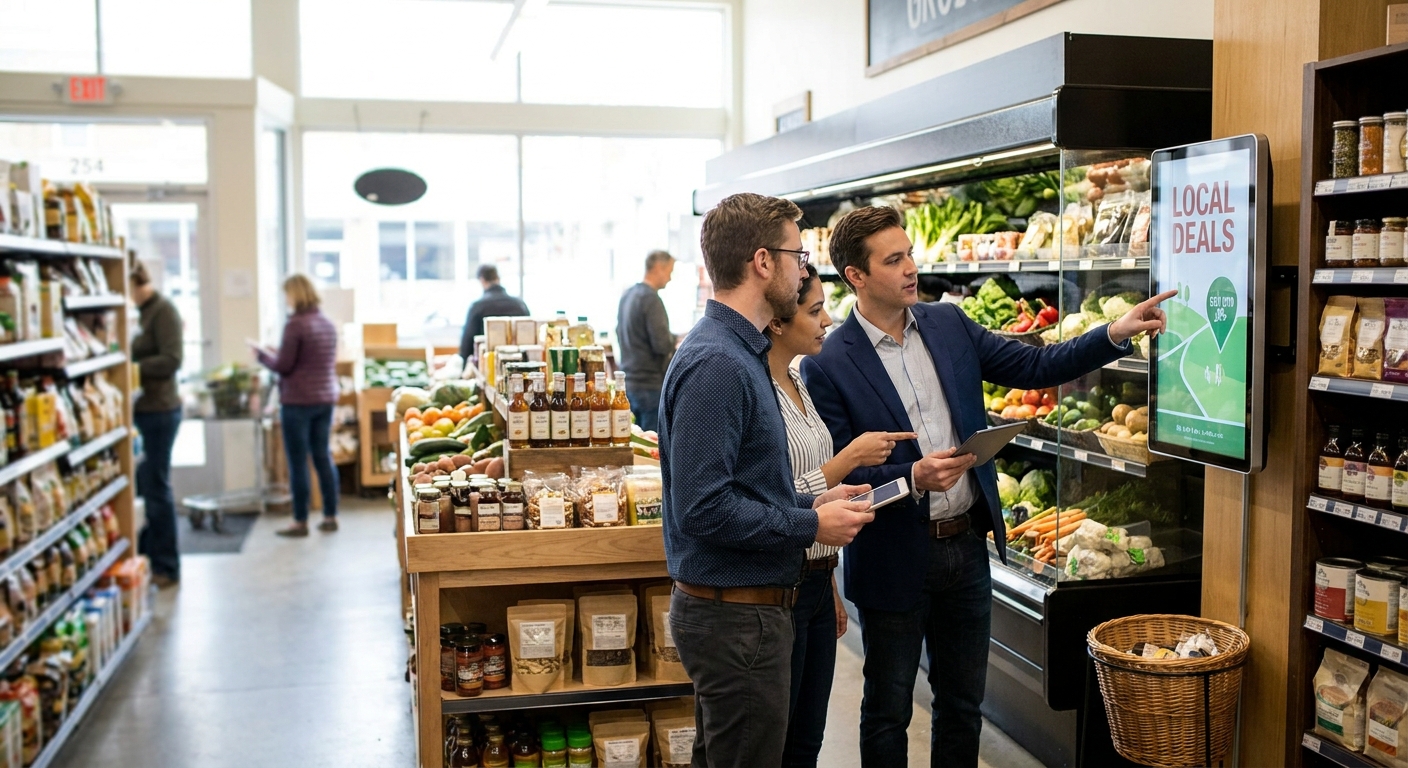
List every placement you can sell without new engineering work: homepage banner, category-page banner, sponsored search slot, app push notification, in-store kiosk screen, printed circular space. Most independent grocers already have 4 to 6 of these live and unsold.
Why it matters: brands don't pay for hypothetical inventory — they pay for placements you can screenshot and demo on a call.
3. Set a pricing model and rate card
Start with flat monthly fees for onsite placements ($500-$2,000 per slot is a common independent-grocer starting range) rather than CPM, since you won't have the ad-server traffic reporting to back up impression counts on day one. Add a cost-per-acquisition tier once you can attribute sales to a placement.
Common mistake: underpricing to land the first deal. A brand that pays $300 for a homepage banner will anchor every future negotiation at $300.
4. Recruit CPG partners without a national sales team
Go direct to regional brand managers and local distributors instead of national ad agencies — they move faster and don't require RFPs. Local and regional CPG brands are often more eager for placement with an independent grocer than a national chain that already has 40 competing sponsors.
Expected outcome: 3 to 5 signed pilot partners within 30 to 45 days of outreach if you're offering real inventory and a clear rate card.
5. Build measurement and reporting
Track impressions, click-through, and attached sales by SKU for each placement, and send a one-page recap to each partner every 30 days. Your order management system is the source of truth here — a program that operates on order management software for multi-location grocery chains can tie a sponsored placement directly to the SKU that got purchased.
Common mistake: reporting impressions only. Brands renew based on sales lift, not view counts.
6. Launch with a pilot category
Pick one high-margin, high-repeat category — produce, deli, or a private-label line — and run a 60-day pilot with a single partner before opening the program broadly. A narrow pilot gives you a clean before/after comparison and a case study to sell the next five partners.
Expected outcome: a measurable sales lift on the sponsored SKU, even if modest, becomes your pitch deck for 2026's next quarter.
7. Scale to always-on placements
Once the pilot proves out, convert the top 2 to 3 performing placements into always-on contracts and add new inventory types (app push, kiosk screens) one at a time. Don't launch six ad products simultaneously — you'll dilute reporting and confuse partners about what worked.
Build retail media into your storefront
See how a white-labeled grocery platform supports ad placements and order data in one system.
Troubleshooting
- Brands won't commit without proof of scale. Offer a free 30-day placement to your first partner in exchange for a case study — trade the fee for the data.
- Reporting is inconsistent across placement types. Standardize on one metric (attached sales by SKU) across every placement before adding new inventory types.
- Store staff don't know the program exists. In-store kiosk and circular placements fail without staff buy-in — brief store managers before launch, not after.
- A single big brand wants exclusivity. Cap exclusivity deals at one category maximum in 2026 — broader exclusivity kills your ability to sell competing categories later.
- Pilot data shows flat sales. Check placement visibility before blaming the program — a banner buried below the fold won't move SKUs regardless of the brand paying for it.
Tools and resources
- A white-labeled ecommerce storefront and app that captures first-party shopper data
- Order management software for multi-location grocery chains to tie placements to actual sales
- A rate card document (one page, 3 placement types, clear pricing)
- Monthly reporting template — impressions, clicks, attached sales
- A short list of 10-15 regional CPG or local brand contacts to start outreach
What to do next
Once your retail media pilot is running, the next constraint is usually fulfillment — a sponsored SKU that sells out or ships late kills the case study you're trying to build. Launching same-day delivery without third-party apps closes that gap so a retail media win in 2026 doesn't stall at the last mile.
FAQ
What is a retail media program for grocery?
A retail media program for grocery is a set of paid ad placements — onsite banners, sponsored search, app placements, in-store screens — sold to CPG brands against a grocer's own shopper traffic. It works without a national network as long as the grocer owns its ecommerce data.
How much does it cost to start a retail media program in 2026?
Independent grocers typically start with existing digital inventory, so the cost is mostly time — 30 to 45 days of outreach and setup rather than new spend. Flat-fee placements in the $500-$2,000 range are a common starting rate card for a single onsite slot.
Do I need a national chain to run retail media?
No. A single-store or regional grocer with first-party order data and controlled ad inventory can launch a retail media program without any national scale. The pitch to brands is targeted local shopper data, not reach.
How long does a retail media pilot take to show results?
A focused pilot with one category and one CPG partner typically runs 60 days before you have enough sales data to report a lift. Always-on placements come after the pilot proves out.
What ad inventory can an independent grocer sell?
Homepage and category-page banners, sponsored search results, in-app push placements, in-store kiosk screens, and printed circular space are all sellable inventory most independent grocers already operate in 2026.
Is CPM or flat-fee pricing better for a new retail media program?
Flat-fee pricing is better for a new program because it doesn't require impression-level ad-server reporting on day one. Move to CPM or cost-per-acquisition pricing once measurement is reliable.
How do I measure retail media performance without a DSP?
Track impressions, clicks, and attached sales by SKU through your order management system rather than a dedicated ad server. A one-page monthly recap per partner is enough to prove and renew a pilot.
What's the biggest mistake grocers make launching retail media?
Underpricing the first placement is the biggest mistake — a brand that pays $300 for prime inventory will anchor every future renewal at that rate. Price the pilot at what you'd charge partner five, not partner one.
One last thing
The grocers making retail media work in 2026 without a national network are the ones treating their order data as the product, not the ads. The banner is just the delivery mechanism — the SKU-level purchase data behind it is what a CPG brand is actually paying for, and that data only exists if the storefront and order system are yours to begin with.