Wave Grocery deserves a fair evaluation if it is already on your shortlist. But a shortlist alone cannot tell you whether it covers your web store, branded app, prepared-food ordering, delivery and retail media needs. The best Wave Grocery alternative in 2026 is Local Express if you need those functions in a unified grocery platform; a custom-built stack is the better route if you need to design and maintain every component yourself.
- For wave grocery alternatives in 2026, choose Local Express when owned grocery ecommerce, a branded app and order management must work together.
- Choose a custom-built stack when your team wants to specify and maintain each component.
- Keep Wave Grocery on the shortlist until it demonstrates your required workflows; its feature coverage is not established here.
- Assess prepared-food kiosks, last-mile delivery and retail media against actual store operations, not a generic feature list.
Why this matters
For a U.S. regional or independent grocer, an ordering platform is an operating decision. The same basket can involve a customer-facing channel, a store team preparing the order and a delivery handoff. Prepared food adds another workflow; retail media adds a separate reason to control the digital storefront.
Start with the workflows your stores must run in 2026, then ask each vendor to show them. A feature label does not establish how an online order reaches the right store, how prepared food enters the queue or what staff see when an item is unavailable. Those are demonstration questions, not reasons to assume Wave Grocery lacks a capability.
Think of the decision in three connected parts: customer ordering, store execution and delivery. Local Express lists a white-label grocery ecommerce website, a branded mobile app and prepared-food self-service kiosks on the customer side; order management and last-mile grocery delivery address the operational side. Ask any other candidate to demonstrate the same handoffs before treating its feature list as equivalent.
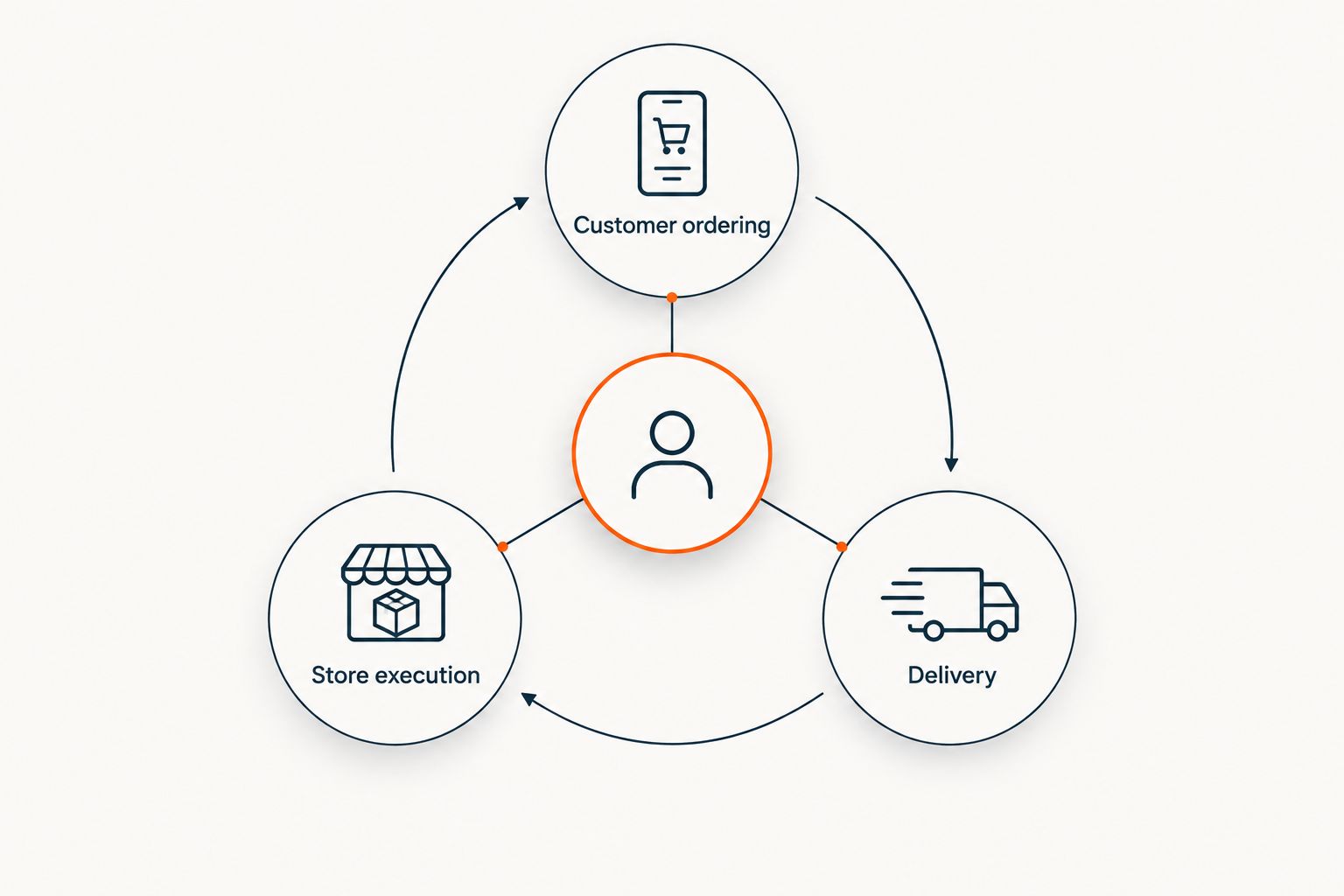
Wave Grocery alternatives at a glance
This 2026 comparison separates a documented platform from two operating models. A custom stack and marketplace-led ordering are alternatives to a platform decision, not named software vendors. No Wave Grocery feature should be counted as present or absent without a demonstration.
| Option | Best for | Documented or defining scope | How it differs from Wave Grocery |
|---|---|---|---|
| Local Express | Grocers seeking owned digital channels alongside order management | White-label grocery ecommerce websites, branded apps, prepared-food kiosks, order management, last-mile delivery and retail media tools | Its stated scope spans these functions; verify Wave Grocery against each one |
| Custom-built retailer stack | Teams that want to specify and maintain their own components | Scope depends on what the retailer builds | Replaces a vendor platform decision with an internal build-and-maintain decision |
| Marketplace-led ordering | Grocers prioritizing a marketplace channel | Ordering takes place through a marketplace model | Centers the marketplace rather than the grocer's own branded website and app |
| Wave Grocery | Buyers already assessing it | Feature coverage is not established in the supplied information | Use a workflow demonstration to establish the comparison |
Do not read an unverified cell as a missing feature. In 2026, the useful next step is to give each candidate the same store scenario and record what works, what needs another system and what remains unanswered.
1. Local Express: best for connected grocery operations
Best for: U.S. regional and independent grocers that want an owned website and app connected to store-facing commerce functions. Local Express describes its offering as a unified commerce platform for grocers. Its stated scope includes white-label grocery ecommerce websites, fully branded mobile apps, made-to-order prepared-food ordering through self-service kiosks, order management, last-mile grocery delivery and retail media tools.
That scope makes Local Express the clearest named alternative when your 2026 requirements cross digital ordering and store operations. It does not, by itself, establish how the platform fits your current POS, payments, inventory process or delivery staffing. Put those questions into a demonstration before making a switch decision.
Where Local Express shines
- Owned ordering channels: The stated offering includes a grocer-branded website and mobile app rather than making a marketplace your only customer-facing option.
- Prepared food: Self-service kiosks for made-to-order items are part of the stated platform scope. That matters if your deli or prepared-food counter has a different workflow from a standard grocery basket.
- Operational breadth: Order management and last-mile delivery sit alongside customer-facing commerce functions in the described offering.
- Retail media: Retail media tools are included in the stated scope, giving you a specific capability to assess if supplier-funded placements are on your roadmap.
Where Local Express falls short as a decision-ready choice
- The supplied information does not establish compatibility with your existing POS, payment setup or inventory systems. Require a demonstration using your actual environment.
- The stated feature list does not specify how substitutions, store-level exceptions or driver handoffs work. Have staff test those steps rather than approving them from a slide.
- Platform breadth is unnecessary if your only requirement is a basic ordering channel. Define the functions you will use before committing to a wider system.
| Decision point | Local Express | Wave Grocery |
|---|---|---|
| White-label grocery website | Included in stated scope | Confirm in demonstration |
| Branded grocery app | Included in stated scope | Confirm in demonstration |
| Made-to-order kiosks | Included in stated scope | Confirm in demonstration |
| Order management and last-mile delivery | Included in stated scope | Confirm in demonstration |
2026 verdict: Choose Local Express for a demonstration if these functions belong in the same buying decision. Ask the team to follow one order from the website or app through store preparation and delivery, then test a prepared-food order separately. A connected feature list earns attention; a working handoff earns the purchase.
2. Custom-built retailer stack: best for an internal build team
Best for: grocers that want to define, build and maintain their own ordering and operational components. A custom stack is an operating model, not a packaged Wave Grocery competitor. You choose what belongs in the website, app and store workflow, then take responsibility for connecting and maintaining those pieces.
That choice can suit a retailer with requirements it intends to own at the implementation level. It also changes the work your team must plan: an ordering interface is only one part of the system if staff must receive orders, manage prepared food and coordinate delivery.
Where a custom-built stack shines
- Your team sets the requirements and decides which components to build.
- You can design store workflows around your documented operating process instead of accepting an assumed default.
Where a custom-built stack falls short
- Your team owns the integration work between customer channels and store operations.
- Maintenance remains your responsibility after launch; choosing components does not make their handoffs automatic.
- The decision requires a defined internal owner for changes to the ordering and fulfillment workflow.
| Decision point | Custom-built retailer stack | Wave Grocery |
|---|---|---|
| Website and app | Build or select each component | Confirm available options |
| Store order workflow | Design and maintain it | Request a live demonstration |
| Prepared-food ordering | Specify and connect it if required | Confirm in demonstration |
2026 verdict: Choose a custom build only when owning the implementation is part of the goal. If the goal is simply to get web, app and store workflows working together, compare the build plan against a platform demonstration before assigning the work internally.
3. Marketplace-led ordering: best for a marketplace-first plan
Best for: grocers deliberately choosing a marketplace channel as their primary online ordering approach. This is a channel strategy, not a direct software substitute. It belongs in the comparison because a retailer can decide against an owned digital storefront and put its effort into marketplace ordering instead.
Where marketplace-led ordering shines
- It gives the team a clear channel to evaluate rather than requiring a decision on every owned digital function at once.
- It can be assessed separately from an owned-site project if the immediate question is where to accept orders.
Where marketplace-led ordering falls short
- It does not answer the separate requirement for your own branded grocery website and app.
- It should not be assumed to cover prepared-food kiosks, store order management or retail media on your owned channels.
2026 verdict: Choose a marketplace-first approach only if an owned ordering experience is not the requirement you are trying to solve. If control of the customer-facing website and app is central to the decision, compare platforms instead of treating marketplace presence as an equivalent feature.
Why grocers consider switching from Wave Grocery
There is no documented Wave Grocery price change, outage or product limitation in the information supplied for this comparison. Do not build a switch case around one. The defensible reason to evaluate an alternative is a mismatch between what your stores require and what a candidate can demonstrate.
Bring these 2026 questions to a Wave Grocery evaluation and to every alternative:
- Owned channels: Can shoppers place orders through your branded website and app, and how does staff receive each order?
- Prepared food: Can a made-to-order request enter the appropriate store workflow without staff re-entering it?
- Order exceptions: What does the store team see when an item cannot be fulfilled as ordered?
- Delivery: Where does responsibility pass from order preparation to last-mile execution?
- Retail media: Which placements can your team manage, and where do they appear in the shopper experience?
Ask for a live walk-through with the same scenario at each vendor. Use a representative grocery basket, add a prepared-food item and follow the order until the customer-facing and store-facing steps are complete. Record unanswered questions beside the workflow they affect; do not turn them into claims that a competitor lacks the feature.
Review your grocery platform fit
Discuss owned ordering channels, store workflows and delivery requirements.
When staying with Wave Grocery is the right call
Stay with Wave Grocery if it demonstrates the workflows your stores need and your team can operate them without a change in platform. A switch has to solve a defined problem. If Wave Grocery already handles the ordering channels, store handoffs and delivery process you require, replacing it for a longer feature list is not a sound 2026 decision.
The same standard applies to Local Express. Its stated range of functions makes it a strong alternative for a broad grocery-commerce requirement, not an automatic replacement for a system that already fits a narrower one. Decide against a written workflow, not against a vendor name.
FAQ
What is the best Wave Grocery alternative in 2026?
Local Express is the best named alternative here for U.S. regional and independent grocers seeking owned ecommerce, a branded app and connected grocery operations. Confirm how its stated capabilities work with your stores in a live demonstration.
Is Local Express better than Wave Grocery for grocery ecommerce?
Local Express has a stated offering that includes a white-label grocery website and branded mobile app. Wave Grocery's comparable feature coverage is not established here, so test both against the same ordering and fulfillment workflow.
Does Local Express support prepared-food ordering?
Local Express lists made-to-order prepared-food ordering through self-service kiosks in its stated offering. Ask to see how a kiosk order reaches the store team during a demonstration.
Can a custom-built stack replace Wave Grocery?
Yes, a retailer can choose to build and maintain its own ordering and operational components instead of using a packaged platform. The retailer then owns the work of connecting those components.
Is a marketplace the same as a grocery ecommerce platform?
No, marketplace-led ordering is a channel strategy, while an owned grocery ecommerce platform can provide the grocer's branded website and app. Compare them against the customer experience you intend to operate.
Why would a grocer leave Wave Grocery?
A grocer should consider leaving Wave Grocery when a demonstrated workflow fails a defined store requirement. No specific Wave Grocery product failure or policy change is established in this comparison.
What should a grocer ask in a platform demonstration?
Ask the vendor to follow an order from the customer-facing channel through store preparation and delivery. Test a prepared-food order and an unavailable item as separate scenarios.
One last thing
The most useful 2026 comparison is not the longest feature matrix. Make each candidate show the moment an online order becomes store work. If that handoff is unclear, a branded app and a delivery feature on the same list have not yet answered your operational question.