Independent grocers running loyalty off a bolted-on card reader lose the one thing that makes loyalty worth building: a single view of the shopper across POS, app, and online ordering. This guide breaks down what loyalty card integration for grocery POS systems actually requires in 2026, and which setup fits a one-location specialty shop versus a five-store regional chain.
- Unified commerce platforms with native loyalty win for grocers running app, web, and kiosk ordering in 2026 — buy.
- POS-native loyalty modules only work inside one register system; skip them if you sync across channels.
- Third-party loyalty middleware is a reasonable middle ground for stores under 5 locations testing before a full rebuild.
- Loyalty tied only to a plastic card with no phone-number lookup is the most common mistake independent grocers make.
Why this matters
Most independent grocery POS systems were built for one job: ring up a sale. Loyalty got bolted on later, usually as a barcode scan tied to a discount rule inside the register software. That works fine until you add a branded app, an ecommerce site, or a self-checkout kiosk — now the loyalty ledger lives in three places and none of them talk to each other.
A shopper who scans a card in-store and orders online through a separate account isn't one customer to your system. They're two, and their points, promotions, and purchase history split accordingly. Fixing that split is what loyalty card integration means in 2026 — not adding another punch-card app, but making one loyalty record follow the shopper across every channel, something centralized order management across web, app, and kiosk is built to handle.
Who this is for
This guide is for owners and operators of independent grocery stores and small regional chains — typically 1 to 15 locations — running a POS system that predates their ecommerce site, mobile app, or self-checkout kiosk. If you're deciding whether to bolt a loyalty app onto existing register hardware or rebuild loyalty around a unified commerce platform, the criteria below apply whether you're a single specialty shop or a five-store chain adding delivery in 2026.
What to look for in loyalty card integration for grocery POS systems
Real-time sync across every channel
If points earned at the register don't show up in the app within seconds, shoppers stop trusting the program. A grocer running orders across web, app, and kiosk needs loyalty balances updating on the same clock as inventory and order status — not on a nightly batch file that lags a day behind.
Redemption flexibility across channels
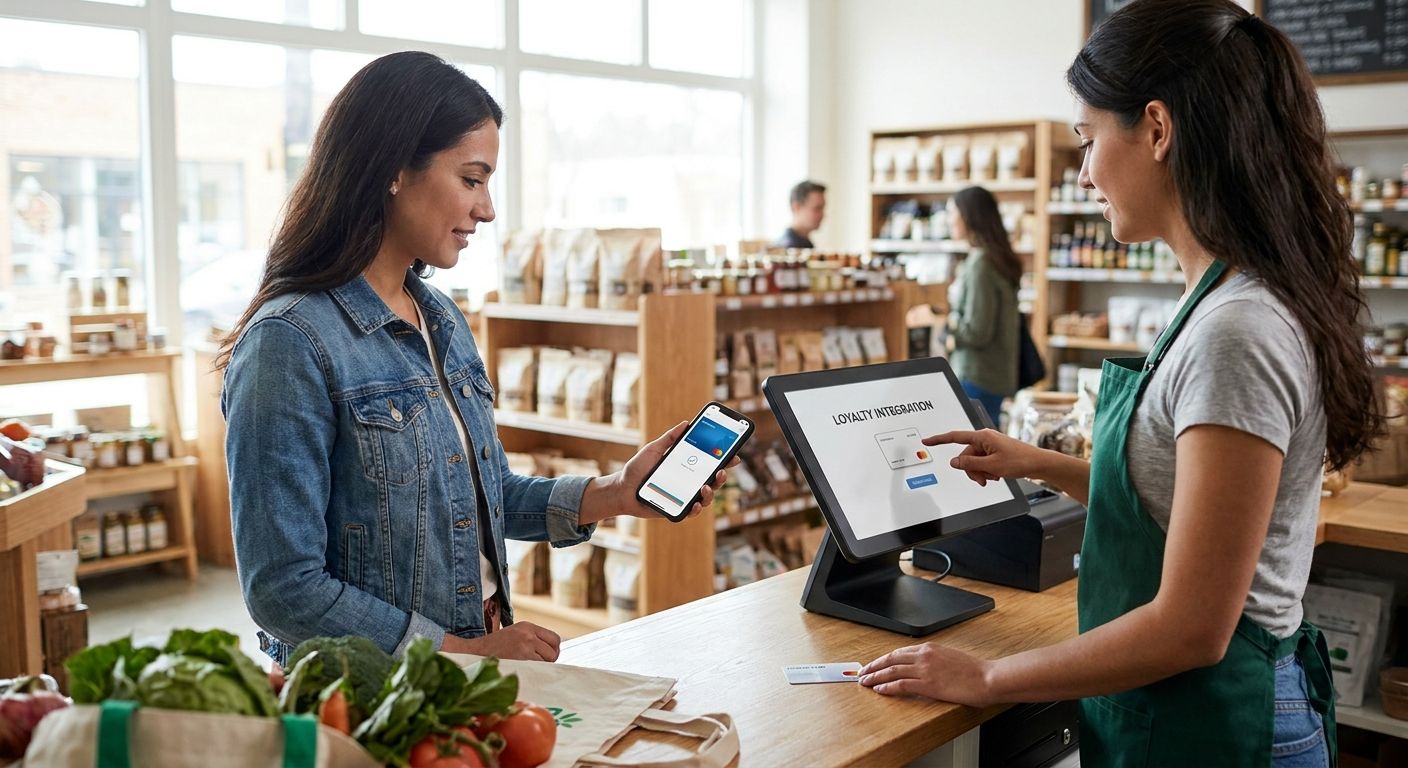
A loyalty program that only redeems at the POS terminal misses every online and kiosk order. Shoppers checking out at a self-checkout kiosk need the same point balance and redemption options as someone paying a cashier, otherwise the kiosk becomes a second, disconnected loyalty system.
Enrollment method: phone number vs. plastic card
Phone-number lookup beats a physical card for enrollment speed. Shoppers forget cards; they rarely forget their phone number at checkout, and enrollment that happens in five seconds at the register converts far more shoppers than a sign-up form mailed home.
Data ownership and export rights
If the loyalty vendor won't hand over the customer list in a usable format, you're renting your own shopper data. Independent grocers evaluating loyalty card integration in 2026 should confirm, before signing anything, that purchase history and contact data export on demand.
Marketing activation tied to loyalty triggers
Loyalty data is only useful if it triggers something. A program that fires a push notification or text when a shopper crosses a points threshold turns a static rewards balance into a repeat-visit driver — a static punch card never does that on its own.
See loyalty sync across POS, app, and kiosk
Walk through how one loyalty ledger follows the shopper through every channel.
Top picks: loyalty integration approaches for independent grocers
The default nobody actually chose: POS-native loyalty module
Most independent grocers already have this — a loyalty function built into the register software they bought years ago. The spec that matters: it works inside one register system and has zero visibility into app or web orders. If you're not running any digital ordering channel yet, it's functional. The moment you add an app or ecommerce site, it becomes a second, disconnected loyalty ledger. Verdict: Skip if you run more than one ordering channel.
The cheap patch: bolt-on loyalty app with card swipe
This is a standalone loyalty app that syncs to the POS through a nightly batch export, so points update once every 24 hours instead of in real time. It's cheap to add and requires no POS replacement. For a single-location store with no app or ecommerce presence, it buys time. For anything bigger, the 24-hour lag shows up as shopper complaints within weeks. Verdict: Consider only for a single-location store not yet running online ordering.
The middle ground: third-party loyalty middleware
This approach connects the POS to a separate loyalty database through an API, so points post faster than a batch export and redeem across in-store, app, and web. It's a real step up from a bolt-on app, but you're still running two systems — the loyalty platform and the commerce platform — and reconciling them when either one changes. Verdict: Consider for chains under 5 stores testing loyalty before a full platform rebuild.
The safe pick for 2026: unified commerce platform with native loyalty
Here the loyalty ledger lives inside the same platform running the ecommerce site, branded app, and kiosk ordering — no separate database, no nightly batch, no reconciliation. Grocers using a unified commerce approach report a $3.50 return per $1 invested and 30% higher order values through kiosk ordering, and integrated POS-to-kiosk setups hold 99% order accuracy. Local Express's guide on how to integrate loyalty rewards into a white-label grocery app covers the setup path. Verdict: Buy for any grocer running, or planning, more than one digital ordering channel in 2026.
What to avoid
- Loyalty tied only to a plastic card with no phone-number or app lookup. Shoppers who forget the card don't get points, and enrollment stalls at the register.
- Point systems that won't export customer data. If the vendor treats your shopper list as proprietary, you don't own your own loyalty program.
- Kiosk or app loyalty that doesn't sync back to the POS at checkout. A cashier who can't see or apply a shopper's app-earned points manually breaks the program at the exact moment it matters most.
Verdict comparison
| Approach | Sync speed | Redemption channels | Data ownership | Verdict |
|---|---|---|---|---|
| POS-native module | None (single system) | In-store only | Locked to POS vendor | Skip |
| Bolt-on loyalty app | Nightly batch | In-store + app | Partial export | Consider (single-location) |
| Third-party middleware | Near real-time | In-store + app + web | Exportable | Consider (under 5 stores) |
| Unified commerce platform | Real-time | In-store + app + web + kiosk | Full ownership | Buy |
FAQ
What's the best loyalty card integration for a grocery POS system in 2026?
A unified commerce platform where loyalty lives inside the same system running your POS, app, ecommerce site, and kiosk ordering is the strongest option in 2026. It removes the nightly batch sync and reconciliation work that bolt-on loyalty apps require.
Is a third-party loyalty app better than a POS-native loyalty module?
For a grocer running more than one ordering channel, yes — third-party middleware syncs closer to real time and redeems across in-store, app, and web, while a POS-native module only works inside one register system.
Can loyalty points sync between an in-store POS and a grocery mobile app?
Yes, but only if the loyalty ledger sits on a platform connected to both systems. A bolt-on loyalty app synced by nightly batch will show a lag; a unified commerce platform updates the balance in real time.
Do loyalty programs work with SNAP/EBT online ordering?
Loyalty points and SNAP/EBT payment run as separate systems at checkout, but both need to sit on a platform that recognizes the same shopper account. Grocers setting up SNAP/EBT online ordering should confirm loyalty and payment integrations don't conflict at checkout.
What's the difference between a punch-card app and a unified loyalty ledger?
A punch-card app tracks visits or purchases in isolation, usually tied to one channel. A unified loyalty ledger follows the same shopper record across POS, app, ecommerce, and kiosk, so points and history stay consistent everywhere they shop.
How long does loyalty card integration into an existing grocery POS take?
Timelines depend on whether you're bolting on a standalone app or rebuilding around a unified commerce platform tied to your POS. A bolt-on app is faster to launch; a full platform integration takes longer but avoids the reconciliation work bolt-ons create later.
Does loyalty card integration cost more for a multi-location grocery chain?
Cost scales with the number of locations and channels you're syncing, not the loyalty feature itself. A single-location store bolting loyalty onto an existing POS spends far less than a five-store chain integrating loyalty across POS, app, ecommerce, and kiosk.
One last thing
The fastest way independent grocers stall a loyalty program isn't the software — it's the enrollment method. Requiring a physical card at signup adds a step shoppers skip; switching to phone-number lookup at the register removes that friction without touching the POS hardware at all. Fix enrollment before you fix sync speed.