Sponsored product placements let independent and regional grocers sell shelf space inside their own app and website to the CPG brands that already fund national retail media budgets — without handing margin or customer data to a third-party marketplace.
- Sponsored product ads for grocery ecommerce work best in search results, category pages, and digital weekly ads — not push notifications.
- Retail media programs built on a grocer's own platform in 2026 avoid the 15-30% cut a national ad network takes off the top.
- Local Express's retail media tools let independent grocers onboard CPG brands directly instead of waiting for a national network invite.
- Skip push-notification sponsored offers until consent and deliverability are solved — they carry the highest compliance risk of any placement type.
Why this matters
CPG brands already spend national retail media dollars at Kroger, Walmart, and Instacart. Independent and regional grocers with their own ecommerce site or app can capture a slice of that same budget directly, if the platform supports it.
The grocers who launch a retail media program without a national network keep the full margin on every sponsored slot instead of splitting it with a marketplace. That's the entire economic case for running sponsored product ads for grocery ecommerce on a platform you control.
Most regional chains still leave this money on the table because their ecommerce vendor never built the inventory for it. That's a platform gap, not a demand gap — CPG brands want the placements.
Who this is for
This is for independent and regional grocers who already run an ecommerce site or branded app with real order volume — not stores still deciding whether to go online. If you're processing online orders weekly and have CPG relationships (or want them), sponsored placements turn existing digital shelf space into a second revenue line without new headcount.
It's also for multi-store chains that want brand-funded placements to scale across locations without renegotiating with every vendor at every store.
What to look for in sponsored product ads for grocery ecommerce
Placement inventory native to your storefront
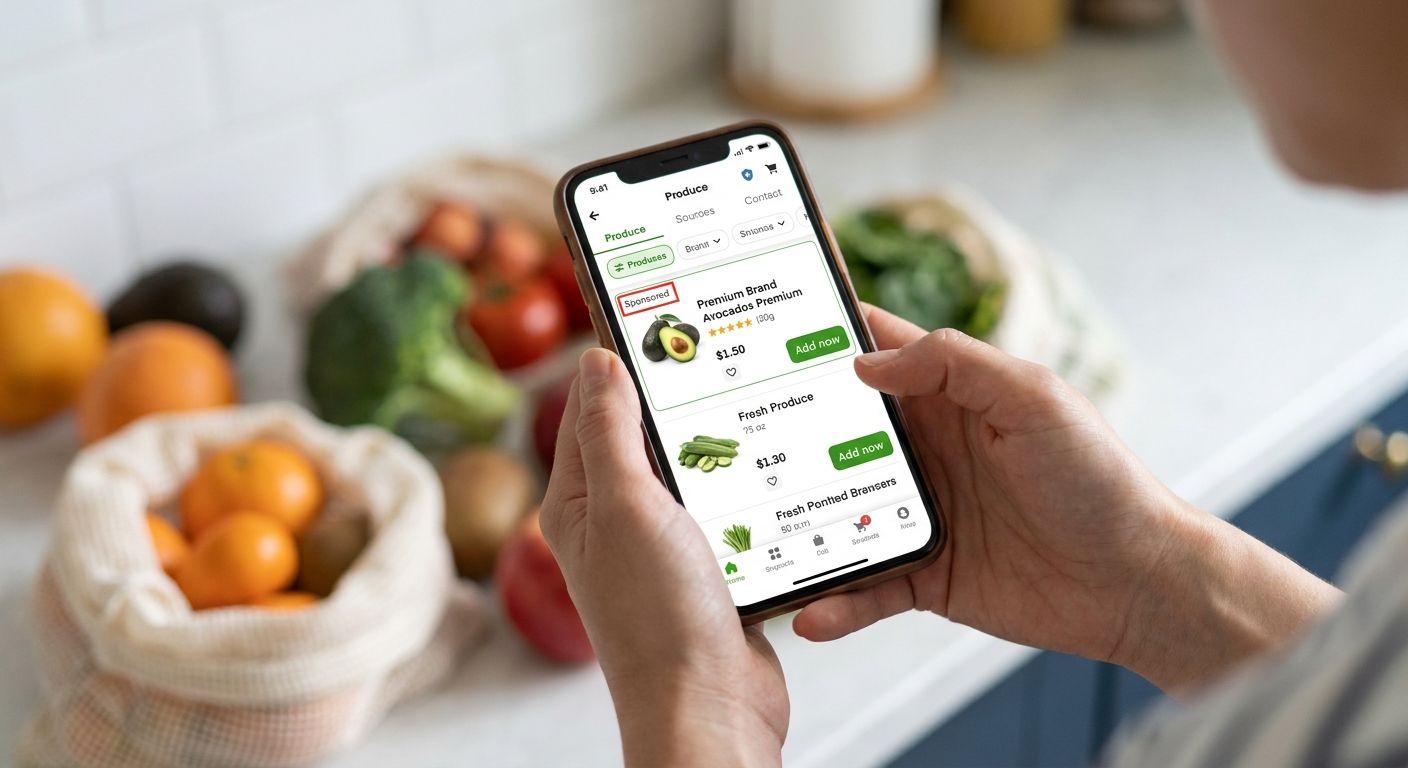
Sponsored slots only work if they sit where shoppers already look: search results, category pages, cart, and app home. A platform that bolts on a generic banner widget misses the intent-based moments where CPG brands pay the most, like a sponsored result on a "pasta sauce" search.
Self-service CPG onboarding
Brands won't wait weeks for a media kit and a phone call. A program that lets CPG teams self-serve budget, creative, and targeting is the difference between a handful of sponsors and dozens. Onboarding CPG brands into a grocery retail media program directly, rather than through a broker, keeps the commission structure in the grocer's favor.
Real-time inventory match
A sponsored slot for an out-of-stock item burns brand trust and shopper trust in the same click. The placement engine needs to check live inventory before it serves an ad, not just at campaign setup.
Transparent measurement and attribution
CPG brands renew based on ROAS, not impressions. If the platform can't tie a sponsored impression to an actual add-to-cart or purchase, brands cut budget after one cycle in 2026's tighter media environment.
Ad load limits and disclosure
Too many sponsored slots on one page trains shoppers to ignore all of them, sponsored and organic alike. A hard cap per page, with a visible "sponsored" label, protects both conversion rate and long-term CPG demand.
Multi-location scalability
Chains need to run a placement across 12 stores or restrict it to three without rebuilding the campaign each time. Store-level and chain-level targeting in the same dashboard is a hard requirement above five locations.
Top placement types worth running in 2026
Search and category page sponsored slots — the workhorse. These sit inside a shopper's existing intent, showing a sponsored item when someone searches "cereal" or browses the snacks category. Grocers running this placement type see it convert at a higher rate than any other slot because the shopper is already buying in that category. Buy.
Digital weekly ad sponsored placements — the volume play. A digital circular gets browsed by nearly every regular shopper before a trip, making it prime CPG real estate for feature placements and coupon bundling. Digital weekly ad and circular software turns a static PDF into a bookable ad unit with its own reporting. Buy.
App home and kiosk sponsored screens — the wildcard. Sponsored banners on an app home screen or a self-service kiosk idle screen reach shoppers before they even start searching, which works for brand awareness but converts less directly than search slots. Run the numbers with a kiosk ROI calculator before committing screen inventory to sponsorship over self-checkout flow. Consider.
Cart and checkout upsell sponsored slots — the margin add-on. A sponsored "add this to your order" prompt at checkout has a small but real lift on basket size, and CPG brands will pay a premium for last-mile placement. Cap it at one slot per cart to avoid checkout friction. Consider.
Push notification sponsored offers — the risk. Sponsored push notifications sound attractive to brands but carry the highest opt-out and deliverability risk of any placement in 2026, especially with tightening consent rules. Most independent grocers don't have the volume to make this worth the compliance overhead yet. Wait.
Build your own retail media program
See how to launch sponsored placements without a national network.
What to avoid
- A national ad network as your only option. It looks like the fast path, but the network takes a cut of every dollar and owns the shopper data, not you.
- Static circulars with no sponsored layer. A PDF weekly ad is free to produce but leaves the entire retail media line item at zero.
- Ad tech built for department stores, not grocery. Vendor-funded placement models aren't exclusive to food retail — a customer acquisition platform built for household appliance retailers runs the same self-service booking logic, which shows the model transfers across verticals but the inventory and SKU logic still has to be grocery-specific to work.
A unified commerce platform like Local Express ties the sponsored placement engine to the same inventory feed running the storefront, so the ad layer and the ecommerce layer never fall out of sync.
Verdict comparison table
| Placement type | Setup effort | CPG demand | Verdict |
|---|---|---|---|
| Search & category slots | Low | High | Buy |
| Digital weekly ad | Medium | High | Buy |
| App/kiosk home screen | Medium | Medium | Consider |
| Cart/checkout upsell | Low | Medium | Consider |
| Push notifications | High | Low | Wait |
FAQ
What are sponsored product ads for grocery ecommerce?
Sponsored product ads for grocery ecommerce are paid placements CPG brands buy inside a grocer's own website or app, showing on search results, category pages, or the digital weekly ad. The grocer sells the inventory directly instead of routing it through a national retail media network.
How much can a grocer earn from in-app sponsored placements?
Earnings depend on order volume, CPG relationships, and placement mix, so there's no single number that applies across stores. Chains running search, category, and weekly ad slots together see the highest CPG demand of the placement types available in 2026.
Do I need a national retail media network to run sponsored placements?
No. A grocer can launch a retail media program without a national network by using a platform that supports self-service CPG onboarding and real-time inventory matching. This keeps the full margin instead of splitting it with a broker.
Is sponsored product placement better than a national ad network for independent grocers?
For independent grocers, direct sponsored placement usually wins on margin because there's no network commission taken off the top. A national network can offer more brand reach initially, but at the cost of that revenue share and shopper data ownership.
What's the difference between sponsored search results and banner ads in a grocery app?
Sponsored search results show a paid item inside a shopper's active search, capturing existing purchase intent. Banner ads sit outside the search flow and work more for brand awareness than direct conversion.
How do I onboard CPG brands into a retail media program?
Onboard CPG brands directly through a self-service dashboard where they set budget, upload creative, and choose targeting without a broker in the middle. This is faster than a manual media-kit process and keeps commission structure in the grocer's favor.
Can sponsored placements work alongside SNAP/EBT online ordering?
Yes, sponsored placements run independently of payment method, so SNAP/EBT-eligible stores can still sell CPG ad inventory on non-SNAP items or general browsing surfaces. The ad layer and the payment layer operate separately in a unified commerce platform.
What placement type should a small independent grocer start with?
Start with search and category page sponsored slots because they require the least setup effort and see the highest CPG demand among placement types tracked in 2026. Expand to the digital weekly ad once that's generating consistent bookings.
One last thing
The placement type most grocers overlook first — the digital weekly ad — is also the one shoppers open most consistently before a trip, which makes it the highest-volume sponsored slot available once it's built as an ad unit instead of a static PDF.