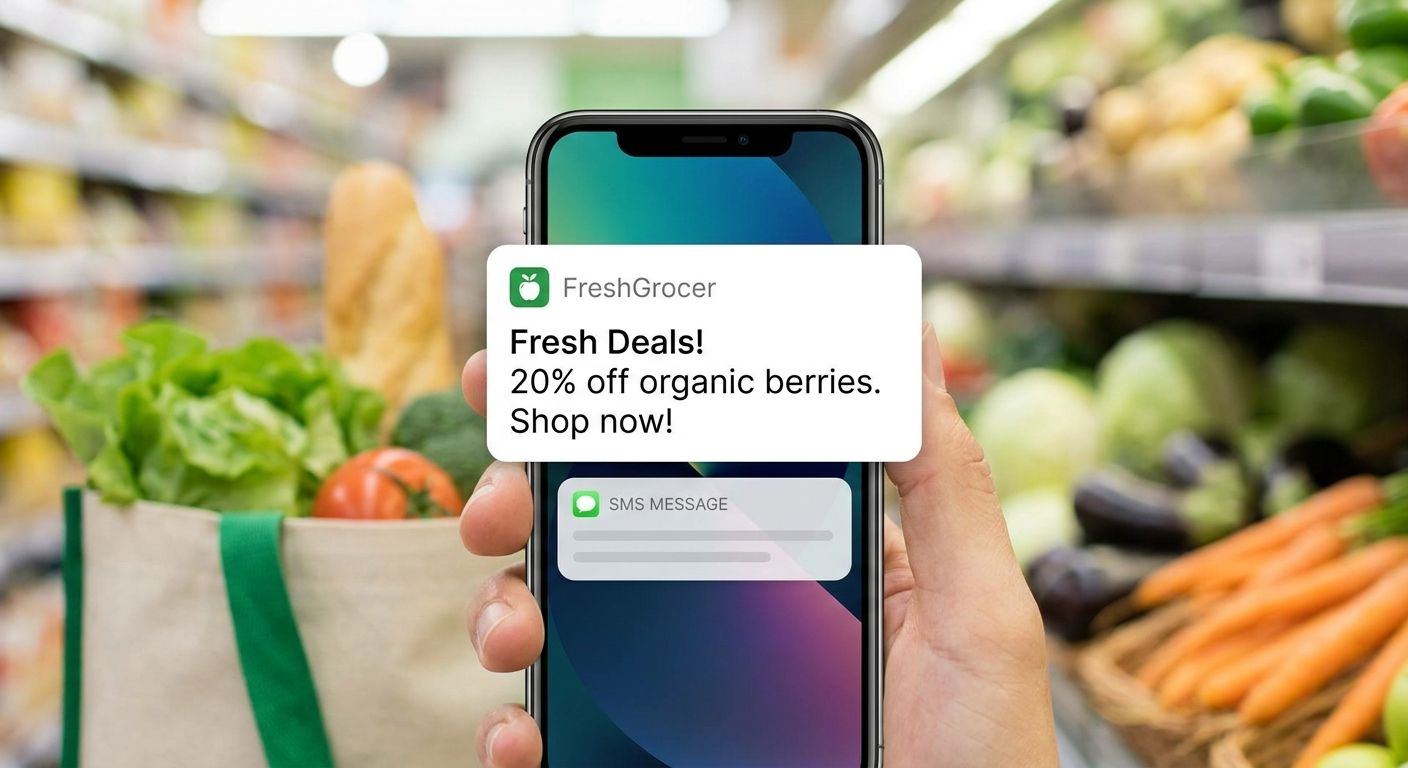
Push notifications and SMS messages beat email for grocery apps because grocery shopping is time-sensitive — a restock alert or a today-only markdown only works if it lands in the next hour, not the next newsletter cycle.
- Push notification marketing for grocery apps works best from inside a branded app with SMS as fallback, not a bolt-on tool: Buy the bundle.
- SMS messages average a 98% open rate versus roughly 20% for email, so time-sensitive markdowns belong on SMS.
- In-app sponsored placements turn CPG brands into a funding source for push programs: Consider once you're past a handful of stores.
- Standalone tools like Klaviyo or Attentive add a second bill and a second login on top of your grocery app: Consider only at high volume.
Why this matters
Every order placed through a third-party delivery marketplace app hands that customer's contact data, purchase history, and attention to someone else's push channel. You never get to message them again.
A grocer running its own branded mobile app owns that channel outright: the push token, the phone number, the order history that tells you when to send a restock alert versus a weekend promo. In 2026, that ownership is the entire argument for push notification marketing for grocery apps over relying on marketplace traffic.
Who this is for
This guide is for regional and independent grocers running, or about to launch, a branded app who want that app to actually move product instead of just taking orders. If you operate anywhere from 2 to 50 stores and still lean on a marketplace app for most digital orders, push and SMS marketing won't help you until you have your own channel to send them through.
It's also for chains that already have an app with push turned on but treat it like a broadcast bullhorn — one blast to everyone, no segmentation, opt-outs climbing every quarter.
What to look for in push notification marketing for grocery apps
1. Native push inside your own app
Push notifications sent through a marketplace app belong to that marketplace, not to you. A native push channel inside your own branded grocery app means every alert reinforces your brand and your loyalty program, not a delivery aggregator's.
2. SMS as the fallback, not the headline channel
SMS messages carry a roughly 98% open rate against roughly 20% for email, and a median read time near 90 seconds. That makes SMS the right channel for time-critical alerts — a canceled delivery window, a today-only markdown on rotisserie chicken — but it's expensive per send at scale, so push should carry the daily volume and SMS should carry the urgent 10%.
3. Segmentation by store and purchase history
A shopper at your Route 9 location doesn't care about a sale at the store across town, and a shopper who buys gluten-free weekly doesn't need a bakery blast. Segmentation by store location and purchase history is what separates a marketing tool from a spam cannon.
4. Real-time triggers
Restock alerts, order-ready pings, and cart-abandonment nudges need to fire off inventory and order-status events, not a marketer's calendar. If the platform can't trigger off real-time stock or order data, every message arrives a day late.
5. Retail media integration
CPG brands will pay to reach your shoppers with sponsored placements inside your push and app experience — that's the same logic behind in-app sponsored product placements. A push tool that can't carry sponsored content leaves that revenue on the table.
6. Opt-in and compliance management
SMS marketing in the US runs under TCPA rules — double opt-in, clear opt-out, documented consent. A tool that doesn't manage consent records for you turns every campaign into legal exposure, not just a marketing task.
Top picks for push notification and SMS tools
The foundation pick: a branded mobile app with native push built in. A branded mobile app platform that ships push notifications as a core feature, not an add-on, means every install is already a push-ready customer record. Grocers running one app across multiple stores get segmentation by location out of the box instead of stitching it together after the fact. Verdict: Buy.
The monetization pick: in-app sponsored placements. Once your app has enough active shoppers, sponsored product placements let CPG brands fund push slots and banner space instead of you eating the cost of every campaign. This only pencils out once you're past a handful of stores with real order volume behind you. Verdict: Consider.
The bolt-on pick: a standalone SMS or email platform. Tools like Klaviyo, Attentive, or Iterable are built for ecommerce broadly, not grocery specifically, and they sit outside your app's order and inventory data. That means someone on your team has to manually sync purchase history and stock triggers instead of the platform reading them natively. Worth it only once push and SMS volume outgrows what your core app tool handles. Verdict: Consider at scale, Skip below it.
The DIY pick: building push into a custom app from scratch. Some chains ask a developer to wire push notifications into a homegrown app rather than adopt an existing platform. It's technically possible, but you're now maintaining push infrastructure, opt-in compliance, and segmentation logic in-house with no vendor support when Apple or Google changes push APIs. Verdict: Skip unless you already run an internal engineering team dedicated to the app.
Own your push and SMS channel
See what it takes to launch a branded grocery app with native push built in.
What to avoid
- Marketplace-app push notifications. If your delivery volume runs through a third-party marketplace's app, you don't own that push channel — the marketplace does, and it can change your access or pricing at any time.
- Unsegmented mass SMS blasts. Sending every promo to your entire list regardless of store or purchase history spikes opt-outs fast; SMS opt-out is one tap, unlike unsubscribing from email.
- Push notification overload. More than one or two pushes a day trains shoppers to disable notifications entirely, killing the channel for the messages that actually matter — restock and order-ready alerts.
Verdict comparison
| Approach | Primary channel | Setup effort | Best for | Verdict |
|---|---|---|---|---|
| Branded app with native push | Push, SMS fallback | Low once app is live | Any grocer with an owned app | Buy |
| In-app sponsored placements | Push, in-app banner | Moderate | Chains with real order volume | Consider |
| Standalone SMS/email platform | SMS, email | High (manual sync) | High-volume senders outgrowing core tools | Consider at scale |
| DIY custom push build | Push | High, ongoing maintenance | Chains with dedicated engineering | Skip |
FAQ
What's the best push notification tool for grocery apps in 2026?
The best setup is native push built into your own branded grocery app rather than a bolt-on tool, since it already has access to your order and inventory data for real-time triggers. Standalone platforms make sense only once your push and SMS volume outgrows what the core app handles.
Is SMS marketing better than push notifications for grocery stores?
Neither replaces the other: SMS averages a 98% open rate and a 90-second median read time, making it right for urgent alerts, while push handles higher daily volume at lower cost per send. Use SMS for the 10% of messages that are truly time-critical.
Do I need a separate SMS platform if I already have a branded app?
Not at first. Most grocery app platforms include SMS as a fallback channel alongside push, and a separate platform only earns its cost once your send volume or segmentation needs outgrow what's built in.
How often should a grocery store send push notifications?
Cap it at one or two a day. Sending more trains shoppers to disable notifications entirely, which kills the channel for order-ready alerts and restock pings that actually drive repeat visits.
Can push notifications work without a mobile app?
No — push notifications require an installed app with a registered device token. Grocers without an app are limited to SMS and email for direct messaging.
What's the difference between push notifications and retail media?
Push notifications are messages you send to your own shoppers, while retail media is inventory you sell to CPG brands to reach those same shoppers inside your app or push channel. In-app sponsored placements are one form of retail media running through the push and banner space you already own.
Do push notifications need customer opt-in?
Yes, both major mobile operating systems require explicit opt-in for push, and SMS marketing in the US runs under TCPA rules requiring documented consent and a clear opt-out. Platforms that manage consent records for you reduce compliance risk significantly.
Should small independent grocers bother with SMS marketing?
Yes, even a single-location grocer benefits from SMS for order-ready and delivery alerts, since the channel's 98% open rate beats email regardless of store count. Segmentation by purchase history matters more at scale, but the channel itself pays off from day one.
One last thing
The grocers getting the most out of push notification marketing for grocery apps in 2026 aren't the ones sending the most messages — they're the ones who moved urgent alerts to SMS and left daily promos on push, then let CPG-funded sponsored placements cover part of the bill. Channel discipline beats volume every time.