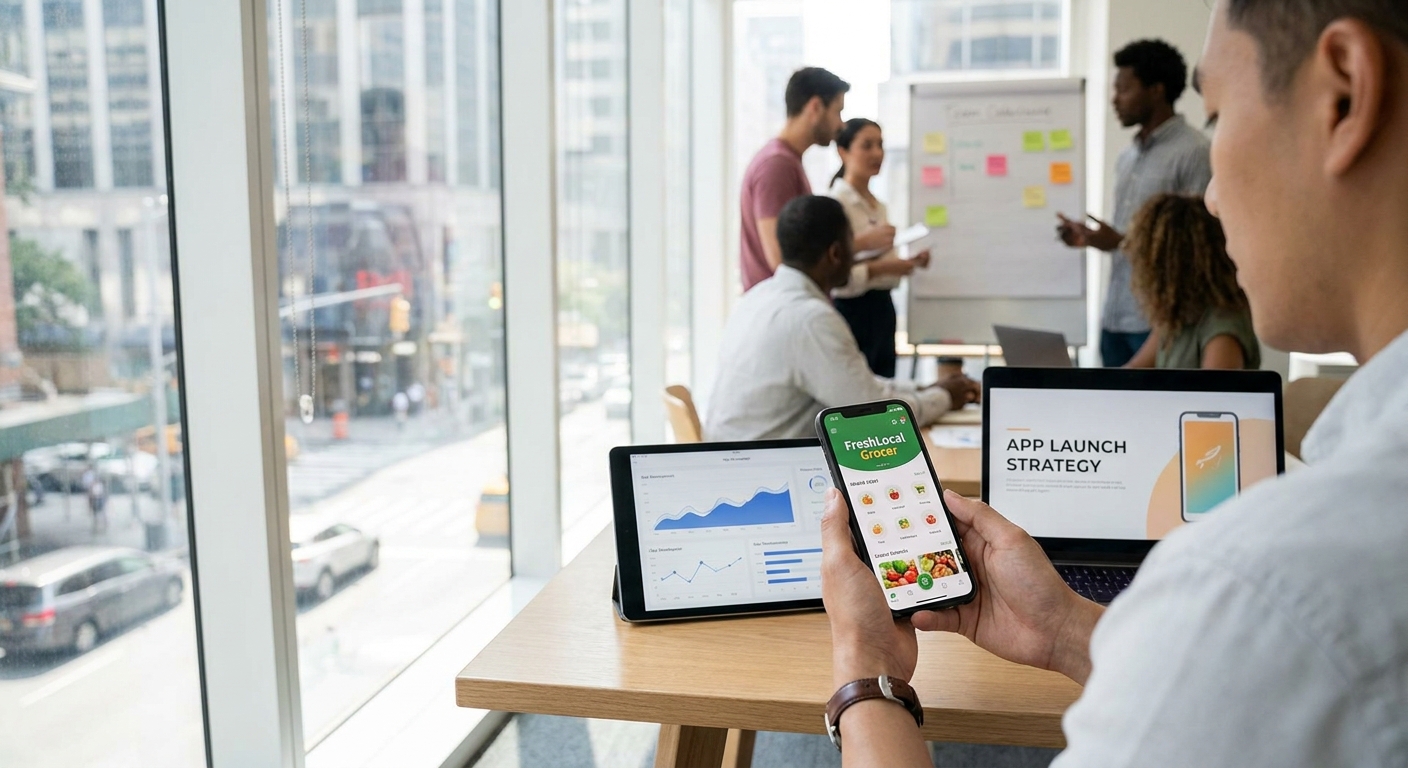
Launching a branded mobile app for a regional grocery chain in 2026 takes 4-8 weeks on a white label platform, not the 6-12 months a custom build usually runs — here's the exact sequence, from catalog audit to App Store approval.
- Regional chains that launch a branded mobile app for a grocery chain on a white label platform go live in 4-8 weeks, not months.
- Clean SKU-level catalog data before the build starts — this is the step most launches skip and regret.
- First-party ordering apps cut cart abandonment roughly 18% versus marketplace apps, per 2026 industry data.
- Sync order management and POS before launch day or inventory accuracy drops below the 95% benchmark chains expect.
Why this matters
A regional grocery chain that ships a branded app without prepping the backend ends up with a storefront that looks finished and functions badly — wrong prices, phantom stock, and a support line full of angry regulars. The upside for getting it right is real: self-service digital ordering channels report roughly 30% higher order values than staffed checkout in 2026 comparisons, and AI-powered grocery platforms return an average $3.50 for every $1 invested.
Most regional chains don't need a custom-coded app. A white label grocery delivery app built for regional chains gets you branded iOS and Android apps, a synced product catalog, and order routing without hiring a mobile dev team. The steps below assume that path, since it's the one that actually gets regional chains live in weeks instead of quarters.
What you'll need
- Current POS export — full SKU list with pricing, weights for produce and deli, and category tags
- A white label ecommerce and mobile app platform — not a from-scratch dev shop
- App Store Connect and Google Play Console accounts registered under the chain's business entity
- Payment processor already approved for card-not-present grocery transactions
- Delivery or pickup fulfillment plan — in-house drivers, third-party dispatch, or a hybrid
- Staff assigned to order fulfillment for at least the first two weeks post-launch
- A marketing plan for the launch week — email list, in-store signage, loyalty program tie-in
The steps
Step 1: Audit and clean your product catalog
This is the step that determines whether the app works on day one or breaks by day three. Export every SKU from the POS, tag weight-based items (deli, produce, bulk bins) separately from fixed-unit items, and flag anything discontinued in the last 90 days. Chains that skip this step ship apps where customers order items that haven't been on shelf since 2025. Common mistake: syncing catalog once at launch instead of setting a recurring feed — stock drifts within a week.
Step 2: Pick a white label platform over a custom build
A custom-coded app for a regional chain typically runs 6-12 months and needs an internal engineering team to maintain. A white label platform ships a fully branded app under your name in weeks because the ordering engine, payment flow, and delivery logic are already built and proven across other grocery operators. Compare options at the best white label grocery delivery apps for regional chains guide before committing to a vendor.
Step 3: Connect order management to your POS and inventory
The app is only as accurate as the systems feeding it. Order management software needs a live connection to your POS and warehouse or backroom inventory, refreshing at minimum every 15 minutes during business hours. Chains running order management software across multi-location grocery chains report inventory accuracy near the 95% benchmark once the sync is live — below that, out-of-stock substitutions frustrate first-time app users and they don't come back.
Step 4: Set delivery zones, fees, and fulfillment rules per store
Each location needs its own delivery radius, minimum order threshold, and fee structure — a single-store default breaks down the moment a second or third location goes live. Map zones by drive time, not straight-line distance, since a 3-mile suburban zone and a 3-mile rural zone are not the same delivery cost. The guide on structuring delivery zones and fees for multi-store chains walks through the math store by store. Expected outcome: each location shows accurate delivery windows and fees the moment a customer enters their address.
Step 5: Configure payment, SNAP/EBT, and checkout rules
If any portion of your customer base uses SNAP/EBT, this has to be configured before submission, not patched in after launch — app store reviewers and customers both notice a broken checkout fast. Set eligible-item flags at the SKU level so EBT-eligible groceries and non-eligible items (prepared hot food, alcohol) split correctly at checkout.
Step 6: Submit to the App Store and Google Play
Apple's review typically runs 24-48 hours in 2026 for a compliant grocery submission; Google Play review is usually faster. Have your business entity, app icon, screenshots, and privacy policy finalized before submission — incomplete metadata is the single biggest cause of rejection on first pass. Common mistake: submitting before payment processing is fully tested in production, which triggers an automatic reject.
Step 7: Train store staff and soft-launch to a loyalty segment
Run a soft launch to your existing loyalty list or top 500 customers for 5-7 days before a full public push. This surfaces fulfillment gaps — wrong pick times, missing substitution rules — while volume is still low enough to fix same-day. Staff should know the app's substitution and refund flow cold before the wider launch, not learn it from an angry customer.
See the platform behind the launch
White label grocery apps, order management, and delivery in one system.
Troubleshooting
- App shows items that are out of stock in-store — catalog sync frequency is too low; move from daily to 15-minute intervals.
- Delivery fee looks wrong for a specific address — zone boundaries were drawn by straight-line distance instead of drive time; redraw per store.
- App Store rejection on first submission — usually missing privacy policy language or incomplete payment testing; resubmission typically clears in 24-48 hours once fixed.
- Customers abandon cart at checkout — SNAP/EBT split isn't configured correctly, or a payment method isn't fully live; test the full checkout flow in production before soft launch.
- Order accuracy complaints in week one — order management isn't fully synced to POS; verify the connection before blaming staff.
- Low adoption after launch week — no in-store or loyalty push; a branded app doesn't market itself, it needs the same push a new store location would get.
Tools and resources
- White label grocery delivery apps for regional chains — vendor comparison before you commit
- Order management software for multi-location grocery chains — the sync layer behind accurate inventory
- How to structure delivery zones and fees for multi-store chains — per-store zone and fee math
- How to set up SNAP/EBT online ordering for your grocery store — checkout compliance before submission
What to do next
Once the app is live and order volume is stable, the next lever is reducing what you pay third-party marketplaces to bring customers to your own front door — worth reading before your first renewal decision on any marketplace contract.
FAQ
How long does it take to launch a branded mobile app for a grocery chain?
A regional grocery chain can launch a branded mobile app in 4-8 weeks on a white label platform in 2026, versus 6-12 months for a custom build. Catalog cleanup and POS integration are usually the longest steps, not app store review.
Is a white label app better than building custom for a grocery chain?
For most regional chains, yes — a white label platform gets a fully branded iOS and Android app live in weeks with proven ordering and payment logic already built. Custom builds make sense only for chains with an internal engineering team and a multi-year runway.
Does a grocery app need to support SNAP/EBT?
If any share of your customer base uses SNAP/EBT, checkout needs to split eligible and non-eligible items at the SKU level before launch. Adding it after launch means re-submitting to the app stores and re-testing checkout in production.
How much does a branded grocery mobile app cost in 2026?
Cost varies by platform and store count, so get a quote scoped to your number of locations rather than relying on a flat industry number. White label platforms typically cost a fraction of a custom build across the first two years.
What's the biggest reason grocery app launches fail?
Dirty or stale catalog data is the most common cause — customers order items that are out of stock in-store, and trust in the app drops fast. Syncing catalog and POS every 15 minutes instead of once daily fixes most of this.
Do app store reviews slow down a grocery app launch?
Apple's review for a compliant grocery submission typically runs 24-48 hours in 2026, and Google Play is usually faster. Most delays come from incomplete metadata or untested payment flows, not the review itself.
Should delivery fees be the same across all store locations?
No — delivery zones and fees should be set per store based on drive time, not a single chain-wide default. A rural location and a dense suburban location have different delivery economics even at the same mile radius.
One last thing
The soft launch to a loyalty segment is the step chains skip most often, and it's the one that catches fulfillment gaps while volume is still low enough to fix same-day — a full public launch with unresolved substitution or refund flows turns week-one app store reviews negative fast, and those reviews sit there through 2026 and beyond.