Delivery zone management for grocery chains breaks down the moment each store sets its own radius, minimum order, and fee logic in a spreadsheet nobody else can see. Structuring zones by store, distance tier, and fulfillment cost — instead of one flat radius for the whole chain — is what actually protects margin as you scale past three or four locations in 2026.
- Zone by distance tier per store, not one chain-wide radius — this is the core of delivery zone management for grocery chains.
- Set minimum order thresholds between $25 and $35 on outer tiers to stop far deliveries from bleeding margin.
- Route fee logic through order management software once you pass 4-5 locations; spreadsheets stop scaling around there.
- Test overlap zones between stores monthly — duplicate coverage is the most common multi-store delivery error.
- Review zone performance quarterly against driver payout and order volume, not just customer complaints.
Why this matters
A single grocery store can run delivery zones off gut feel. A five-store chain cannot, because each location has different driver density, different order volume, and different neighborhood income levels that change what a customer will pay for delivery.
Get the zone structure wrong and one of two things happens: stores near each other double-cover the same ZIP codes and split orders between drivers who both drive half-empty, or a store undercuts its delivery fee on a 6-mile order and loses money on every single one. Order management software built for multi-location grocery chains exists specifically to stop this — it lets you configure zones, fees, and minimums per store node instead of forcing one rule across the whole banner.
In 2026, the chains getting this right are the ones treating delivery zones as a pricing exercise, not a map exercise.
What you'll need
- Store-level delivery radius data — pull actual delivered-order addresses for the last 90 days, not a guessed radius
- An order management platform that supports per-store zone and fee configuration
- Historical order volume by ZIP or postal code, broken out by store
- Driver or fleet capacity per location, including any third-party gig coverage
- A defined fee waterfall: base fee, distance surcharge, small-order fee, and any peak-hour add-on
The steps
1. Map each store's serviceable radius separately
Do not inherit one radius across the chain. A downtown store might serve a tight 3-mile radius profitably; a suburban location 20 miles away might need 8 miles to hit meaningful order volume. Pull the last 90 days of delivered orders per store and plot where they actually landed — this tells you the real radius, not the theoretical one.
Common mistake: using drive-time apps to draw a circle instead of using real delivery data. Circles ignore rivers, highways, and neighborhoods with no parking, all of which change actual delivery time.
2. Build three distance tiers per store
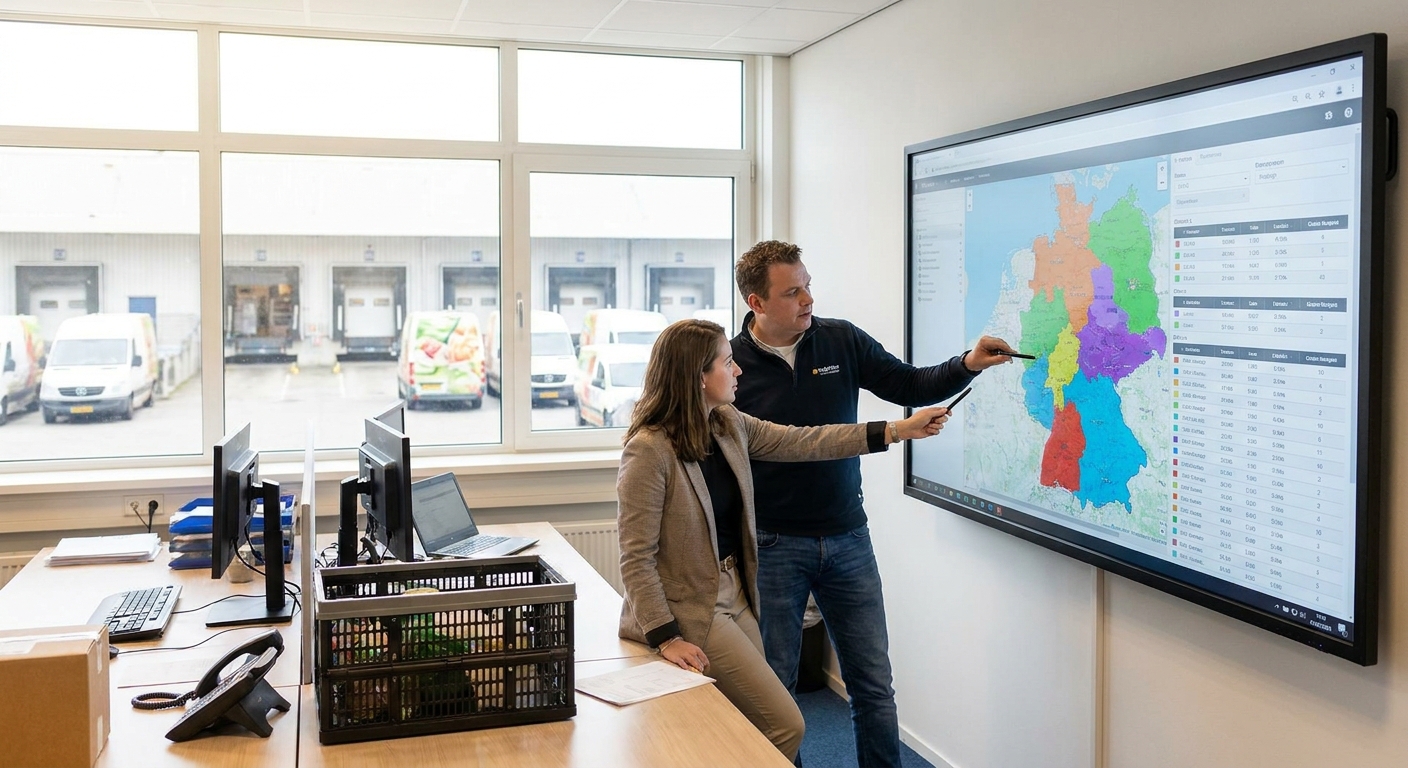
Split each store's radius into near (0-3 miles), mid (3-6 miles), and far (6+ miles) tiers. This is the backbone of delivery zone management for grocery chains because fee and minimum order logic should change by tier, not stay flat.
Each tier gets its own delivery fee and its own minimum order value. A near-tier order might carry a $3.99 fee with a $20 minimum; a far-tier order might need a $7.99 fee with a $35 minimum to stay profitable.
3. Set minimum order thresholds per tier
Minimum order value is the lever that protects margin on far deliveries. A $25-$35 minimum on outer tiers keeps you from dispatching a driver 20 minutes each way for a $14 basket.
Expected outcome: average order value on far-tier deliveries should sit visibly above near-tier AOV once minimums are enforced correctly. If it doesn't, the minimum is set too low for that tier's drive time.
4. Assign delivery fees per tier, not flat chain-wide
A flat $4.99 fee across every store and every distance ignores the actual cost of the delivery. Fees should scale with distance and, ideally, with time-of-day demand. This is where most multi-store chains still lose money — one banner-wide fee that was set once and never revisited.
Common mistake: copying a competitor's flat fee instead of pricing off your own driver cost per mile and per stop.
5. Layer in surge or peak-hour rules
Friday evening and Sunday morning order spikes strain driver capacity differently than a Tuesday afternoon. Add a peak-hour surcharge — even a modest $1.50-$2.50 add-on during known high-volume windows — to smooth driver availability instead of letting delivery times slip.
Why it matters: customers tolerate a clearly labeled peak fee far better than a vague "longer than expected" delivery window.
6. Sync zone data across your order management system
Once zones, tiers, fees, and minimums are set per store, they need to live in one system that every store location and every channel — web, app, kiosk — reads from. Manually updating fees in five different POS backends guarantees drift within a month.
Expected outcome: a customer entering the same address on two different store fronts within the chain should see consistent, correctly-tiered pricing, not two different numbers.
7. Test overlap zones between neighboring stores
Where two stores' far tiers intersect, decide explicitly which store fulfills that ZIP code, and route by fulfillment cost or inventory availability, not by whichever system processed the order first.
Common mistake: leaving overlap zones ungoverned, which causes duplicate delivery attempts or, worse, orders that silently fail because two stores both assumed the other would fulfill them.
8. Review and adjust quarterly
Zone performance shifts as neighborhoods change, as driver networks expand, and as fuel and labor costs move. Review fee-to-cost ratios per tier every quarter in 2026 rather than setting zones once and forgetting them.
Get your delivery zones audited
See how Local Express structures zones and fees across multi-store grocery chains.
Troubleshooting
Drivers keep bouncing between overlapping zones. Assign each ZIP code or postal sector to exactly one fulfilling store in your order management configuration — no shared coverage without an explicit priority rule.
Far-tier orders lose money even with a surcharge. Your minimum order value is too low relative to drive time. Raise it in $5 increments and watch the margin-per-delivery number for two weeks before adjusting again.
Customers abandon carts at checkout when they see the delivery fee. Show the fee and minimum order threshold earlier in the flow — on the store locator or landing page — not for the first time at checkout.
One store's zones look nothing like its neighbor's, even though they're 4 miles apart. That's expected if driver density and order volume differ. Do not force zone parity between stores just for administrative simplicity.
Peak-hour surcharge triggers complaints. Label it clearly on the order summary as a time-based fee, not a generic "surge" charge — transparency reduces complaint volume more than the fee amount does.
Rural or edge-of-territory stores can't hit profitable order density. This usually means the zone-and-fee model built for urban stores is being force-fit onto a low-density market. Last-mile delivery networks built for rural grocery retailers solve for exactly this gap.
Tools and resources
- An order management platform with per-store zone, tier, and fee configuration — see order management software for multi-location grocery chains
- A last-mile delivery network that can flex coverage for lower-density service areas, particularly last-mile delivery networks for rural grocery retailers
- A white-label delivery app comparison if you're evaluating vendors — start with best white label grocery delivery apps for regional chains
- 90 days of delivered-order address history per store, exported by ZIP or postal sector
- A documented fee waterfall spreadsheet as the source of truth before it moves into your platform configuration
What to do next
Once zones and fees are structured correctly, the next bottleneck for most chains is third-party marketplace dependency eating into the margin you just protected. If your chain still routes a chunk of delivery volume through third-party apps, read how to reduce dependency on third-party delivery marketplaces next.
If same-day delivery isn't live yet across all locations, how to launch same-day delivery without third-party apps walks through the sequencing.
FAQ
What is delivery zone management for grocery chains?
Delivery zone management for grocery chains is the practice of setting distance-based delivery radii, minimum order values, and fees separately for each store location instead of applying one flat rule chain-wide. It protects margin on far deliveries and prevents overlapping coverage between nearby stores.
How many delivery zones should a grocery store have?
Most grocery stores run three distance tiers per location in 2026: near (0-3 miles), mid (3-6 miles), and far (6+ miles). Each tier carries its own fee and minimum order threshold.
What should the minimum order value be for grocery delivery?
Minimum order values typically run $20-$25 for near-tier delivery and $30-$35 for far-tier delivery in 2026. The exact number depends on driver cost per mile and average basket size at each store.
How do you price delivery fees across multiple store locations?
Price delivery fees per distance tier and per store, not as one flat chain-wide fee. A near-tier fee might be $3.99 while a far-tier fee on the same order type runs $7.99 or more, reflecting actual driver drive time.
What happens when two store delivery zones overlap?
Overlapping zones cause duplicate delivery attempts or missed orders when no single store is assigned fulfillment responsibility. Assign each ZIP code or postal sector to one fulfilling store inside your order management system to prevent this.
Do grocery chains need separate software for delivery zones?
Chains with more than 4-5 locations generally need order management software with per-store zone configuration, because spreadsheet-based fee management breaks down once fees vary by tier and location.
How often should delivery zones be reviewed?
Review delivery zone performance quarterly. Fuel costs, driver density, and neighborhood order volume shift enough within a few months to make a zone structure set a year ago inaccurate.
Should peak-hour delivery fees be different from standard fees?
Yes. Adding a modest $1.50-$2.50 surcharge during known high-volume windows like Friday evenings smooths driver availability without forcing customers to accept longer delivery windows.
One last thing
The chains that get delivery zone management for grocery chains right in 2026 don't start with a map — they start with a driver-cost-per-mile number for each store, then draw the zones backward from that. Every zone, tier, and fee decision above only works if that number is accurate first.