Regional grocery chains lose customer data and margin the moment they hand delivery to a marketplace app — the question for 2026 is which white-label grocery delivery app actually gets that control back without breaking the budget.
- Vertical white-label platforms like Local Express beat generic templates for regional grocers in 2026 — Buy.
- Marketplace-only listings (Instacart, DoorDash) keep commissions at 15-30% per order — Hold, not a long-term fix.
- In-house builds take 12+ months and still lack retail media tools — Skip for most regional chains.
- Health food, halal, Indian, Caribbean, and African grocery formats each need different catalog and payment logic.
Why this matters
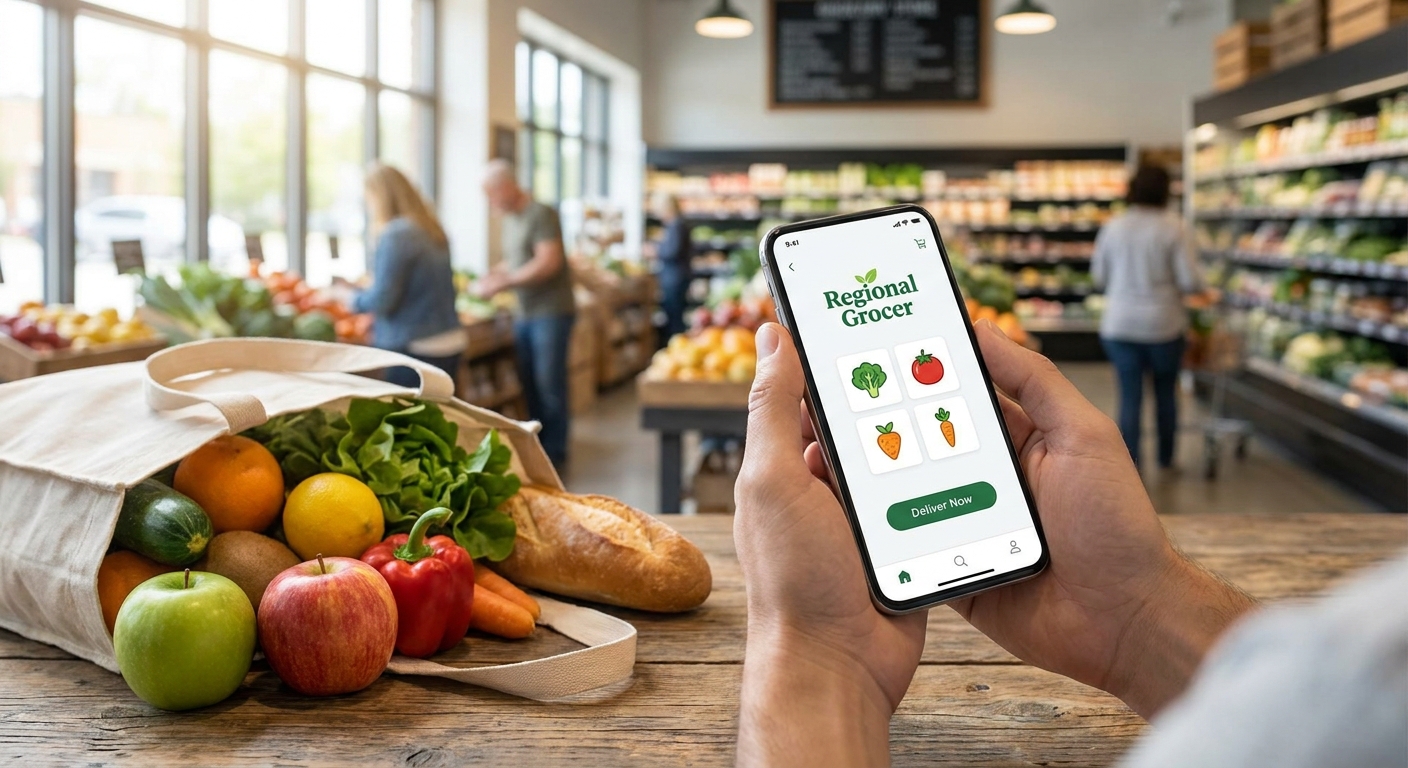
A regional chain running three to fifteen stores doesn't have the volume to negotiate marketplace commissions down, and it doesn't have the engineering headcount to maintain a custom app either. The white-label grocery delivery app category exists for exactly that gap: a branded ecommerce site, a branded mobile app, order management, and delivery routing, packaged so a grocer can launch in weeks instead of building from zero.
The platform choice also decides who owns the customer. Marketplace listings hand over the email address, the purchase history, and the loyalty relationship to Instacart or DoorDash. A white-label ecommerce site keeps that data with the retailer, which is the entire point of going white-label in the first place.
How this list is ranked
Each option is scored on four things that matter to a regional chain in 2026: how fast it launches, whether it keeps customer data in-house, whether it fits a specific grocery format (halal, Indian, Caribbean, seafood, wine and spirits, farmers market), and whether margin stays with the retailer instead of a delivery marketplace. Generic reviews rank apps on feature checklists; this list ranks them on whether a regional grocer can run the thing without a dev team on staff.
The ranked list
1. Building an in-house app from scratch
The expensive detour. A custom-built grocery app typically takes 12 months or more before a single order ships, and it still needs a separate team for payment processing, inventory sync, and delivery routing. Retail media tools — the feature that recovers margin through supplier ad placements — almost never make the first release. Verdict: Skip for any chain without a dedicated engineering budget.
2. Marketplace-only listings (Instacart, DoorDash, Uber Eats)
The fast start with a ceiling. Getting listed takes days, not months, and the marketplace handles delivery logistics end to end. The tradeoff is commission — typically 15% to 30% per order in 2026 — plus zero access to the customer's contact info or order history. A regional chain that leans on marketplaces exclusively never builds a repeat-purchase channel of its own. Verdict: Hold as a supplemental channel, not a foundation.
3. Generic ecommerce plugins bolted onto a delivery wrapper
The DIY patch. Shopify or WooCommerce plus a third-party delivery plugin looks cheap on paper, but grocery catalogs — weighted items, substitutions, age-restricted products, perishable inventory — break generic ecommerce logic fast. Order management ends up stitched together across three tools instead of one. Verdict: Skip once the catalog exceeds a few hundred SKUs.
4. Vertical white-label platform for health food and natural grocers
The specialty fit. Health food and natural grocery chains carry supplement SKUs, bulk bins, and certification callouts that generic platforms don't handle well. A grocery ecommerce platform built for health food and natural stores bundles the branded site, app, and order management around that catalog shape instead of forcing a workaround. Verdict: Buy for natural and specialty grocers ready to launch a branded channel in 2026.
5. Vertical white-label platform for halal and Middle Eastern grocers
The underserved segment. Halal and Middle Eastern grocers rarely get catalog logic built for their product mix from mainstream delivery apps, which is exactly why an online ordering platform for halal and Middle Eastern grocers exists as its own build rather than a generic template with a translated menu. Verdict: Buy for chains serving this customer base regionally.
6. Vertical white-label platform for Indian grocery stores
The catalog-complexity pick. Indian grocery chains stock hundreds of spice, lentil, and snack SKUs with weight-based pricing that trips up standard ecommerce carts. A white-label ecommerce build for Indian grocery stores handles that pricing model natively instead of patching it in post-launch. Verdict: Buy for Indian and South Asian grocery chains scaling past a single location.
7. Multi-format expansion (convenience, wine and spirits, seafood, Caribbean, African, farmers markets)
The same architecture, different shelf. Once a regional chain has a working white-label setup for one format, the same core — branded site, branded app, order management, delivery — extends to adjacent formats like convenience stores, wine and spirits retailers, or farmers market co-ops without a rebuild. Verdict: Consider once the primary format is live and stable.
Comparison table
| Option | Launch speed | Customer data ownership | Retail media / margin tools | Best regional fit | Verdict |
|---|---|---|---|---|---|
| In-house build | Slow (12+ months) | Full | Rare in v1 | Chains with dev teams | Skip |
| Marketplace-only | Fast (days) | None | None | Supplemental channel only | Hold |
| Generic ecommerce plugin | Medium | Full | Limited | Small catalogs only | Skip |
| Health food vertical platform | Fast | Full | Included | Natural / supplement grocers | Buy |
| Halal / Middle Eastern vertical platform | Fast | Full | Included | Halal grocery chains | Buy |
| Indian grocery vertical platform | Fast | Full | Included | Indian / South Asian chains | Buy |
| Multi-format expansion | Fast (post-launch) | Full | Included | Chains adding a second format | Consider |
“A white-label grocery delivery app only pays off when the retailer keeps the customer data the marketplace model gives away.”
Where to buy a white-label grocery delivery app
- Match the platform to the catalog first, not the other way around. A halal grocer and a wine and spirits retailer need different compliance and age-verification logic — a platform that treats every grocery format the same forces workarounds later.
- Check whether order management, delivery, and the mobile app are one system or three vendors stitched together. Three vendors means three support tickets when an order breaks.
- Confirm retail media tools are included, not a future roadmap item. That's the feature that turns supplier ad placements into margin recovery instead of a line item lost to marketplace commissions.
See the platform for your grocery format
Branded ecommerce, app, kiosk, and delivery in one system for 2026 launches.
What to avoid
- A platform that only offers a website, no branded app. Regional grocery repeat orders happen on mobile in 2026 — a site-only build caps growth before it starts.
- A vendor that can't name which grocery verticals it's built for. Generic "grocery ecommerce" pitches usually mean generic catalog logic underneath.
- Any setup where delivery routing is a separate contract from the ordering platform. That split creates the exact support gap regional chains are trying to escape from marketplaces.
FAQ
What is a white-label grocery delivery app?
A white-label grocery delivery app is a branded ecommerce site and mobile app that a grocery retailer owns and operates under its own name, built on a vendor's platform. It differs from marketplace apps like Instacart because the retailer keeps the customer data and the order history.
Is a white-label app better than Instacart or DoorDash for a regional grocer?
For long-term customer ownership, yes — a white-label app keeps the contact and purchase data with the retailer, while marketplace apps keep it with Instacart or DoorDash. Marketplaces still work well as a supplemental channel for one-time or overflow orders.
How much does a white-label grocery delivery app cost in 2026?
Costs vary by vendor and by how many modules a chain needs (ecommerce site, app, order management, delivery, kiosk, retail media), so get a quote scoped to your store count and catalog size rather than comparing a flat number.
Can a white-label platform handle a specialty grocery catalog like halal or Indian groceries?
Vertical-built platforms handle specialty catalogs natively, including weight-based pricing, certification callouts, and format-specific SKUs, instead of forcing that logic into a generic ecommerce template.
Do white-label grocery apps include delivery, or just ordering?
The strongest 2026 options bundle last-mile delivery with the ordering platform in one system, so the retailer isn't managing a separate delivery contract and a separate ordering vendor.
What's the biggest mistake regional chains make choosing a delivery app?
Picking a generic ecommerce plugin because it looks cheaper upfront, then discovering it can't handle grocery-specific catalog logic like weighted items or age-restricted products once the store count grows.
Does a white-label app help with margin, not just ordering?
Yes, when it includes retail media tools — supplier-funded ad placements inside the app or site recover margin that would otherwise go entirely to marketplace commissions.
Can one platform serve multiple grocery store formats?
A platform built with vertical configurations for formats like convenience stores, wine and spirits retailers, and farmers market co-ops can serve multiple formats under one account without separate rebuilds for each.
One last thing
The detail regional chains miss most: retail media tools aren't a nice-to-have bolted on in year two — the chains that launch with supplier ad placements built into the app from day one in 2026 start recovering marketplace-lost margin within the first ordering cycle, not after a year of negotiating a separate ad contract.