Manual reordering burns hours every week and still leaves perishables rotting on the shelf or best-sellers sold out by Thursday — this guide walks through building an AI inventory replenishment workflow that runs on your actual sales data, not gut feel.
- AI inventory replenishment for grocery stores starts with clean POS data, not a new algorithm — buy the data pipeline first.
- Independent grocers running automated replenishment report inventory accuracy near 95% versus manual counts, per 2026 industry benchmarks.
- Set safety stock by category, not storewide — perishables need different buffers than shelf-stable goods.
- Local Express order management ties replenishment triggers directly to POS and ecommerce order data, closing the manual-reorder gap.
- Exception-based review, not full automation, is the workflow that actually survives contact with a real store in 2026.
Why this matters
Grocery margins run 1-3% on a good week, and every case of spoiled produce or every stockout on a Saturday morning eats straight into that margin. Manual replenishment — a buyer walking the aisles with a clipboard or eyeballing a spreadsheet — can't keep pace with the SKU count in even a single independent store, let alone a multi-location chain.
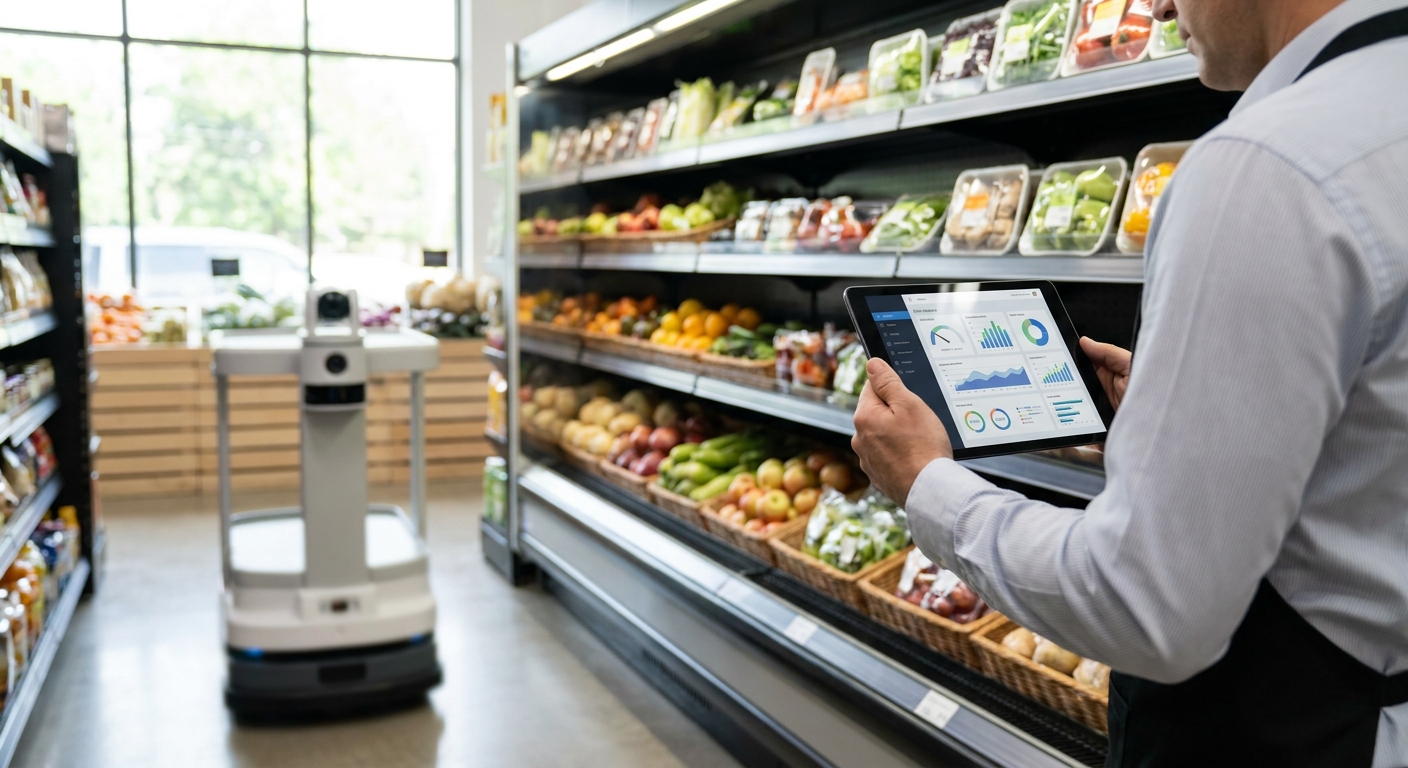
AI-driven replenishment platforms pull sales velocity, seasonality, and vendor lead times into one forecast, and the accuracy gap shows up fast: aggregated 2026 data on AI grocery ecommerce adoption puts inventory accuracy at 95% for stores running automated demand forecasting, against the 70-80% typical of spreadsheet-based reordering. That gap is the difference between a full shelf and a lost sale.
The same data set ties automated merchandising and inventory workflows to roughly $113B in efficiency gains across the grocery sector for 2026 — stockout reduction, shrink reduction, and labor hours redirected away from manual counts. None of that requires a full enterprise system. It requires a workflow, built in the right order.
What you'll need
- POS and ecommerce order history — minimum 12 months of SKU-level sales data, ideally synced through a platform like Local Express that already connects ordering, delivery, and in-store data
- Vendor lead time data — actual delivery windows per supplier, not contract terms
- Waste and shrink logs — even a basic spreadsheet of what got thrown out and when
- Category-level margin targets — so the workflow knows what to protect first
- A buyer or ops lead who reviews exceptions — full automation without a human checkpoint fails on promotions and weather
- 2-4 weeks for the first calibration cycle before you trust the outputs
The steps
1. Audit your current replenishment data
Before any AI model touches your inventory, find out what data actually exists and where it lives. Most independent grocers have POS sales data, but waste logs and vendor lead times sit in someone's head or a paper binder.
Pull 12 months of SKU-level sales history, cross-reference it against known stockout dates, and flag any SKU with more than 20% variance between what sold and what should have sold based on foot traffic. That variance list is your starting point for calibration.
Common mistake: starting the AI model on 3 months of data because that's what's easy to export. Seasonality gets missed and the first forecast cycle overcorrects on slow-movers.
2. Connect POS and ecommerce data to a demand forecasting engine
The forecasting engine needs one unified feed, not three disconnected exports. If your store runs both in-store POS and an online ordering channel, those two data streams have to merge before any model can generate a reliable signal — a platform that unifies commerce data, rather than bolting ecommerce onto a separate system, removes this step entirely.
Run the first forecast pass against a category you know well — dairy or produce — and manually check the output against what actually happened last month. If the forecast is off by more than 15% on a stable category, the data feed has a gap, not the model.
Expected outcome: a working demand curve per SKU, refreshed daily, that flags reorder points automatically instead of on a fixed weekly schedule.
3. Set service-level targets and safety stock rules by category
A single storewide safety stock rule — say, "keep 5 days of coverage" — fails because a case of milk and a case of canned beans do not behave the same way. Perishables need tighter buffers and faster turn; shelf-stable goods can run leaner reorder points with looser timing.
Set a service-level target (95% in-stock rate is a reasonable default for 2026 independent grocery operations) per category, then let the model calculate safety stock against that target using lead time variability, not just average lead time.
Common mistake: copying safety stock formulas from a big-box retailer playbook. Independent grocers run tighter cash cycles and can't carry 30 days of buffer stock on slow-moving specialty items.
4. Automate purchase order generation with vendor lead-time buffers
Once reorder points are set, the workflow should generate draft purchase orders automatically when a SKU crosses its threshold — not wait for a buyer to notice. This is where order management software earns its place in the stack: it ties the reorder trigger directly to the vendor record and lead time, so the PO reflects a real delivery date, not a guess.
Build in a lead-time buffer of at least 1.5x the vendor's historical average variance, not their quoted lead time. Vendors quote best-case; your buffer needs worst-case.
Expected outcome: draft POs waiting for one-click approval instead of a buyer building them from scratch every morning.
5. Layer in real-time signals for promotions and local events
A demand forecast built purely on historical sales misses anything unusual — a local event, a weather event, a promotion. Layer these signals in as manual overrides that temporarily adjust the forecast multiplier for affected SKUs.
For multi-location chains, this step matters even more: a promotion running at one store shouldn't distort the replenishment forecast at a location three towns over. Structuring delivery zones and demand data separately by location — the same logic used in structuring delivery zones and fees for multi-store chains — keeps location-level signals from bleeding into each other.
Common mistake: applying a storewide promotion multiplier across every SKU instead of the specific items on promotion, which triggers over-ordering on unrelated categories.
6. Build an exception-based review workflow for buyers
Full automation without a human checkpoint is the fastest way to lose a buyer's trust in the system. Build the workflow so that 80-90% of reorder decisions execute automatically, and the remaining 10-20% — anything flagged as high-variance, new SKU, or above a dollar threshold — routes to a buyer for a five-minute review.
This is the step that determines whether the workflow survives past month two. Buyers who feel like the system replaced their judgment will quietly override everything; buyers who review exceptions stay bought in.
Expected outcome: a daily exception queue of 10-30 items instead of a full manual reorder cycle across hundreds of SKUs.
7. Monitor and recalibrate weekly
Check forecast accuracy against actual sales every week for the first two months, then move to a monthly cadence once the variance stabilizes under 10%. Recalibrate safety stock rules quarterly as seasonality shifts and vendor relationships change.
See a unified inventory workflow in action
Connect POS, ecommerce, and order management on one platform.
Troubleshooting
- Overstock keeps happening on perishables — safety stock is set storewide instead of by category; tighten the buffer specifically on high-spoilage SKUs and shorten the review cycle to daily.
- Forecasts miss badly during promotions — the model has no override layer; add a manual multiplier step (Step 5) before the promotion starts, not after sales data comes in.
- Vendor lead times are inconsistent week to week — the PO buffer is using quoted lead time instead of historical variance; recalculate using actual delivery dates from the last 90 days.
- Multi-location transfers get ignored by the workflow — the forecast engine is treating each store as isolated when a chain-wide view would catch a surplus at one location and a shortage at another; order management software built for multi-location chains solves this by showing cross-store inventory in one view.
- New SKUs have zero forecast accuracy — there's no sales history to model; default new SKUs to a manual review status for the first 60 days instead of trusting the AI forecast on day one.
- Buyers are overriding every automated PO — the exception threshold is set too tight, routing too much volume to manual review and eroding trust; widen the automatic-approval band and rebuild confidence with smaller wins first.
Tools and resources
- A unified commerce platform that connects POS, ecommerce, and delivery data in one feed — fragmented data is the single biggest reason AI replenishment forecasts fail in year one
- Order management software for multi-location grocery chains for chains coordinating replenishment across stores
- A vendor lead-time tracking sheet, updated from actual delivery dates rather than contract terms
- Weekly forecast-vs-actual variance reports, reviewed by whoever owns purchasing
What to do next
Once replenishment is running on autopilot for the back-of-house side, the next lever is the storefront itself — a slow, clunky ecommerce site undercuts every inventory gain by pushing customers to a competitor. Building a grocery ecommerce website without a developer covers the storefront side of the same unified data problem.
FAQ
What is AI inventory replenishment for grocery stores?
AI inventory replenishment for grocery stores uses sales history, vendor lead times, and demand signals to automatically generate reorder points and purchase orders instead of relying on manual counts. It typically pushes inventory accuracy toward 95% versus 70-80% for spreadsheet-based reordering.
How much does AI inventory replenishment cost for an independent grocer?
Cost depends on whether it's part of a broader unified commerce platform or a standalone forecasting tool, and pricing varies by store count and data integration needs. Check current platform pricing directly rather than relying on a single flat number.
Is AI replenishment better than manual reordering?
Yes, for accuracy and labor time: automated systems catch reorder points a buyer would miss on a weekly walk-through, and 2026 industry data ties automated merchandising to roughly $113B in sector-wide efficiency gains. Manual reordering still has a role for exception review and new SKUs with no sales history.
How long does it take to set up an AI replenishment workflow?
Expect 2-4 weeks for the first calibration cycle once POS and ecommerce data are unified, plus another 4-8 weeks of weekly monitoring before variance stabilizes under 10%. Multi-location chains take longer due to cross-store data reconciliation.
Does AI replenishment work for perishables and fresh categories?
Yes, but perishables need category-specific safety stock rules and tighter review cycles than shelf-stable goods. A single storewide buffer rule is the most common reason perishable overstock persists after automation goes live.
Can small independent grocers use AI replenishment, or is it only for big chains?
Independent grocers can run AI replenishment on a single-store or multi-store basis; the workflow scales down as easily as it scales up when it's built on a unified data feed rather than an enterprise-only system.
What data do I need before starting an AI replenishment workflow?
At minimum, 12 months of SKU-level POS sales history, vendor lead time records, and waste or shrink logs. Missing or fragmented data is the top reason first-pass forecasts come in inaccurate.
Should replenishment be fully automated or reviewed by a buyer?
Exception-based review works better than full automation: let 80-90% of reorder decisions execute automatically and route high-variance or new SKUs to a buyer for quick review. Full automation without a human checkpoint tends to lose buyer trust within the first two months.
One last thing
The workflow step most grocers skip is Step 6 — the exception queue — because it feels like it defeats the point of automating in the first place. It doesn't: the stores that keep buyers reviewing 10-30 flagged items a day are the ones still running the system a year later, while the ones that went full automation on day one are back to spreadsheets by month three.