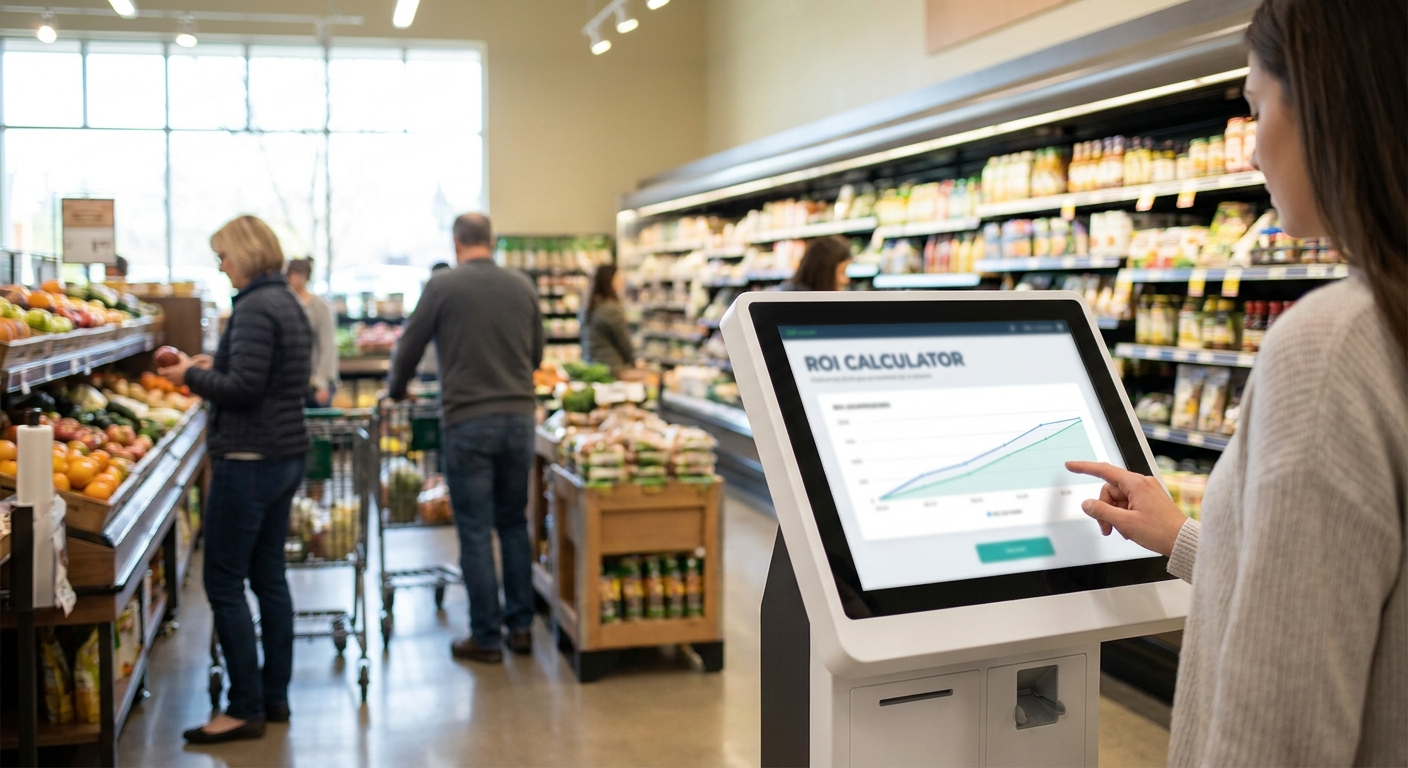
Calculating ROI on a self-service kiosk for prepared food or checkout isn't guesswork — it's a payback formula with four inputs: hardware cost, labor savings, throughput gain, and average order value lift. Run the math before you sign a contract, not after the kiosk sits idle in the deli corner.
- Self-service kiosk ROI in grocery stores hinges on labor hours saved, ticket size lift, and throughput per hour — model all three before buying.
- Kiosk hardware runs $3,000 to $8,000 per unit installed in 2026; most independent grocers hit payback in 9 to 18 months.
- A deli kiosk that lifts average order value 15% and cuts one labor hour per shift often pays for itself faster than a pure checkout kiosk.
- Verdict: run the 5-step formula below before evaluating vendors — buy only after the payback number clears 18 months.
Why this matters
Grocers keep buying kiosks off a vendor's promise of "reduced labor costs" without ever plugging in their own transaction volume. That's how a $6,000 kiosk sits unused by month four. The ROI calculation takes maybe 30 minutes with your own POS data, and it tells you whether a kiosk pays back in 9 months or never pays back at all.
Independent and regional grocers running prepared food counters or high-traffic checkout lanes are the segment where kiosk ROI actually pencils out in 2026 — thin-margin, high-labor-cost operations where shaving even 20 minutes of cashier time per shift compounds fast across a year.
What you'll need
- 90 days of POS transaction data for the counter or lane you're evaluating (deli, checkout, or MTO food)
- Current hourly labor cost for the staff position the kiosk would offset
- Average order value (AOV) for that counter, plus any known upsell attach rate
- A vendor quote with hardware, software licensing, and integration fees itemized separately
- A spreadsheet or the back of an envelope — this doesn't need software to calculate
If you're evaluating kiosks for a deli or made-to-order food counter specifically, pull transaction times too — the ROI math for prepared food ordering kiosks leans more on throughput than on straight labor replacement.
The steps
1. Pull your baseline transaction volume and labor cost
This sets the denominator for every calculation that follows. Pull 90 days of transactions for the specific counter or lane — not the whole store — because kiosk ROI is counter-specific, not store-wide.
Multiply the labor hours currently staffing that counter by the fully loaded hourly wage (wage plus payroll tax and benefits, typically 1.25x to 1.4x base pay). A cashier at $16/hour fully loaded often costs $20-$22/hour once you add the overhead.
Common mistake: using store-wide average transaction data instead of counter-specific numbers. A deli counter and a front checkout lane have completely different volume patterns, and blending them understates or overstates the ROI.
2. Calculate labor hours the kiosk actually offsets
A kiosk rarely eliminates a position outright — it reduces the hours needed to staff a counter during peak windows. Most independent grocers reassign, rather than cut, the freed hours to stocking or online order picking.
Estimate conservatively: if a kiosk handles 40% of transactions during peak hours, you're not saving 40% of a shift, you're saving the marginal labor needed to cover that volume without a second cashier. For most single-lane deli or checkout setups, that's 1 to 2 labor hours per shift.
Multiply hours saved per shift by shifts per week by 52 weeks, then by your fully loaded hourly rate from Step 1. That's your annual labor savings line.
3. Model the average order value lift
Kiosks with visual menus and suggested upsells consistently outperform a rushed human order-taker on attach rate — a customer staring at a touchscreen for 15 seconds adds a side or a drink more often than one dictating an order out loud. Industry-reported lift on AOV from kiosk ordering typically falls in the 10% to 20% range for prepared food counters.
Apply that percentage to your counter's current AOV and multiply by annual transaction volume. This is usually the single largest line item in the ROI calculation for MTO food kiosks — bigger than the labor savings in most cases.
Common mistake: ignoring AOV lift entirely and modeling the kiosk purely as a labor-replacement tool. That understates ROI by half for food-ordering use cases.
4. Add throughput gains during peak windows
A kiosk doesn't get tired, doesn't chat with regulars mid-rush, and doesn't need a break. During lunch rush or Saturday morning peak, that translates to more transactions processed per hour without adding a register.
Estimate the revenue captured from customers who would have walked away from a long line. If your counter loses even 5 transactions a day during peak hours to line abandonment, at a $9 average ticket that's over $16,000 a year recovered — money that never shows up in a POS report because it was never a transaction.
5. Total the hardware and software cost
Get the vendor quote itemized: hardware unit cost, software licensing (often monthly per kiosk), integration with your POS and inventory system, and any onboarding or training fee. Kiosk hardware in 2026 typically runs $3,000 to $8,000 per unit installed, with software licensing adding $100 to $300 per month per unit depending on the vendor.
Don't let a vendor bundle integration fees into a vague "setup cost" line — ask for the breakdown so you know what you're actually paying for versus what you're paying to make it talk to your existing systems.
6. Calculate payback period and compare vendors
Add Step 2 (labor savings) plus Step 3 (AOV lift) plus Step 4 (throughput capture) to get total annual return. Divide total hardware and first-year software cost from Step 5 by that annual return, times 12, to get payback in months.
A payback period under 12 months is a strong buy signal. 12 to 18 months is workable if the counter has room to grow volume. Past 18 months, the math says wait, renegotiate the vendor quote, or pick a lower-cost hardware tier.
Compare vendors on this single number — payback in months — rather than sticker price. A $7,500 kiosk that pays back in 10 months beats a $3,500 kiosk that pays back in 20 months.
See kiosk options built for grocery counters
Compare self-ordering kiosk setups for deli and specialty food counters.
Troubleshooting
- Payback period comes out negative or over 24 months — your counter's transaction volume is too low to justify kiosk hardware yet. Revisit after volume grows, or model a shared kiosk across two adjacent counters.
- Labor savings line is near zero — you're likely staffing the counter at minimum levels already. Shift the ROI case toward AOV lift and throughput capture instead of labor replacement.
- AOV lift assumption feels optimistic — run a 30-day pilot with one kiosk before committing to a full rollout. Real attach-rate data beats an industry-average estimate every time.
- Vendor quote has vague integration fees — ask specifically whether the kiosk connects to your existing POS and inventory system out of the box, or whether that's a custom integration billed separately.
- Kiosk sits unused after install — this is a training and placement problem, not a hardware problem. Staff need to actively direct customers to the kiosk for the first 4-6 weeks or adoption stalls.
Tools and resources
- Your POS transaction reports (90-day export, by counter or lane)
- A payback calculator — a spreadsheet with the six-step formula above works fine
- Vendor comparison sheet itemizing hardware, software, and integration costs separately
- For checkout-specific kiosks rather than food-ordering kiosks, see self-checkout kiosk options for independent grocery stores
- For stores running ecommerce and delivery alongside in-store kiosks, review how order management ties the two together
What to do next
Run the six-step formula against your own transaction data before you take a vendor call — you'll negotiate from a position of knowing your real numbers instead of trusting theirs. If the ROI case for a kiosk in your deli or checkout lane doesn't clear 18 months payback, the fix usually isn't a cheaper kiosk — it's rethinking whether that counter needs one at all this year.
Grocers also cutting reliance on third-party marketplaces for delivery should look at how the same unified-commerce logic applies there — the math is different, but the discipline of running the numbers before committing is identical. See how to reduce dependency on third-party delivery marketplaces for that calculation.
FAQ
What's the average ROI payback period for a grocery store self-service kiosk?
Most independent grocers see payback in 9 to 18 months in 2026, driven mainly by average order value lift and peak-hour throughput rather than pure labor replacement. Counters with low transaction volume often see payback stretch past 24 months.
How much does a self-service kiosk cost for a grocery store?
Hardware runs $3,000 to $8,000 per unit installed in 2026, with software licensing adding $100 to $300 per month per unit. Integration fees with your existing POS system are usually quoted separately and vary by vendor.
Do self-service kiosks actually increase average order value?
Yes — kiosks with visual menus and suggested upsells typically lift average order value 10% to 20% on prepared food counters compared to human order-taking. The lift comes from customers adding sides or drinks they wouldn't verbally request under time pressure.
Is a self-checkout kiosk better ROI than a self-ordering food kiosk?
It depends on the counter. Self-checkout kiosks return value mainly through labor hours saved, while self-ordering food kiosks return value mainly through AOV lift and throughput — food kiosks often show faster payback for delis and MTO counters specifically.
How many labor hours does a kiosk actually save?
Most single-lane deli or checkout kiosks save 1 to 2 labor hours per shift, not a full position, because staff get reassigned rather than cut. Model conservatively using your own peak-hour staffing pattern.
Should a small independent grocer buy a kiosk or wait?
Buy if your six-step payback calculation clears 18 months and your counter has stable or growing transaction volume. Wait if labor savings and AOV lift together don't cover the hardware and software cost within two years.
What's the biggest mistake grocers make calculating kiosk ROI?
Modeling the kiosk purely as a labor-replacement tool and ignoring average order value lift, which is usually the largest return line for food-ordering kiosks. Store-wide averages instead of counter-specific data is the second most common error.
Can a kiosk pay for itself through throughput alone?
Sometimes, especially at counters with heavy line abandonment during peak hours. Recovering even 5 lost transactions a day at a $9 average ticket adds over $16,000 in annual revenue that never shows up in existing POS reports.
One last thing
The AOV lift line in Step 3 gets ignored more than any other input in this formula, and it's usually the difference between a kiosk that pays back in 10 months and one that never clears its own hardware cost. Run that number before you run anything else.