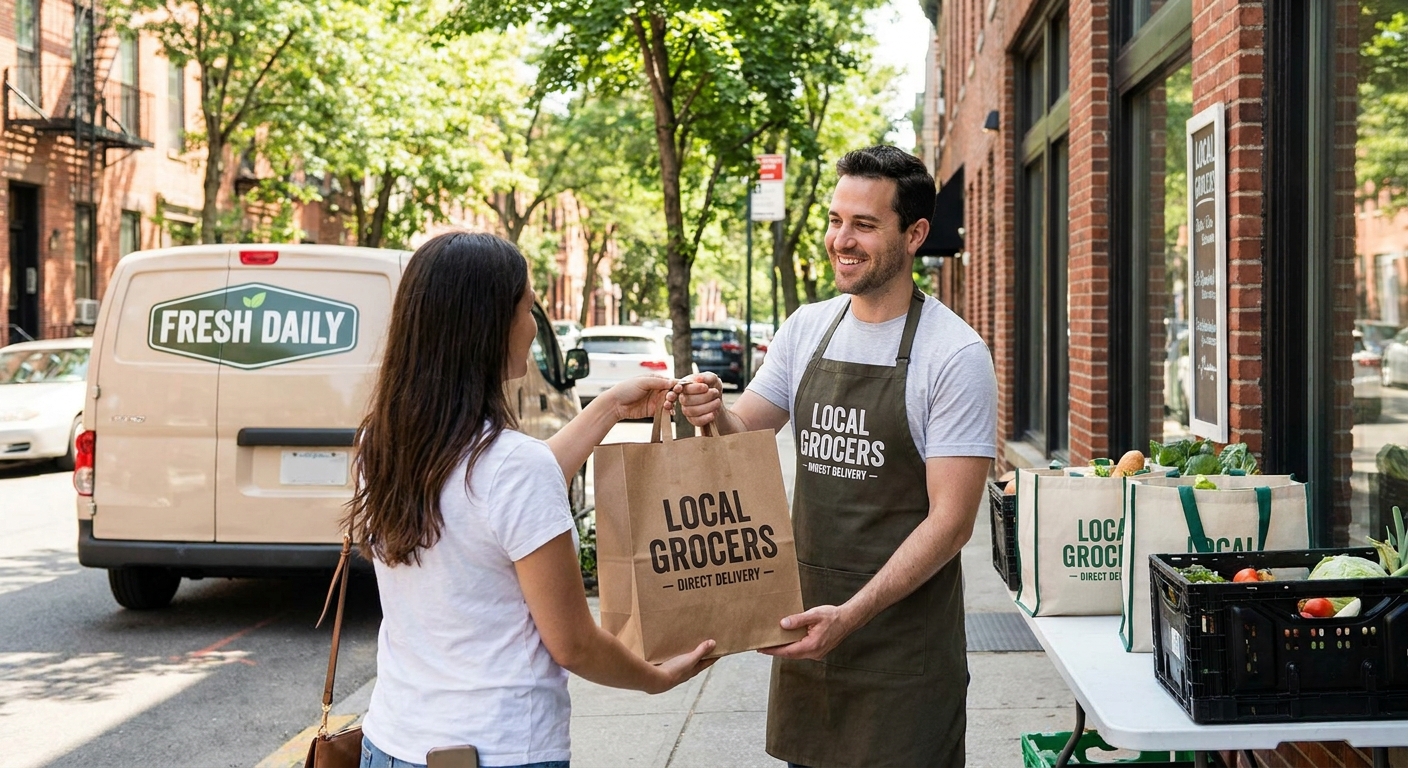
Same-day grocery delivery without third-party apps means running your own ordering site, your own dispatch, and your own drivers instead of paying DoorDash or Instacart a cut of every basket. This guide walks through the exact steps to get a same-day program live in 2026 without handing your customer list to a marketplace.
- Same-day grocery delivery without third-party apps runs on your own storefront, dispatch, and driver pool, not a marketplace app. Build it in-house.
- A white label grocery ecommerce platform replaces per-order commissions with a flat subscription, which pays off past roughly 200 weekly delivery orders.
- Keep delivery zones under 5 miles and pick windows under 90 minutes for a realistic single-store same-day launch in 2026.
- Skipping third-party apps means you keep the customer's email, phone, and order history. That data is the whole point.
Why this matters
Every order placed through a third-party marketplace app costs the grocer 15% to 30% in commission, and the marketplace keeps the customer relationship, not you. The shopper's name, order history, and repeat-purchase pattern belong to Uber Eats or Instacart, not your store.
Running delivery through your own Local Express storefront and dispatch flips that. You keep the margin, you keep the data, and you control the delivery promise instead of an algorithm deciding whether your store shows up in someone's app feed.
The tradeoff is real: you take on dispatch, driver management, and delivery zone math yourself. This guide is the operational playbook for doing that without third-party apps in the mix.
What you'll need
- A branded ecommerce storefront or app that accepts delivery orders directly (not a marketplace listing)
- An order management system that routes orders to pickers in real time
- A driver pool — employees, contracted drivers, or a mixed model
- A defined delivery radius and delivery fee structure
- POS or inventory integration so online stock matches shelf stock
- For stores with a prepared food counter, a way to route hot-bar and deli orders separately — prepared food ordering kiosks handle this without adding a third app to the stack
- 60 to 90 days to pilot before a full storewide rollout
The steps
1. Pick a white label ordering platform, not a marketplace listing
The first decision determines everything downstream. A marketplace listing (DoorDash Marketplace, Instacart) puts your store inside someone else's app; a white label platform puts your brand on your own storefront and app.
Look for a platform built specifically for grocery, not adapted from restaurant delivery software — grocery orders average 40+ line items versus 3-5 for a restaurant order, and picking logic has to account for substitutions, weight-based produce, and cold chain items.
Common mistake: picking a generic ecommerce platform (Shopify plugin, restaurant delivery app) and bolting on grocery features later. Rebuilding six months in costs more than choosing correctly the first time.
2. Set your delivery radius before you set your delivery fee
A 5-mile radius keeps drive times under 20 minutes for most single-location stores, which is what makes a 60 to 90 minute delivery window realistic. Push past 8 miles and your same-day promise turns into next-day reality.
Price the delivery fee to cover driver cost plus a margin, not to match whatever the marketplace apps charge. You're not competing on fee anymore — you're competing on the fact that the order goes straight to your own picking queue instead of a third-party dispatch board.
3. Connect your inventory feed so online stock matches shelf stock
Nothing kills a same-day delivery program faster than an order confirmation for an item that sold out an hour earlier. Sync your POS or inventory system to the storefront so stock counts update in real time, or close to it.
For multi-department stores — produce, deli, dairy — set substitution rules ahead of time (customer picks 2-3 backup items at checkout) instead of leaving it to a picker's judgment call mid-shift.
Common mistake: launching with a nightly inventory sync instead of real-time. A 12-hour lag between shelf and site turns into daily out-of-stock complaints.
4. Build the pick-and-pack workflow around your store layout
Assign picking zones (produce, dry goods, dairy, deli) so one order doesn't send a single picker walking the entire floor. Order management software should route orders to whichever picker or shift is free, not just first-in-first-out.
Target a 20 to 30 minute pick time for a standard 30-40 item order. Anything past 45 minutes for picking alone eats into the delivery window before the driver even leaves the lot.
5. Set up your own dispatch instead of routing through a marketplace driver network
This is the step that actually removes the third-party app from the equation. Options include an employee delivery fleet, a contracted local courier service, or a delivery management tool that assigns your own drivers to routes.
A dispatch system should batch nearby orders when volume allows, calculate the fastest route, and give the driver a single app to follow — not a text message with an address.
If your delivery window slips past 90 minutes, you're competing with the marketplace apps you were trying to avoid.
6. Train staff on the full order lifecycle, not just picking
Staff need to know how to handle a substitution call, a missing item, and a driver running late — all without escalating to a marketplace support line, because there is no marketplace support line anymore. It's your support line now.
Run a two-week internal pilot with staff-only test orders before opening delivery to real customers. Catch workflow gaps before a customer does.
7. Launch to a limited zone, then expand
Start same-day delivery in the tightest radius around your store — often a 2 to 3 mile zone for the first 30 days — and expand outward only once pick times and delivery windows are consistently hitting target. A staged rollout catches capacity problems while the blast radius of a bad week is small.
For stores that also run a self-checkout or self-ordering counter, the best self-ordering kiosk for grocery and specialty food stores can absorb in-store pickup traffic while delivery orders route separately, keeping the two workflows from colliding at the front counter.
Troubleshooting
- Orders arrive faster than pickers can fill them. Cap the number of concurrent delivery slots per hour until picking speed catches up — an unlimited order queue with a fixed picking staff is the most common cause of late deliveries.
- Drivers are idle between batches. Add a pickup-only option for nearby customers so the same driver pool covers both delivery and curbside without downtime.
- Substitutions cause repeat complaints. Move substitution preferences to checkout instead of leaving them to picker discretion — customers who set their own backup items complain less than customers surprised by a swap.
- Delivery fee pushback from customers used to free delivery apps. Reframe the value: direct ordering skips marketplace markup on individual items, which the apps often bake into pricing to offset their own commission.
- Inventory sync lags during peak hours. Batch sync frequency should increase during your busiest 2-3 hours of the day, not stay flat across a 24-hour cycle.
- Multi-department stores struggle with picking coordination. Assign a single order captain per shift to route multi-zone orders, rather than expecting pickers to self-coordinate.
Move delivery off marketplace apps
See how a white label storefront and dispatch replace commission-based delivery apps.
Tools and resources
- A white label grocery ecommerce platform for the storefront, app, and order routing
- Order management software that connects picking, dispatch, and delivery in one workflow
- POS or inventory integration for real-time stock accuracy
- For regional chains running delivery across multiple locations, white label grocery delivery apps for regional chains cover multi-store dispatch and zone management in one system
- For convenience-format stores adding delivery alongside walk-in traffic, white label delivery apps for convenience stores are built for smaller basket sizes and faster pick times
- A driver-facing route app, whether built into the platform or a standalone dispatch tool
What to do next
Once same-day delivery is stable in your core zone, the next lever is retail media and loyalty data captured directly through your own storefront — something a marketplace app never hands back to you. Review your order history data monthly for repeat-customer patterns before deciding whether to expand delivery radius, add a second driver shift, or open a new pickup zone.
FAQ
Can a single independent grocery store run same-day delivery without third-party apps?
Yes, a single store can run same-day grocery delivery without third-party apps using a white label ordering platform and its own driver pool. Most single-location launches start with a 2 to 5 mile delivery radius to keep pick-and-deliver times under 90 minutes.
How much does it cost to launch delivery without DoorDash or Instacart?
Costs vary by platform and driver model, but the ongoing expense is typically a flat subscription plus driver wages, replacing the 15% to 30% per-order commission marketplace apps charge. Check current platform pricing directly since subscription tiers vary by store size.
Is same-day delivery without third-party apps better than using Instacart or DoorDash?
It's better for margin and customer data ownership, since you keep both instead of sharing them with a marketplace. It requires more operational setup upfront, including dispatch and driver management that a marketplace app would otherwise handle.
How long does it take to launch same-day grocery delivery?
A staged rollout typically takes 60 to 90 days from platform selection to a stable full-store launch. The first 30 days are usually a limited-zone pilot before expanding delivery radius.
What delivery radius works best for same-day grocery delivery?
A 5-mile radius keeps drive times under 20 minutes for most stores, supporting a realistic 60 to 90 minute delivery window. Radii past 8 miles push same-day promises closer to next-day reality.
Do I need a separate app for delivery drivers?
Most white label platforms include a driver-facing route app as part of the order management system, so a separate standalone app usually isn't needed. Confirm this is included before committing to a platform.
What's the biggest mistake grocers make launching same-day delivery?
Syncing inventory nightly instead of in real time is the most common mistake, since it causes online orders for items that already sold out on the shelf. Real-time or near-real-time sync prevents most stockout complaints.
Can prepared food and deli orders run through the same same-day delivery system?
Yes, prepared food and deli orders can route through the same delivery system when the platform supports separate picking workflows for hot-bar and made-to-order items. Kiosk-based ordering for the deli counter keeps that workflow from bottlenecking the rest of the store.
One last thing
The grocers who succeed at same-day delivery without third-party apps in 2026 aren't the ones with the biggest driver fleet — they're the ones who capped their delivery radius tight enough that pick time, not drive time, became the bottleneck they had to solve first. Solve picking speed before you solve delivery speed; the second problem is easier once the first one is fixed.