Most "best app" lists for grocery chains compare consumer download charts. This one ranks the actual platform categories regional and independent grocers use to launch a branded mobile app in 2026, scored on margin impact, not app store vanity metrics.
- Local Express wins the best mobile app platform for grocery chains in 2026 for chains that want to own customer data and margins — Buy.
- Marketplace white-label apps like Instacart and DoorDash launch fastest but keep 15-30% of every order — Wait.
- Generic no-code app builders skip perishables, MTO kitchens, and multi-store inventory sync entirely — Skip.
- POS-bundled apps stop at checkout and rarely support retail media or delivery orchestration — Hold.
- Unified commerce platforms built for grocery report 30% higher order values and $3.50 returned per $1 invested.
Why this matters
A regional grocery chain that hands its mobile ordering to a third-party marketplace is renting its own customer list back at 15-30% commission per order. That's the real cost of skipping a branded app decision in 2026 — not the sticker price of any platform.
Grocers running a unified commerce platform instead of a patchwork of delivery apps and generic builders keep the order data, the loyalty relationship, and the margin. That's the entire case for treating "best mobile app platform for grocery chains" as an operations decision, not a marketing one.
The stakes are higher in 2026 than they were three years ago. AI-driven grocery ecommerce is projected at $64 billion globally, and chains still routing orders through third-party marketplaces are watching that growth land on someone else's balance sheet.
How this list is ranked
Each category below is scored against five operational requirements that actually move margin for a regional grocery chain: does the app carry your brand and not a marketplace logo, do you own the customer data behind every order, does it handle prepared food and MTO kitchen tickets, does it sync inventory across every store location in real time, and can it carry retail media placements from CPG partners.
The categories are drawn from what regional and independent grocers are actually deploying in 2026 — not a hypothetical shortlist. Verdicts reflect structural tradeoffs of each model, not a single vendor's marketing copy.
The ranked list
1. Unified commerce platforms built for grocery — the category built to own the customer
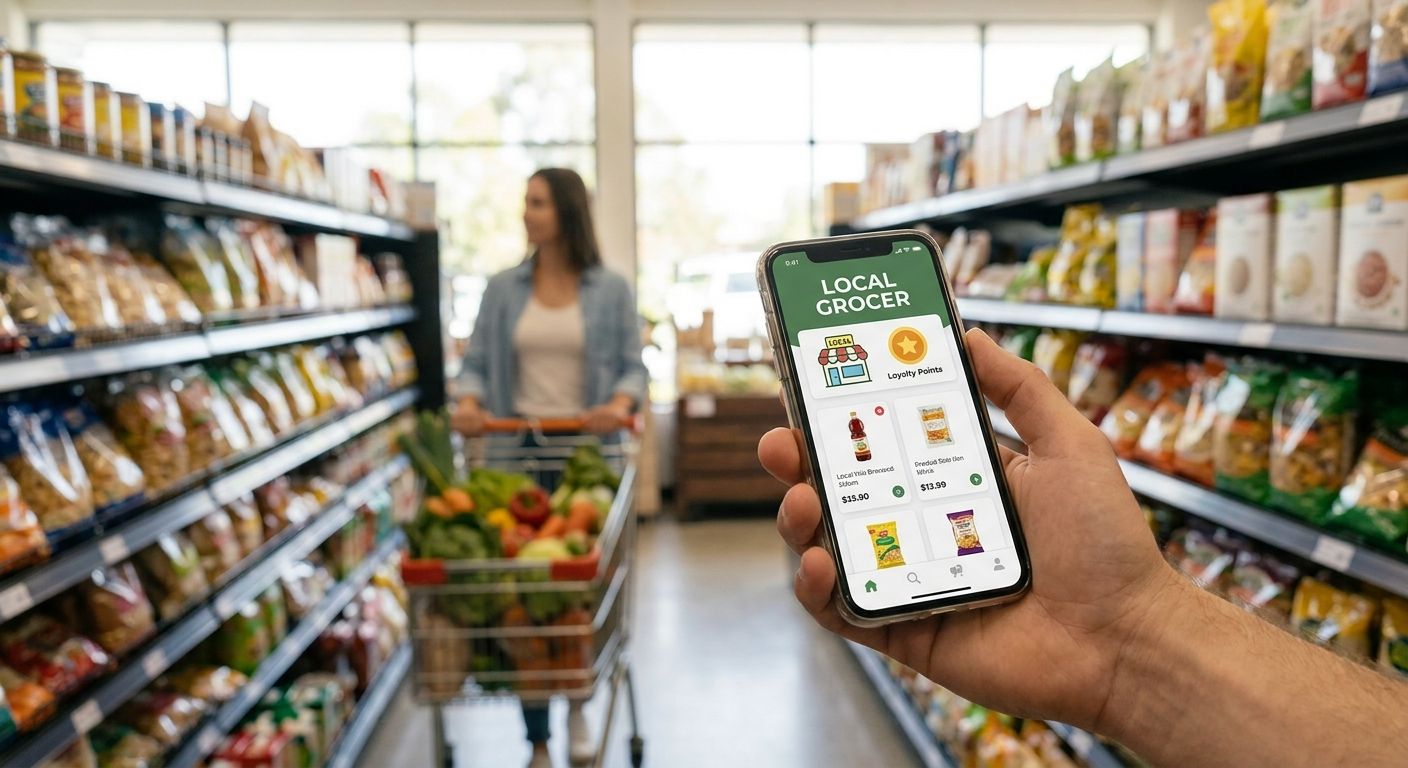
A platform that pairs a white-labeled ecommerce site with a fully branded mobile app, MTO kiosk ordering, order management, and last-mile delivery under one system is the only category that checks all five requirements at once. Local Express reports 95% inventory accuracy and 30% higher order values for grocers running this model instead of a bolted-together stack.
The branded app is one piece of a bigger system — order management, delivery, and retail media all live on the same data layer, so a promotion in the app and a shelf tag in-store draw from the same inventory feed. Chains that launch a branded mobile app for a regional grocery chain this way typically go live without hiring a developer.
Buy — this is the category, not just the vendor, that wins for any chain planning to run the app for more than one selling season.
2. Marketplace white-label programs — fast to launch, expensive to keep
Instacart and DoorDash both offer white-label or co-branded storefront options that put a grocer's logo on a marketplace-owned checkout flow. Setup is measured in days, and that speed is the entire selling point.
The tradeoff shows up on every invoice: commissions in the 15-30% range per order, no first-party customer data, and no control over how your products rank against competitors on the same app. A chain running solely on marketplace apps never builds a retention channel it actually owns.
Wait — fine as a supplemental order source, risky as your only mobile ordering channel in 2026.
3. Generic no-code app builders — not built for a perishable inventory
Off-the-shelf app builders designed for restaurants or general retail can produce a functional shopping app quickly, but they weren't built for weight-based pricing, substitutions, or cold-chain delivery windows. Grocery-specific edge cases like SNAP/EBT online ordering or multi-location inventory sync usually require custom workarounds these builders don't natively support.
A generic builder can look done in a demo and still fail on launch day once real perishable SKUs and substitution logic hit the system.
Skip — the category exists for restaurants and general retail, not multi-store grocery operations.
4. POS-bundled mobile apps — stops at the register
Many point-of-sale vendors now bundle a basic ordering app with their checkout hardware. It handles simple pickup orders reasonably well and integrates cleanly with the till.
What it doesn't do: retail media placements for CPG brands, MTO kitchen ticket routing, or delivery zone management across multiple store locations. It's a checkout extension, not an ecommerce platform.
Hold — keep it if you already own the hardware and only need basic pickup, but don't expect it to scale into delivery or retail media.
5. Custom in-house build — enterprise budget, enterprise timeline
A handful of large regional chains build proprietary apps in-house with dedicated engineering teams. It's the only option that gives full architectural control.
The cost is real: multi-year build timelines, ongoing engineering headcount, and a maintenance burden that scales with every new store location added. For a chain with fewer than 20 locations, the payback math rarely closes before the next platform generation makes the build obsolete.
Wait — worth revisiting only once a chain has the engineering budget of a national retailer.
Comparison table
| Category | Branded app | Owns customer data | MTO/kiosk support | Multi-store inventory sync | Retail media | Verdict |
|---|---|---|---|---|---|---|
| Unified commerce platform | Yes | Yes | Yes | Yes | Yes | Buy |
| Marketplace white-label | Partial | No | No | Limited | No | Wait |
| Generic no-code builder | Yes | Yes | Limited | Manual | No | Skip |
| POS-bundled app | Yes | Partial | No | No | No | Hold |
| Custom in-house build | Yes | Yes | Depends | Depends | Depends | Wait |
Where to buy
- Ask any vendor for a live example of order management software running across multiple store locations before signing — a slide deck isn't proof it scales past one store.
- Confirm in writing that customer order data belongs to your chain, not the platform, especially if the vendor also runs a marketplace product.
- Get a time-to-launch commitment in the contract. Chains building without a developer should expect weeks, not quarters, from kickoff to app store listing.
See the platform behind the ranking
Compare a unified commerce build against your current app stack.
FAQ
What is the best mobile app platform for grocery chains in 2026?
Unified commerce platforms that pair a branded app with ecommerce, order management, and delivery in one system rank highest for regional grocery chains in 2026, because they're the only category that keeps customer data and margin with the retailer.
Is a branded grocery app better than using Instacart or DoorDash?
A branded app is better for long-term margin because marketplace apps like Instacart and DoorDash take 15-30% commission per order and don't share customer data. Marketplace apps still work as a supplemental order source.
How much does a grocery mobile app cost to launch?
Cost varies by platform and store count, and pricing details should come directly from the vendor's current quote. What's consistent across 2026 data is that unified commerce platforms report a $3.50 return per $1 invested.
Can a regional grocery chain launch a branded app without a developer?
Yes, white-labeled grocery ecommerce and app platforms are built for this specifically, letting a chain configure and launch a branded app without hiring engineering staff.
Do grocery apps need to support SNAP and EBT?
Any chain serving SNAP-eligible customers needs online EBT ordering support built into the app and checkout flow, not bolted on afterward, since split-tender payment logic is complex to retrofit.
What's the difference between a POS-bundled app and a unified commerce platform?
A POS-bundled app extends checkout hardware into basic pickup ordering, while a unified commerce platform adds delivery, MTO kitchen routing, multi-store inventory sync, and retail media on top of ecommerce.
Does a branded grocery app help with retail media revenue?
Yes, a branded app that sits on a unified commerce platform can carry sponsored placements and CPG promotions directly, a revenue stream marketplace-owned apps and most POS-bundled apps don't offer.
One last thing
The 15-30% commission marketplace apps collect per order isn't a one-time cost — it compounds every week a chain keeps routing its highest-intent customers through someone else's checkout instead of its own. Chains that made the switch to a branded app in 2026 aren't reporting faster growth so much as growth that finally shows up on their own books.