Grocery delis that still scrawl pastrami orders on a paper ticket are bleeding prep time to the counter down the street running a kiosk. This guide breaks down what a prepared food ordering kiosk actually needs to do for a grocery deli in 2026, which configurations fit which counter type, and what to skip when a vendor pitches you a generic restaurant kiosk instead.
- A prepared food ordering kiosk pays off once a deli counter clears roughly 40+ made-to-order tickets a day.
- Local Express's self-ordering kiosk routes weight-based and MTO orders straight to a kitchen display — Buy for full-service delis.
- Seafood and halal counters need menu logic a generic POS kiosk skips entirely — check segment-built setups first.
- Skip any kiosk that can't confirm order status fast; a stalled queue defeats the whole point of self-ordering.
Why this matters
A deli counter running on paper tickets or a single register queue caps its own throughput no matter how good the food is. Every order that requires a clerk to key it into the register by hand adds 20-40 seconds of dead time per ticket during a lunch rush, and that adds up fast once a line forms.
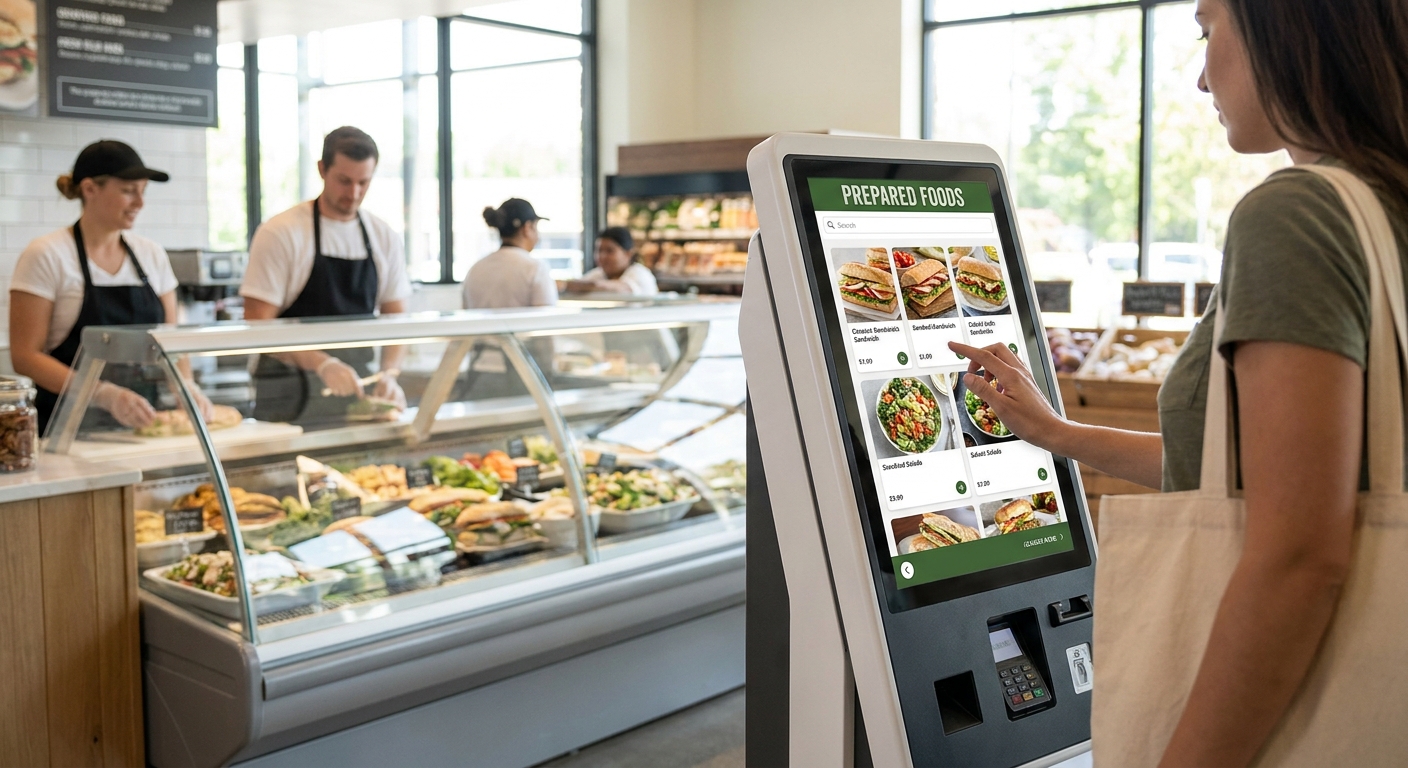
A prepared food ordering kiosk moves that keying step to the shopper, sends the ticket straight to the prep station, and frees staff to actually make food instead of typing orders. For grocery delis specifically — not quick-service restaurants — the kiosk also has to handle weight-based pricing, substitutions, and multi-language menus that a bolted-on restaurant POS kiosk was never built for.
Who this is for
This guide is for grocery store owners, deli managers, and specialty food retailers evaluating a self-ordering kiosk for a prepared food counter — full-service delis, seafood counters, hot bars, and halal or Middle Eastern grill counters that run made-to-order tickets alongside grab-and-go. If your counter does under 40 MTO tickets a day, a kiosk is probably premature; below that volume a staffed counter with a clear specials board usually wins on cost.
What to look for in a prepared food ordering kiosk for grocery delis
Real-time order routing to the kitchen
The kiosk has to push the ticket to a kitchen display or printer the moment the shopper confirms, with no manual re-entry step. Any system that still requires a clerk to retype the order into a second screen has just moved the bottleneck instead of removing it.
Weight-based and made-to-order item handling
Deli counters sell sliced meats and cheeses by the pound, not the unit — a kiosk built for burgers and fries usually can't prompt for "quarter pound, half pound, or one pound" without a workaround. Confirm the menu builder supports weight tiers and per-item customization (extra cheese, no mayo, sliced vs shaved) before signing anything.
Multi-language ordering support
A deli in a neighborhood with a large Spanish-, Arabic-, or Urdu-speaking shopper base loses sales the moment the kiosk only speaks English. Multi-language screens aren't a nice-to-have here — they're the difference between a kiosk that gets used and one shoppers avoid.
POS and loyalty integration
The kiosk needs to sit on top of the store's existing POS and loyalty program, not next to it as a separate island. Orders that don't sync to loyalty points or store credit create reconciliation headaches at close-out every single night.
Wait-time and queue transparency
Shoppers who can't see where their order stands will walk to the register and ask, which erases the labor savings the kiosk was supposed to create. A visible order-status screen or SMS ping keeps the line moving without staff intervention.
Top picks by counter type
The safe pick — full-service deli and prepared foods counter. A deli running rotisserie chicken, sliced meats, hot bar, and sandwich-to-order needs a kiosk built for grocery, not a repurposed QSR terminal. Local Express's self-ordering kiosk for grocery and specialty food stores handles weight-based pricing and routes tickets directly to the prep station. Verdict: Buy for any deli clearing 40+ tickets a day.
The specialist — seafood and fresh-cut counters. Fresh fish and shellfish orders come with substitution requests (filleted vs whole, size swaps) that a generic kiosk menu builder chokes on. The seafood market ecommerce and ordering setup is built around exactly that kind of variable, made-to-order item. Verdict: Buy if the counter does custom cuts regularly; Consider if it's mostly pre-packed.
The niche win — halal and Middle Eastern grill counters. Grill and kabob counters often run on a smaller staff during prayer-time gaps, which is exactly when order volume backs up without a kiosk. The halal and Middle Eastern grocer ordering platform covers Arabic-language menus and the counter-specific item logic these grills need. Verdict: Consider — strong fit for counters with a defined prayer-time staffing dip.
“If the kiosk can't route a half-pound order to the right prep station by itself, it isn't a kiosk — it's just a screen.”
What to avoid
- Restaurant kiosks retrofitted for grocery. They handle whole-item orders fine but choke on weight-based deli pricing and bulk substitutions — the menu logic simply wasn't built for a scale.
- Kiosks with no kitchen display integration. If a runner still has to walk a printed ticket to the prep station, you've added a screen without removing the actual bottleneck.
- Single-language kiosks in diverse shopper markets. A kiosk shoppers can't read in their own language gets ignored, and the counter reverts to full staffing anyway.
Verdict comparison
| Counter type | Best for | Order routing | Multi-language | Verdict |
|---|---|---|---|---|
| Full-service deli & prepared foods | Rotisserie, hot bar, sandwich-to-order | Direct to kitchen display | Yes | Buy |
| Seafood & fresh-cut counter | Custom cuts, made-to-order shellfish | Direct to prep station | Yes | Buy |
| Halal & Middle Eastern grill | Kabob/grill counters, prayer-time gaps | Direct to kitchen display | Arabic/Urdu supported | Consider |
| Generic QSR kiosk retrofit | Not built for grocery deli workflow | Manual re-entry | Limited | Skip |
See the kiosk built for grocery delis
Check fit for your counter volume and menu before you buy.
FAQ
What is a prepared food ordering kiosk for grocery stores?
It's a self-service touchscreen that lets shoppers place made-to-order deli, hot bar, or seafood orders directly, routing the ticket to the kitchen without a clerk keying it in manually. In 2026 the strongest versions handle weight-based pricing and multi-language menus, which restaurant-style kiosks generally can't.
How much does a deli ordering kiosk cost?
Pricing varies by vendor, hardware count, and how deep the POS integration goes, so check current pricing directly with a provider rather than relying on a flat industry number. Ask specifically whether weight-based menu setup and multi-language screens are included or billed as add-ons.
Do self-ordering kiosks work for weight-based deli items?
Only if the menu builder was designed for it — a kiosk built for restaurants typically only handles per-unit pricing, not per-pound tiers. Confirm weight-tier support before buying if the counter sells sliced meats, cheese, or bulk items.
Can a kiosk integrate with our existing POS?
Most grocery-built kiosks are designed to sit on top of an existing POS and loyalty system rather than replace it. Ask for a live integration demo with your specific POS before signing, since "compatible" claims vary widely between vendors.
Is a kiosk better than a staffed counter for a small grocery deli?
Not always — a counter doing under roughly 40 made-to-order tickets a day usually doesn't generate enough volume to justify the hardware and integration cost yet. Above that threshold, the labor time saved on order entry starts outweighing the setup cost.
Do kiosks reduce wait times at the deli counter?
They cut the time a clerk spends keying in orders, which is often the biggest bottleneck during a lunch rush. The gain disappears if the kiosk lacks a visible order-status screen, since shoppers without status visibility tend to walk up and ask anyway.
Can a kiosk support multiple languages for a diverse grocery shopper base?
Yes, but only if the vendor built multi-language menus into the platform rather than bolting on translation after the fact. This matters most for halal, Middle Eastern, and Caribbean grocery counters serving shoppers who may not read English menus comfortably.
Do prepared food kiosks work for seafood and specialty counters?
They work well when the menu builder supports made-to-order customization like cut size and preparation style, which standard kiosks often lack. Seafood counters specifically need substitution logic built in, not added as a workaround.
One last thing
The counters that get the most out of a kiosk in 2026 aren't the biggest ones — they're the ones with the most repetitive, customizable orders per ticket. A rotisserie counter selling whole chickens off a warmer barely needs a kiosk; a sandwich counter juggling bread type, protein, and six condiment choices per order needs one badly. Match the kiosk to order complexity, not just counter size.