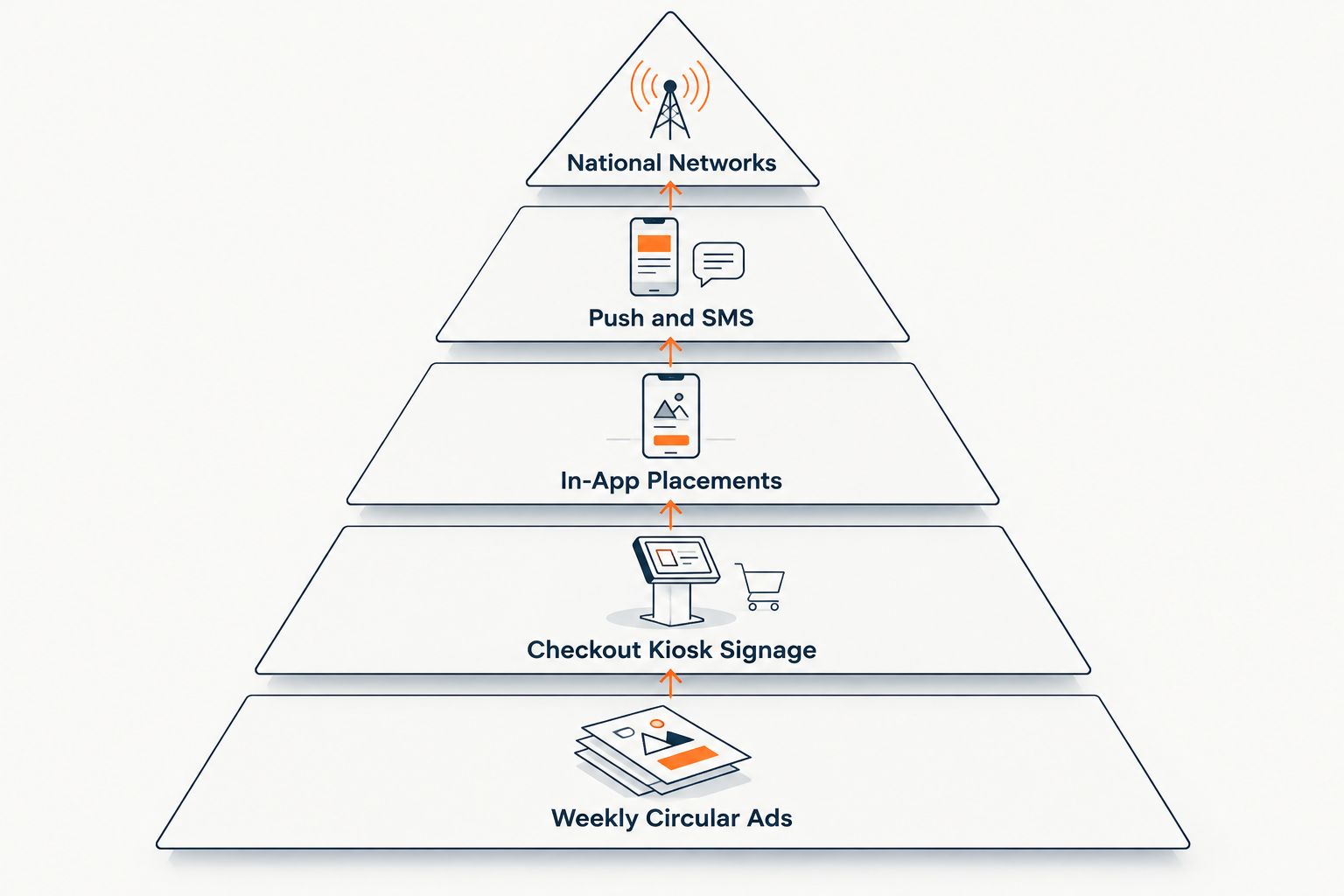
Retail media platform CPM for grocery depends on the channel, not the store's size — in-app sponsored placements, digital circulars, checkout kiosk signage, push and SMS campaigns, and national retail media networks all price CPG ad inventory differently in 2026. Best overall for regional and independent grocers: in-app sponsored product placements. Best budget option: digital weekly ad and circular sponsored placements. Best for in-store impulse categories: self-checkout kiosk digital signage.
- In-app sponsored product placements win overall on retail media platform CPM for grocery in 2026 — highest tier, most direct attribution.
- Digital weekly ad and circular sponsored placements are the lowest-cost entry point for CPG partners.
- Self-checkout kiosk digital signage sells strong CPM on impulse categories like candy, floral, and bakery.
- National retail media networks post premium CPMs but stay out of reach for most independent grocers.
- Push and SMS sponsored campaigns carry high CPM value but limited inventory due to send-frequency caps.
Why this matters
CPG brands now expect a grocer of any size to run a retail media program, not just chains with national scale. A regional or independent grocer that skips retail media in 2026 leaves a revenue line on the table — one that doesn't touch margin the way markdown promotions do, and one that runs on ad dollars a CPG brand was already going to spend somewhere.
The problem is CPM confusion. A CPG media buyer comparing a grocer's in-app placement rate to a checkout kiosk signage rate is comparing two different audiences, two different purchase-intent windows, and two different measurement standards. Local Express works with regional and independent grocers to turn owned app, web, and kiosk traffic into sellable retail media inventory instead of leaving that value on a national network's table.
An independent grocer doesn't need to wait for scale to start selling ad inventory. It needs to know which channel to sell first, and how to launch a retail media program without a national network is the practical starting question, not a five-year plan.
What makes the best grocery retail media platform for CPM
- Purchase-intent proximity — placements closer to checkout or cart post higher CPM because conversion is easier to prove to a CPG buyer.
- First-party shopper data depth — loyalty history, SNAP/EBT status, and past orders let a grocer justify a premium rate instead of guessing at one.
- Inventory scarcity — a limited number of high-visibility slots, like an app home screen or a kiosk display, commands more per impression than an unlimited email footer.
- CPG self-serve tools — brands spend more when they can set a budget and see performance without a phone call to a sales rep.
- Independent-retailer accessibility — a channel only matters for this audience if a regional or independent chain can turn it on without joining a national network.
- Cross-channel reach — CPM improves when the same sponsored placement runs across app, web, and kiosk instead of sitting in one channel alone.
Retail media platform CPM for grocery: at a glance
| Channel | Best for | Standout feature | CPM tier | Key limitation |
|---|---|---|---|---|
| In-App Sponsored Product Placements | Independent grocers overall | Combines loyalty data with checkout-adjacent placement | Premium | Needs baseline app or site order volume to attract CPG budget |
| Digital Weekly Ad & Circular Sponsored Placements | Budget-conscious grocers | Reaches shoppers before the list is built | Value | Harder to attribute to a sale than an in-app click |
| Self-Checkout Kiosk Digital Signage | In-store impulse categories | Captures attention at the point of decision | High | Limited to the physical footprint of self-checkout lanes |
| Push Notification & SMS Sponsored Campaigns | High-engagement targeted reach | Delivered straight to opted-in shoppers | Premium | Send-frequency limits cap total available inventory |
| National Retail Media Networks | CPG brands chasing scale | Largest combined audience across many stores | Premium (inaccessible) | Independent grocers can't join or replicate one alone |
Table order matches the ranking below. The "CPM tier" column is relative — premium means the channel commands the top rate a grocer can charge in 2026, not a fixed dollar figure, since rates move with season, category, and CPG demand.
1. In-App Sponsored Product Placements: best retail media channel for independent grocers overall
In-app sponsored product placements put a CPG brand's product in front of a shopper already inside a grocer's own ecommerce app or website — on the home screen, in search results, or inside a category page. Local Express runs this through in-app sponsored product placements built into the same platform that handles ordering, so the placement sits inside a purchase flow the shopper already trusts rather than a separate ad network. CPM lands in the premium tier because the grocer controls both the audience and the purchase data tied to it, and that combination is exactly what a CPG media buyer pays extra for.
In-App Sponsored Product Placements pros:
- Ties directly to loyalty and order history, so a CPG brand can see which placements drove actual baskets
- Runs on inventory the grocer already owns — no national network membership required
- Works across web, mobile app, and kiosk when the platform is unified
In-App Sponsored Product Placements cons:
- CPM stays low until the grocer has enough app or site order volume to interest a CPG media buyer
- Requires someone on staff, or a platform partner, to manage the CPG relationship and reporting
Best for: regional and independent grocers with an owned ecommerce app or website. Verdict: Buy — build this first.
2. Digital Weekly Ad and Circular Sponsored Placements: best retail media channel for budget-conscious grocers
A digital circular puts sponsored products inside the weekly ad a shopper flips through before building a list — the oldest grocery ad format, now running through digital weekly ad and circular software. CPM sits in the value tier because attribution is harder to prove than an in-app click, but reach is wide and setup cost is low, which makes it the easiest first sale to a CPG brand new to a grocer's program.
Digital Weekly Ad and Circular Sponsored Placements pros:
- Cheapest sponsored slot to sell to a CPG brand new to a retail media program
- Reaches shoppers before they've decided what to buy, when they're most open to a new brand
- Works for grocers without a mature app yet
Digital Weekly Ad and Circular Sponsored Placements cons:
- Attribution to an actual sale is weaker than app-based placements
- CPG brands with performance-marketing budgets often want proof a circular ad can't fully give them
Best for: grocers just starting a retail media program with a small CPG-brand roster. Verdict: Buy — lowest lift to launch.
3. Self-Checkout Kiosk Digital Signage: best retail media channel for in-store impulse categories
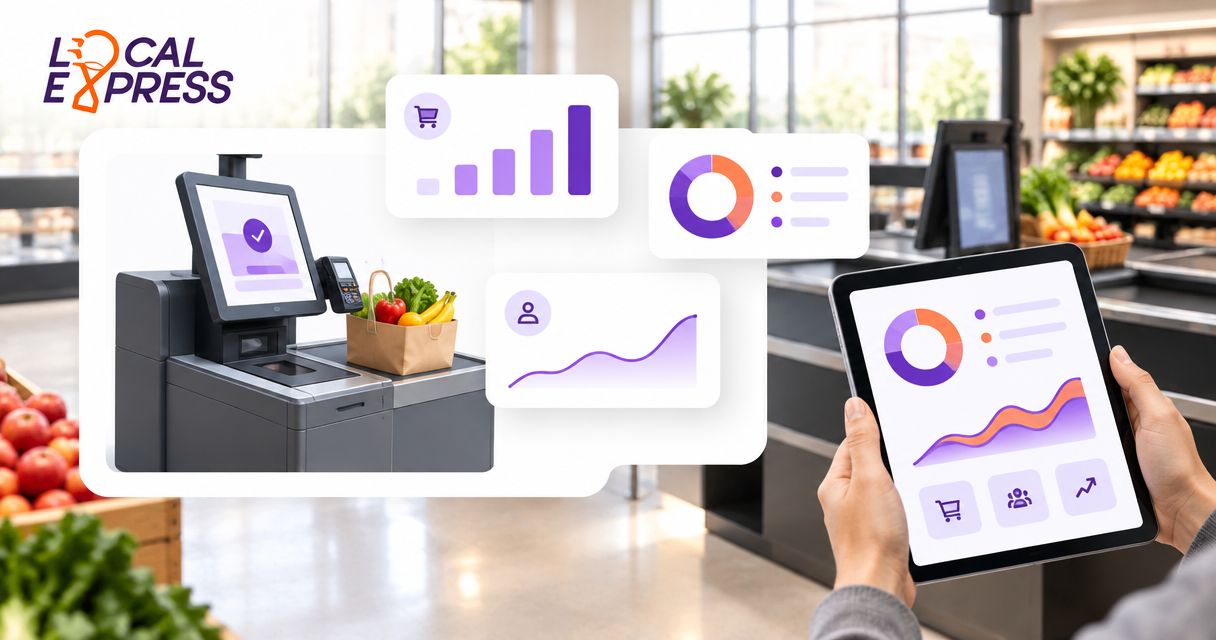
Self-checkout kiosk digital signage places a sponsored ad on the screen a shopper stares at while bagging groceries — the last screen before they leave the store. Self-checkout kiosk digital signage sells especially well for impulse categories like candy, floral, and bakery add-ons, where the buying decision happens in seconds, not minutes. CPM runs high because the screen has a captive audience and near-zero distraction from other ads.
Self-Checkout Kiosk Digital Signage pros:
- Highest attention window in the store — the shopper has nowhere else to look
- Pairs naturally with impulse and add-on categories that don't need a search query to sell
- No app download required, so it reaches every shopper who checks out
Self-Checkout Kiosk Digital Signage cons:
- Limited to the number of kiosks and lanes a store has installed
- Harder to rotate creative fast without a connected platform behind the screen
Best for: grocers with self-checkout lanes already installed and impulse categories to promote. Verdict: Buy — pairs well with the two channels above.
4. Push Notification and SMS Sponsored Campaigns: best retail media channel for high-engagement targeted reach
Push notifications and SMS put a sponsored offer directly on a shopper's phone, tied to segments built from purchase history or loyalty status. CPM lands in the premium tier because open rates on push and SMS beat email and in-app banners by a wide margin, but total inventory is capped — a grocer can only message a shopper so many times a week before opt-outs start climbing in 2026.
Push Notification and SMS Sponsored Campaigns pros:
- Highest engagement rate of any grocery retail media channel
- Segments cleanly by past purchase, so a CPG brand can target exact buyers
- Works even for shoppers who rarely open the app itself
Push Notification and SMS Sponsored Campaigns cons:
- Frequency caps mean only a handful of sponsored sends fit per week without hurting retention
- Overusing the channel for ads instead of order updates trains shoppers to ignore it
Best for: grocers that already have a loyalty program with clean purchase-history segments. Verdict: Hold — roll out after in-app and circular placements are running.
5. National Retail Media Networks: best retail media channel for CPG brands chasing scale, not for independents
National retail media networks aggregate ad inventory across hundreds or thousands of stores under one chain, giving a CPG brand the largest possible reach in a single buy. CPM sits at the top of the market because the audience size and first-party data scale are unmatched — but the network only exists because the chain owns enough stores to build one in the first place.
National Retail Media Networks pros:
- Largest combined audience any single retail media buy can reach
- Deep first-party data built from years of loyalty and transaction history
- Familiar format to CPG media buyers who already budget for it
National Retail Media Networks cons:
- Built and owned by chains with hundreds of locations — an independent or regional grocer cannot join or replicate one
- CPM this high prices out anything but the largest CPG ad budgets
Best for: national CPG brands with the budget and reach to buy at scale. Verdict: Skip — not attainable for independent or regional grocers, and not worth chasing in 2026.
How we ranked
Each channel above is scored against the six criteria from the section before the table: purchase-intent proximity, first-party data depth, inventory scarcity, CPG self-serve support, independent-retailer accessibility, and cross-channel reach. In-app sponsored product placements won overall because it's the only channel that scores well on all six for a regional or independent grocer in 2026. National retail media networks score highest on data depth and scarcity but fail the accessibility test outright — that's why it ranks last for this audience even though its CPM is the highest in the category.
Start your own retail media program
Sell sponsored placements to CPG brands without joining a national network.
Which retail media channel should you choose?
Start with in-app sponsored product placements if the grocer already has an app or ecommerce site — it's the highest-CPM channel that's actually within reach in 2026. Layer in digital circular ads for CPG brands testing a smaller budget, and add checkout kiosk signage once self-checkout lanes are installed. Push and SMS wait until loyalty segments are clean enough to target without training shoppers to opt out. Local Express customers typically build in that order — circular first, in-app next, kiosk and push once volume supports it. Skip chasing a national retail media network altogether; it isn't built for a single regional or independent chain, no matter how strong the store count gets.
FAQ
What's the best retail media platform CPM for grocery in 2026?
In-app sponsored product placements post the highest usable CPM for a regional or independent grocer in 2026, because they combine loyalty data with checkout-adjacent placement. National retail media networks technically charge more, but they're only accessible to chains with hundreds of stores.
Is in-app sponsored placement better than a digital circular for CPM?
Yes, in-app placements sit in the premium CPM tier while digital circulars sit in the value tier. Circulars are easier and cheaper to launch first, and many grocers use them as the entry point before selling in-app inventory.
How do independent grocers compete with national retail media networks?
Independent grocers don't compete directly with national networks — they build a smaller, owned retail media program across their app, kiosk, and circular instead. That program sells at a lower total volume but keeps 100% of the relationship with the CPG brand.
What CPM tier do checkout kiosk ads fall into for grocery?
Self-checkout kiosk digital signage runs in the high CPM tier, just below in-app placements and national networks. It performs especially well for impulse categories like candy, floral, and bakery add-ons.
Do push notifications and SMS have measurable CPM for grocery retail media?
Yes, push and SMS sponsored campaigns carry premium CPM because engagement outperforms email and in-app banners. The limitation isn't rate, it's volume — send-frequency caps restrict how much inventory a grocer can sell through this channel per week.
Can a regional grocery chain build its own retail media program without joining a national network?
Yes, a regional or independent grocer can launch a retail media program using owned channels like an app, website, weekly circular, and kiosk signage without any national network membership. Most programs start with the circular and in-app channels before adding kiosk and push.
What data do CPG brands need before buying retail media inventory from a grocer?
CPG brands want to see loyalty enrollment numbers, order volume, and some proof that a sponsored placement can be tied to an actual sale. A grocer without that data usually starts with lower-CPM channels like the digital circular until the app or site has enough order history.
One last thing
The channel most grocers overlook first is the one CPG brands ask for most: self-checkout kiosk digital signage tied to impulse categories. Candy, floral, and bakery add-ons don't need a search query to sell — they need a screen the shopper is already staring at while bagging groceries. Pair that channel with in-app placements before starting any conversation about a national network in 2026.