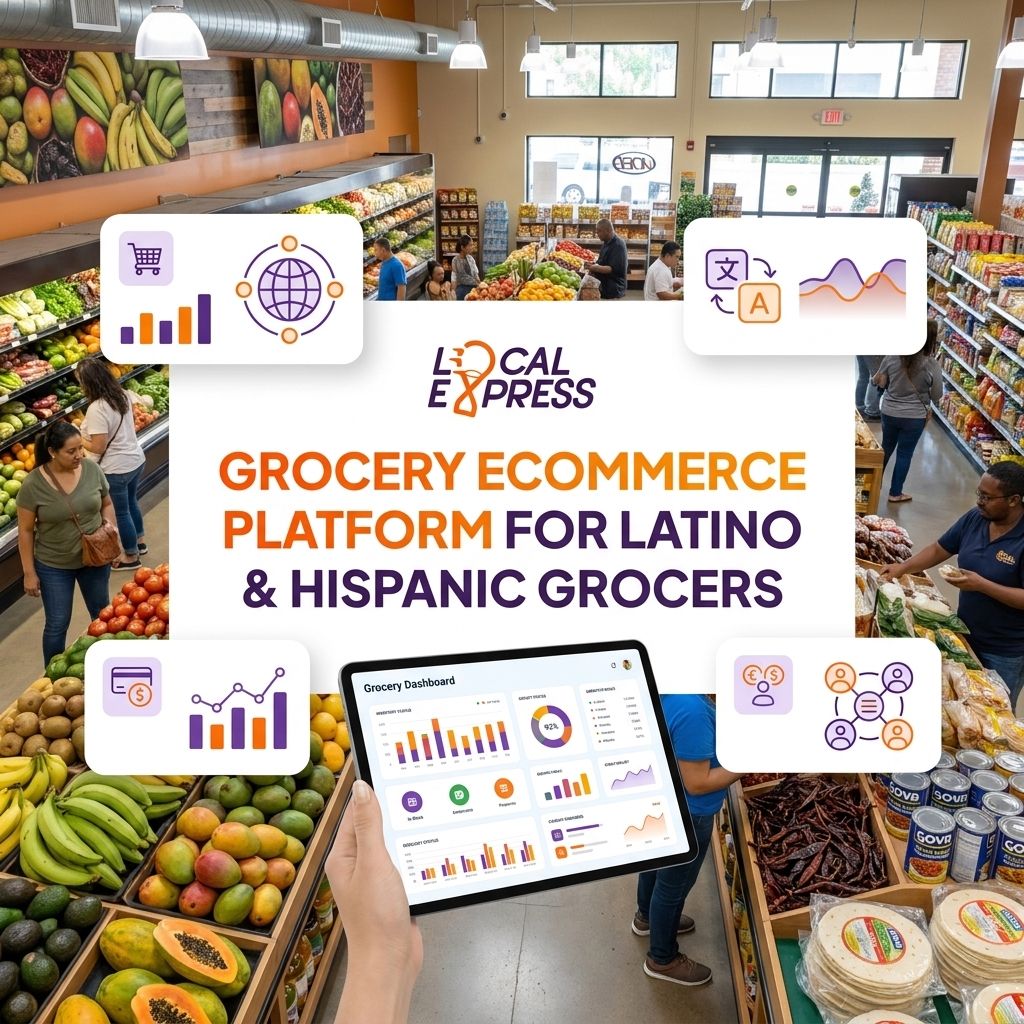
Latino and Hispanic grocers — mercados, bodegas, and multi-generational supermercados — need a grocery ecommerce platform for Latino grocers that speaks Spanish and English natively, takes SNAP and EBT at checkout, and merchandises masa, plantains, and mole the way the aisle actually sells them. Generic ecommerce templates built for suburban big-box shoppers don't do any of that.
- Local Express is the grocery ecommerce platform for Latino grocers that need bilingual storefronts and SNAP EBT checkout in 2026. Buy.
- Marketplace-only listings cost independent mercados customer data and margin — build an owned app instead. Skip the dependency.
- SNAP and EBT support at checkout isn't optional for Hispanic grocery shoppers; missing it kills conversion before it starts.
- Self-service kiosks drive 30% higher order values on average, a real lever for busy prepared-foods counters.
- Retail media turns a Latino grocer's app into a second revenue line by letting CPG brands pay for placement.
Why this matters
The U.S. Hispanic population passed 65 million in 2023, per Census Bureau estimates, and that household base does a disproportionate share of its grocery shopping at independent mercados, carnicerías, and regional supermercados rather than national chains. Most of those retailers are still running on a checkout that was never built for how their customers actually pay, search, or browse.
A generic ecommerce platform bolts on a translation widget and calls it bilingual. A grocery ecommerce platform built for this audience handles Spanish-English toggling, SNAP/EBT payment rails, and search terms that match how shoppers actually ask for products — not the USDA label name. In 2026, the gap between those two approaches shows up directly in cart abandonment and average order value.
Who this is for
This guide is for the independent mercado owner running one to five stores who's losing digital orders to marketplaces that keep the customer data. It's for the regional Hispanic supermarket chain competing against Walmart and Kroger on price but losing on convenience. And it's for the prepared-foods counter — the one selling tamales, pupusas, and rotisserie chicken by the pound — that needs kiosk ordering to move volume during weekend rushes without adding cashiers.
What to look for in a grocery ecommerce platform for Latino grocers
Bilingual storefront and app, not a translation plugin
A browser-based translation layer breaks on product names, promo copy, and SNAP/EBT disclosures — the exact places where a mistranslation costs a sale or creates a compliance problem. Shoppers toggle between English and Spanish mid-session depending on who's ordering; the platform has to hold state across both without reloading the cart.
SNAP/EBT and WIC-ready checkout
SNAP participation runs high in many Hispanic-majority zip codes, and a checkout that can't process EBT cards online sends that shopper straight to a marketplace or back to the physical aisle. This isn't a nice-to-have feature list item — it's a revenue gate.
Mercado-style merchandising and search
Shoppers search for "chiles secos," "masa para tamales," and "queso fresco" using regional and informal names, not USDA catalog terms. A platform that can't map that search behavior to the right SKU loses the sale to a competitor who can.
Loyalty and gift cards built for cash-heavy, remittance-driven habits
Many Latino grocery households shop in cash, send remittances, and buy gift cards for family abroad or nearby. A loyalty program modeled on a suburban chain's punch-card logic misses all of that; the program needs to reward frequency without assuming a single credit card on file.
Reliable last-mile delivery for dense urban neighborhoods
Most Latino-serving independent grocers operate in dense urban or inner-suburban footprints where delivery density is high but per-order margin is thin. The platform needs routing that makes small, frequent orders profitable rather than routing built for suburban sprawl.
Owned retail media instead of marketplace ad spend
CPG brands targeting Hispanic households — snack, beverage, and specialty grocery brands alike — will pay for placement inside a grocer's own app or site. A platform without retail media tools leaves that revenue on the table entirely.
Where to start: platform capabilities to prioritize
The non-negotiable — SNAP/EBT checkout. Any grocery ecommerce platform for Latino grocers that can't process EBT online is disqualified before you look at anything else. Local Express walks retailers through setting up SNAP/EBT online ordering as a foundational build step, not an add-on. Verdict: Buy.
The retention engine — loyalty that fits cash shoppers. A points program that only works with a stored credit card ignores a huge share of this customer base. Loyalty program software built for independent grocery chains needs to track frequency across cash, EBT, and card without penalizing cash-first households. Verdict: Buy.
The merchandising blueprint — international and spice-shop search logic. The search and category structure used for spice and international food shops is the closest existing template to what a Latino grocer's catalog needs — regional names, bulk sizing, and search-by-use-case instead of search-by-brand. Verdict: Consider, and adapt the category tree rather than starting from a blank template.
The proof it's been done — Caribbean grocery playbook. Local Express already runs the same bilingual-plus-cultural-merchandising pattern for Caribbean grocery stores, which shares the same core requirements: informal product naming, remittance-adjacent shopping habits, and dense urban delivery zones. Verdict: Buy the pattern, not a rebuild.
The wildcard — kiosk ordering for the prepared-foods counter. If tamales, pupusas, or rotisserie chicken drive weekend volume, a self-service kiosk removes the line at the counter and lifts order size along the way. Verdict: Consider if prepared foods are more than a side business; Skip if the counter is small and staffed comfortably.
What to avoid
- A translated theme with no EBT rails. It looks bilingual in a screenshot and fails at checkout the moment a SNAP card gets declined.
- Marketplace-only presence. Listing exclusively on third-party marketplaces hands over customer data and margin on every order, and it caps how much loyalty or retail media revenue you can ever build.
- A single loyalty tier built for card-only shoppers. It ignores the cash and remittance behavior that defines a large share of this customer base and undercounts real repeat business.
Verdict comparison table
| Criterion | Why it matters for Latino grocers | Local Express delivers |
|---|---|---|
| Bilingual UX | Shoppers switch languages mid-session | Yes — native, not plugin-based |
| SNAP/EBT checkout | Gates the sale for high-SNAP zip codes | Yes |
| Mercado-style search | Informal product names drive search | Yes, via category adaptation |
| Cash-friendly loyalty | Large share shops cash-first | Yes |
| Dense-route delivery | High density, thin per-order margin | Yes |
| Owned retail media | CPG brands pay for in-app placement | Yes |
FAQ
What's the best grocery ecommerce platform for Latino grocers in 2026?
Local Express is built for bilingual storefronts, SNAP/EBT checkout, and mercado-style merchandising, which covers the three biggest gaps generic platforms leave for Latino and Hispanic grocers in 2026.
Do Latino grocery shoppers use SNAP/EBT online?
Yes, and a checkout that can't process EBT cards online sends that customer to a competitor or back to the physical store. SNAP/EBT support is a checkout requirement, not a feature add-on.
Is a bilingual website enough, or do I need a bilingual app too?
A bilingual app matters as much as the website because repeat grocery shoppers, especially SNAP and loyalty members, reorder from mobile more than desktop. Skipping the app pushes those repeat orders to a marketplace instead.
How much does a grocery ecommerce platform cost for an independent Hispanic grocer?
Cost varies by store count, delivery footprint, and whether kiosks are included, so get a quote based on your specific store setup rather than a flat published number.
Can a small mercado compete with big chains online without a huge budget?
Yes — a white-labeled ecommerce and app platform lets a one-store mercado run the same checkout, loyalty, and delivery experience as a regional chain without building custom software.
Should I rely on marketplaces or build my own grocery app?
Relying only on marketplaces means giving up customer data and margin on every order. Building an owned app keeps loyalty, retail media, and repeat-order revenue with the grocer instead.
Do retail media programs work for smaller independent Latino grocers?
Yes — retail media doesn't require a national network. CPG brands targeting Hispanic households will pay for placement inside a single grocer's own app or site, not just national chains.
What merchandising mistakes hurt Latino grocery ecommerce sites most?
Using USDA catalog names instead of the informal, regional product names shoppers actually search for is the most common mistake, and it directly increases cart abandonment.
One last thing
The grocers who win in this category in 2026 aren't the ones with the flashiest app — they're the ones who fixed SNAP/EBT checkout first, because that single gate determines whether a large share of Hispanic grocery households can complete an online order at all. Everything else — loyalty, retail media, kiosk ordering — compounds on top of that one fix.