Gift cards sound like a simple bolt-on until you try to make one balance work across your website, your app, and the self-checkout kiosk by the deli counter. This guide breaks down what independent and regional grocers running their own ecommerce site need from a gift card program in 2026, and which program types actually hold up once real customers start using them.
- Digital-only gift card programs win for grocers running their own grocery ecommerce site and app in 2026 - buy.
- Physical plus digital hybrid cards fit stores with heavy kiosk and in-person traffic - consider, not the first move.
- Third-party marketplace gift cards hand your customer data to someone else - skip them for your own storefront.
- Federal law requires gift cards stay valid at least 5 years and blocks dormancy fees for the first 12 months.
Why this matters
A gift card program isn't a nice-to-have anymore - it's a customer retention tool that big grocery chains have run for decades while independents mostly skipped it. Every dollar loaded onto a card that only works at a national chain's kiosk or a delivery marketplace's app is a dollar that never touches your own ecommerce site or your own customer record.
Heading into 2026, more independent and regional grocers are building branded ecommerce and app experiences, which means the gift card conversation has changed. The question isn't "should we offer gift cards" - it's which program structure actually works when you're selling across web, app, and in-store kiosk at once.
Who this is for
This is written for the independent grocer, specialty food retailer, or regional chain operator running a branded ecommerce site and mobile app who wants a gift card program that reinforces their own storefront instead of feeding a third-party delivery marketplace. If your checkout still runs through DoorDash or Instacart exclusively, fix that first - a gift card program only pays off once customers are ordering directly from you.
What to look for in a gift card program for grocery ecommerce
Redemption across every channel you sell on
A gift card that only works at checkout on your website and stalls at the kiosk isn't a program, it's a liability waiting to generate a complaint. In 2026, most independent grocers sell across at least three channels - web, branded app, and in-store kiosk - and a gift card balance needs to check out cleanly on all three or you'll spend more time issuing manual refunds than selling groceries.
Compliance with federal and state gift card law
The Credit CARD Act of 2009 sets the floor: gift cards can't expire in under 5 years from activation, and dormancy or inactivity fees can't kick in before 12 months of no use. States layer on their own rules around unclaimed property and disclosure, so whatever program you pick needs to handle expiration logic and fee rules automatically - not through a spreadsheet someone updates once a quarter.
Breakage and liability accounting
Every gift card you sell sits on your books as a liability until it's redeemed, and the unredeemed portion - breakage - needs to be tracked and recognized correctly for your accountant. A program that doesn't give you a clean liability report by card, by store, and by date range creates a mess at year-end that costs more in bookkeeping time than the gift card revenue was worth.
Integration with your POS and loyalty data
A gift card that lives in a silo separate from your point-of-sale and loyalty system means a customer's balance, purchase history, and loyalty points never talk to each other. That's a missed opportunity for the exact kind of first-party customer data independent grocers need to compete with chains that have run loyalty programs for years.
Marketing reach for the program itself
A gift card program with no way to promote it - no push notification, no SMS reminder, no in-app banner - sells itself slowly and expires unnoticed. Grocers who pair gift cards with push notification and SMS marketing tools see faster redemption and fewer forgotten balances sitting as unclaimed liability.
Run gift cards across web, app, and kiosk
One order management system instead of three disconnected systems.
Top picks for gift card programs in grocery ecommerce
Digital-only gift card program - the safe pick
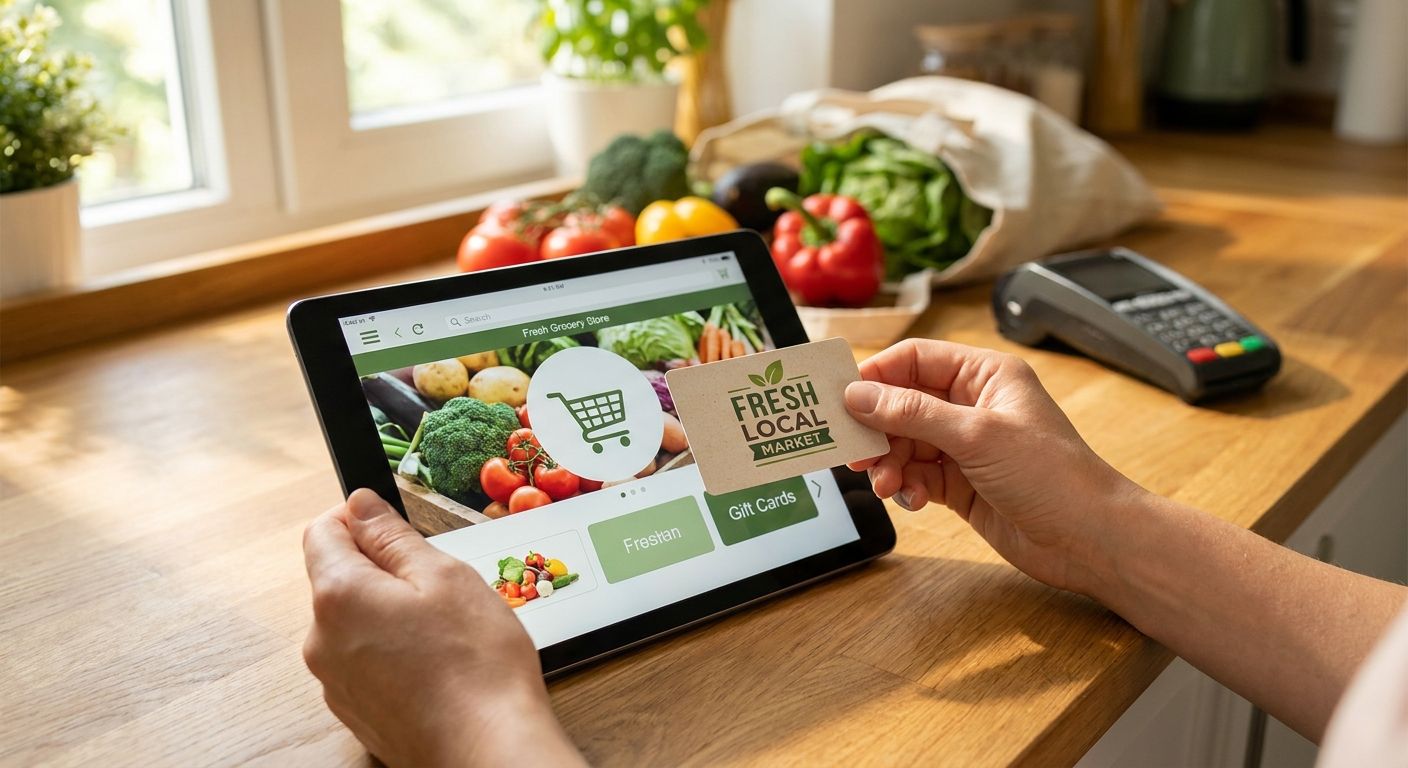
A digital-only card lives entirely inside your ecommerce site and branded app - no plastic, no printing costs, no lost-card calls. It activates instantly at purchase and redeems at checkout across your website and app the same day, which matters most during the 2026 holiday gifting window when customers buy at the last minute. Pair it with push notification and SMS marketing to remind holders before a balance goes stale. Verdict: Buy.
Physical plus digital hybrid - the familiar pick
Some shoppers, especially older or less app-comfortable customers, still want a physical card they can hand to someone as a gift. A hybrid program that issues a plastic card redeemable at self-checkout kiosks alongside a digital version for the app covers both behaviors, but it adds printing cost and inventory tracking for physical stock. Verdict: Consider if in-store kiosk traffic is a meaningful share of your volume in 2026.
Loyalty-linked wallet credit - the wildcard
Instead of a standalone card, some grocers fold gift card value into an existing loyalty wallet, so a purchased balance and earned rewards points sit in the same account. It's less familiar to shoppers as a "gift card" in the traditional sense, but it keeps every dollar tied to a single customer record instead of splitting data across two systems. Verdict: Consider if you already run a loyalty program and want to avoid building a second parallel balance system.
Third-party marketplace-branded gift card - the trap
A gift card sold through a delivery marketplace's own gift card program looks like free marketing, but it routes the purchase, the customer data, and the repeat visit through someone else's app - not your grocery ecommerce site. Grocers trying to build their own branded storefront and customer list should not be handing that relationship to a marketplace. Verdict: Skip.
What to avoid
- Cards with expiration under 5 years or dormancy fees inside 12 months - this isn't just a bad customer experience, it violates the federal CARD Act minimums.
- A gift card system that doesn't sync with your POS or inventory data - you'll end up reconciling balances by hand every month.
- Any program that only works on one channel - if it redeems on the website but not the app or kiosk, customers will hit a wall at checkout and blame your store, not the software.
Verdict comparison table
| Program type | Works web + app + kiosk | Setup effort | Best for | Verdict |
|---|---|---|---|---|
| Digital-only card | Yes | Low | Grocers with active app + web checkout | Buy |
| Physical + digital hybrid | Yes, with kiosk hardware | Medium | Stores with strong in-person kiosk traffic | Consider |
| Loyalty-linked wallet credit | Depends on loyalty system | Medium-High | Grocers with existing loyalty program | Consider |
| Third-party marketplace card | No, marketplace app only | Low (but low control) | Nobody building their own storefront | Skip |
FAQ
What's the best gift card program for a grocery ecommerce site in 2026?
A digital-only gift card program that redeems across your website and branded app is the best fit for most independent grocers in 2026. It activates instantly, avoids printing costs, and doesn't require kiosk hardware to redeem.
Is a physical gift card better than a digital one for grocery stores?
Physical cards still matter for shoppers buying a gift in person, but digital cards redeem faster and cost less to manage. Most grocers running their own ecommerce site do better offering digital-first with physical as an add-on, not the primary format.
How long do gift cards have to stay valid by law?
Under the federal Credit CARD Act of 2009, gift cards must stay valid for at least 5 years from the activation date. Dormancy or inactivity fees can't be charged until the card has gone unused for at least 12 months.
Can a gift card work across a website, app, and in-store kiosk?
Yes, but only if the gift card balance is tied to a centralized order management system rather than three separate checkout tools. Without that, a balance loaded online may not recognize at a kiosk or vice versa.
Should independent grocers sell gift cards through delivery marketplaces?
No - a gift card sold through a delivery marketplace routes the customer relationship and repeat purchase data to that marketplace, not to your own grocery ecommerce site. Grocers trying to build a direct customer base should keep gift card sales on their own storefront.
Do gift cards increase order value for grocery stores?
Gift card recipients often spend beyond the card balance at checkout, since redemption typically happens alongside a regular grocery order. The exact lift depends on your average basket size and how the balance is presented at checkout.
What happens to unredeemed gift card balances?
Unredeemed balances, known as breakage, sit as a liability on your books until redeemed or until state unclaimed property rules apply. Your gift card system needs to track this by card and by date so your accounting stays accurate at year-end.
Does a gift card program need to integrate with loyalty data?
It doesn't have to, but integration gives you a single customer record instead of a split view between purchase history and gift card activity. For grocers running loyalty programs, a linked system avoids managing two separate balances for the same shopper.
One last thing
The program type matters less than the channel gap most grocers overlook: a gift card that works on your website but fails at the kiosk generates more complaint calls than the revenue is worth. Test redemption on every channel you actually sell through before launch day in 2026, not after the first customer hits a wall at checkout.