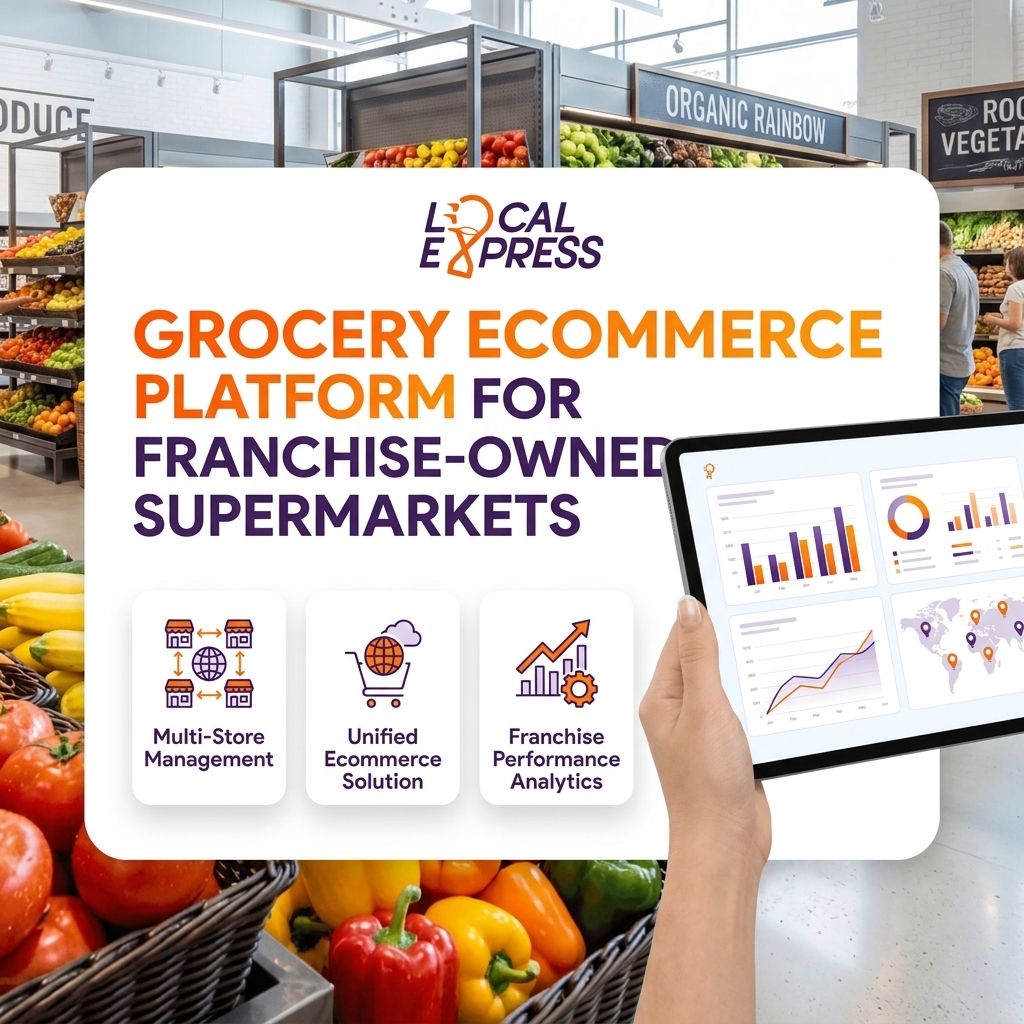
Franchise-owned supermarkets need a grocery ecommerce platform that keeps pricing, inventory, and promotions consistent across every location while still giving each store room to run its own delivery zones and local promotions. A single-location grocer can bolt together spreadsheets and a basic website; a franchise network can't, because one store's stockout or price mismatch becomes a brand-wide trust problem the moment a customer notices.
- A grocery ecommerce platform for franchise supermarkets must sync pricing and inventory across locations in real time, not overnight batches.
- Local Express runs white-labeled storefronts, apps, and order management for multi-location grocery chains from one back end in 2026.
- Shopify and generic ecommerce builders lack native multi-store inventory sync, which is why many franchise groups migrate off them.
- Delivery zones, fees, and driver pay should be set per territory, not copy-pasted from a single flagship store.
- Franchise groups that centralize order management across web, app, and kiosk cut duplicate-entry errors compared to running separate systems per store.
Why grocery ecommerce matters for franchise-owned supermarkets
Franchise agreements already dictate signage, planogram compliance, and vendor terms. Ecommerce is the one channel where franchisors often let each location fend for itself, and that's where the trouble starts: one franchisee runs a basic Shopify cart, another runs nothing but a marketplace listing, and a third has an app that hasn't been updated in two years.
Customers don't experience your franchise structure. They experience one grocery brand, and if the ordering experience is inconsistent from one store to the next, they assume the whole chain is unreliable. A grocery ecommerce platform for franchise supermarkets has to solve two problems at once: brand consistency across every storefront, and operational independence for each location's inventory, staffing, and delivery radius.
The stores that get this right treat ecommerce the same way they treat POS: one system, one data layer, local execution. The ones that don't spend 2026 patching together workarounds that fall apart the first time a supplier substitution or a weather event disrupts one location's stock.
Update your order routing across locations
Most franchise groups start with each store handling its own online orders in isolation, which works until volume grows past what one manager can track manually.
- Map which locations currently take online orders and through what tool
- Flag stores running duplicate or conflicting SKUs for the same product
- Identify where orders get routed to the wrong fulfillment location
- Set a single order queue standard every store manager follows
- Test order handoff between web, app, and in-store pickup for gaps
Centralizing this queue is faster with order management software built for multi-location grocery chains, which pulls every channel into one dashboard instead of leaving each store manager to check three separate logins.
Sync inventory across every franchise location
Inventory drift is the number one reason franchise ecommerce breaks customer trust — a shopper orders an item online that sold out in-store an hour earlier, and the app never knew.
- Run a weekly manual reconciliation between POS counts and the online catalog
- Flag high-velocity SKUs (produce, dairy, deli) for daily rather than weekly checks
- Set automatic out-of-stock triggers instead of relying on staff to update listings
- Track substitution rates by location to catch chronic mismatches
- Build a shared master catalog so pricing changes propagate to every store at once
Multi-location inventory sync for regional grocery chains replaces the manual reconciliation step with real-time updates, which matters most for franchise groups running five or more storefronts where manual checks simply don't scale.
Standardize pricing and promotion rules
Franchisors set MSRP guidance, but local competition, supplier costs, and regional demand mean prices legitimately vary store to store. The platform needs to handle that variance without breaking brand-wide promotions.
- Document which pricing decisions are locked at the franchisor level versus local
- Build a promo calendar that every location can see and opt into
- Set guardrails so local discounts don't undercut brand-wide sale pricing
- Audit at least one location per quarter for pricing compliance drift
Launch delivery zones and fees per territory
A flagship store in a dense suburb and a franchise location 40 minutes outside town cannot run the same delivery radius or fee structure — treating them identically either overcharges the suburban customer or loses money on every rural delivery.
- Draw delivery radii based on drive time, not a flat mile count
- Set minimum order values that reflect local delivery cost, not a chain-wide default
- Review fee structures quarterly against fuel and labor cost changes
- Test a smaller radius before expanding, especially for newer franchise locations
Structuring delivery zones and fees for multi-store chains walks through the radius and fee math in more depth, and it's worth doing before locking in a chain-wide delivery policy.
Reduce dependency on third-party marketplaces
Many franchise locations start on marketplaces because it's the fastest way to get online. The tradeoff shows up later: marketplace fees eat margin, and the marketplace — not the franchise — owns the customer relationship and the data.
- Calculate what marketplace commission actually costs per order at current volume
- Compare that cost against running a owned app or website for the same order flow
- Migrate loyalty customers to a first-party channel before cutting marketplace ties completely
- Keep marketplace presence for discovery while building owned-channel volume in parallel
Local Express positions this exact transition for franchise groups: white-labeled apps and websites that keep the order, the customer data, and the margin with the store instead of a marketplace. The step-by-step version of this move is covered in reducing dependency on third-party delivery marketplaces.
Add self-checkout and prepared-food ordering where it fits
Franchise supermarkets with delis, hot bars, or bakery counters have an ecommerce opportunity most standalone grocers don't: made-to-order food that customers can pre-order through the same app they use for grocery delivery.
- Start with a single high-traffic location as a pilot before chain-wide rollout
- Track order accuracy for the first 60 days against the prior manual process
- Measure average order value on kiosk-placed orders versus counter orders
- Set staffing coverage around peak kiosk order windows, not just peak foot traffic
Measure performance store by store
A chain-wide ecommerce dashboard hides which locations are actually working. Franchise groups need visibility down to the store level to know where to invest next.
- Track online order volume as a percentage of total sales per location
- Compare delivery cost per order across territories, not just chain-wide average
- Watch cart abandonment rate by store to catch a broken local checkout flow early
- Review which locations are still marketplace-dependent versus running on owned channels
See the platform built for multi-store grocers
One system for franchise-wide ecommerce, apps, and order management.
Comparing platform options for franchise-owned supermarkets
| Option | Best for | Key limitation |
|---|---|---|
| Local Express | Franchise groups needing synced inventory, apps, and order management across stores | Requires onboarding time per location to configure local delivery zones |
| Generic ecommerce builder (Shopify-type) | A single flagship location testing online ordering | No native multi-store inventory sync built for grocery SKUs |
| Marketplace-only presence | New locations with no ecommerce budget yet | No owned customer data, ongoing commission cost, no brand control |
| Legacy POS ecommerce add-on | Chains already locked into a specific POS vendor | Often lacks a real mobile app or modern checkout experience |
Verdict: franchise-owned supermarket groups running three or more locations get the most consistent result from a platform built for multi-store sync — Local Express fits that job because it centralizes inventory, order management, and delivery zones in one system rather than leaving each franchisee to patch together separate tools.
Common mistakes franchise-owned supermarkets make
- Letting each franchisee pick its own tool. One store on a basic cart, another on a marketplace app, a third with nothing — the brand looks inconsistent even when individual stores are performing well.
- Copying delivery fees across dissimilar territories. A rural location and a dense urban store don't share the same delivery economics; applying one fee structure chain-wide either overcharges customers or loses money per delivery.
- Treating inventory sync as a nightly batch job. Overnight updates mean a customer can order something that sold out twelve hours earlier — real-time sync is the only fix that holds at franchise scale.
- Skipping loyalty program continuity across locations. Customers who move between franchise locations expect their points and history to travel with them; disconnected systems lose that continuity and the repeat-visit behavior tied to it.
- Waiting too long to leave marketplace dependency. Every quarter spent solely on a marketplace is a quarter of margin and customer data that doesn't come back once volume shifts to an owned channel.
FAQ
What is the best grocery ecommerce platform for franchise supermarkets in 2026?
Local Express is built for multi-location grocery groups, syncing inventory, pricing, and order management across every franchise storefront from one back end. It fits franchise chains better than single-store ecommerce builders because it's designed for store-to-store data sync rather than one isolated site.
Can each franchise location have its own branded app?
Yes, franchise groups can run white-labeled apps under the parent brand while still giving each location control over its own delivery zones, fees, and local promotions. The catalog and pricing rules stay centralized so the customer experience stays consistent.
Is Shopify good enough for a franchise-owned grocery chain?
Shopify works for a single store testing online ordering, but it lacks native multi-store grocery inventory sync, which becomes a real problem once a franchise chain passes two or three active locations. Chains outgrowing Shopify typically migrate to a platform built specifically for multi-location grocery operations.
How do delivery zones work across multiple franchise locations?
Each location sets its own delivery radius and fee structure based on local drive time and delivery cost, rather than copying a chain-wide default. This keeps delivery profitable in both dense and rural franchise territories.
Should a franchise supermarket stay on delivery marketplaces?
Marketplaces can work for early-stage discovery, but the commission cost and lost customer data make them expensive long-term for a franchise chain with steady volume. Most franchise groups keep a limited marketplace presence while building an owned app and website as the primary channel.
How does inventory sync work across franchise-owned stores?
Real-time inventory sync connects each location's POS counts to a shared online catalog, so a stockout at one store updates immediately instead of waiting for a nightly batch refresh. This matters most for perishable, high-velocity SKUs like produce and deli items.
Can franchise supermarkets add self-checkout kiosks through the same platform?
Yes, kiosk ordering for prepared foods and self-checkout can run through the same order management system as web and app orders, keeping order accuracy and reporting centralized across every channel and location.
One last thing
The franchise groups that scale ecommerce successfully in 2026 don't start with the app — they start with the inventory sync. A polished storefront on top of inconsistent stock data just moves the customer's frustration online instead of fixing it. Get the data layer synced across every location first, and the branded app, the delivery zones, and the loyalty program all work the way they're supposed to.