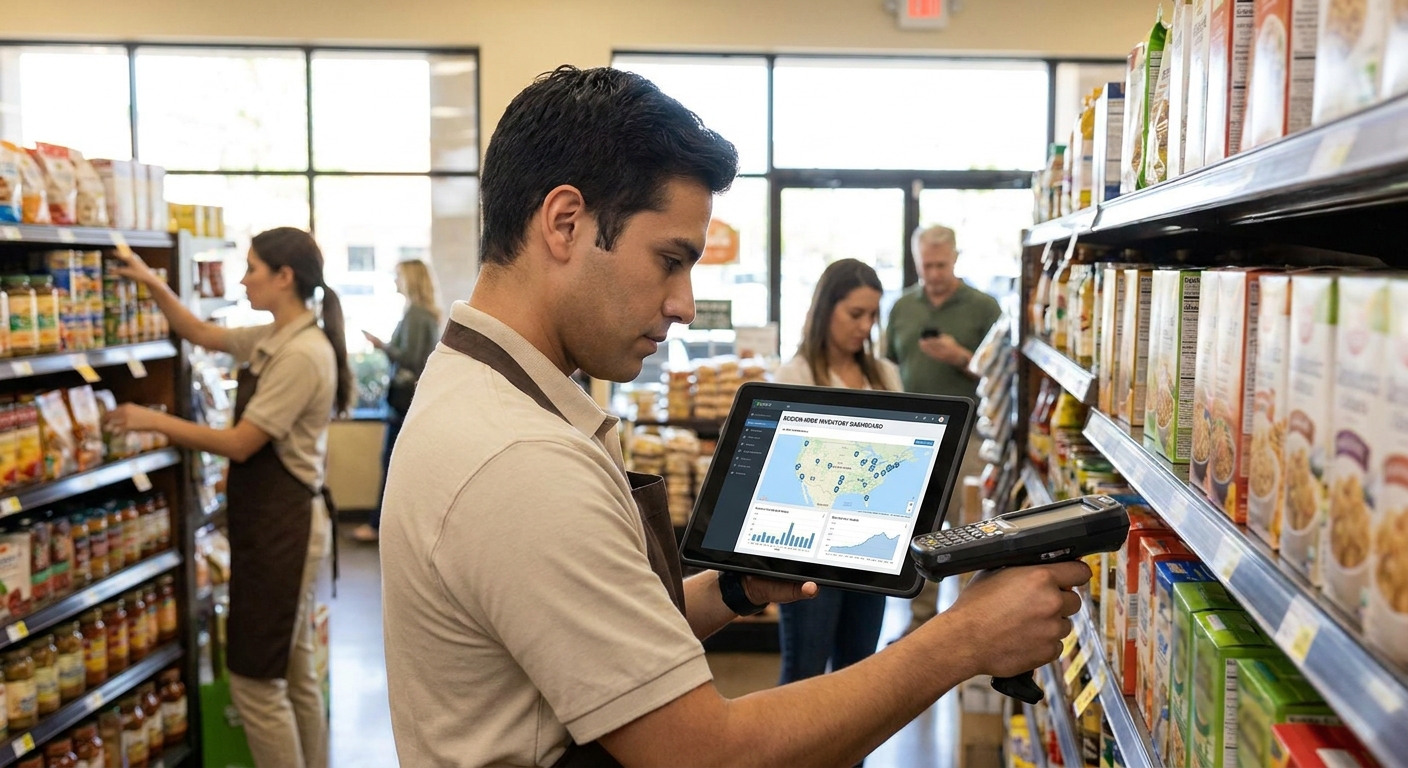
Regional grocery chains running 5 to 50 stores lose margin every week to phantom inventory: the POS says 40 units of a SKU are in stock at Store 12, but the shelf is empty and the warehouse feed hasn't caught up. Multi-location inventory sync for grocery chains fixes that gap by pushing real-time stock data across every store, warehouse, and ecommerce channel from one system.
- Order management software with real-time SKU sync wins for chains running 10+ stores in 2026 — Buy.
- Chain-wide forecasting that ignores per-store demand patterns causes the most stockouts — Skip it.
- Delivery zone and fee structuring only works once inventory sync is live across locations — sequence matters.
- Rural stores need offline-tolerant sync, not just real-time sync — Consider before you Buy.
- Reducing dependency on third-party delivery marketplaces protects margin once inventory data is accurate.
Why this matters
A single-store grocer can survive a manual count once a week. A 15-store chain can't — one out-of-sync location bleeds into every other location's forecasting, delivery promise, and online order accuracy. When shelf data and system data disagree, customers hit "out of stock" on items sitting in the backroom, or worse, place an online order for something that sold out three hours ago.
Accurate, real-time sync also feeds everything downstream: order management software for multi-location grocery chains can't route an order to the nearest available store if the inventory feed is stale. Delivery zones can't be priced correctly if fulfillment capacity per location is a guess. Retail media placements can't sell against a SKU that's phantom-stocked. Sync is the foundation, not a nice-to-have.
Who this is for
This guide is for operations directors, IT leads, and multi-store owners running regional grocery, specialty food, or ethnic grocery chains with 5 to 50+ locations, where each store has its own delivery window and demand curve. If you're running a single location, most of this doesn't apply — go read up on POS-level inventory tracking instead. If you're already syncing inventory across stores but still seeing stockouts on your top 20 SKUs, keep reading.
What to look for in multi-location inventory sync for grocery chains
Real-time SKU-level visibility across every location
Daily or nightly batch syncs are not real-time — they're a 12 to 24 hour lag dressed up as a sync. A regional chain moving perishables and high-velocity SKUs needs stock levels that update within minutes of a sale, whether that sale happened at the register, on the app, or through a kiosk order.
POS and warehouse management integration depth
Sync that only talks to your POS misses warehouse transfers, backroom counts, and vendor deliveries. The deeper the integration — POS, warehouse management, and ecommerce all reading the same ledger — the fewer discrepancies show up at the shelf.
Demand forecasting per store, not chain average
A chain-wide average forecast hides the fact that Store 3 sells three times the oat milk that Store 7 does. Per-store forecasting is what actually prevents overstock at slow locations and stockouts at fast ones. This single distinction separates chains that cut waste from chains that just move the waste around.
Order routing logic when one location is out of stock
When a SKU runs out at the nearest store, the system needs to know instantly which other location can fulfill the order and whether delivery time still works for the customer. Without this logic, online orders get cancelled instead of rerouted — and cancelled orders cost more than lost margin, they cost repeat customers.
Delivery zone and fulfillment alignment
Inventory sync only pays off if delivery zones are structured around real fulfillment capacity per store, not a flat radius drawn on a map. Chains that get delivery zones and fees structured around actual stock-per-location data see fewer failed deliveries and fewer refunds.
Reporting rollup for corporate vs. store-level
Corporate needs the chain-wide view for purchasing decisions; store managers need the store-level view for daily ordering. A sync platform that only reports one or the other forces someone to build a spreadsheet bridge — and spreadsheet bridges are where sync accuracy dies in 2026 just as much as it did in 2020.
Capabilities that actually move the needle
Order management software for multi-location grocery chains — the safe pick. Central order routing across every store and channel, with real-time stock visibility as the backbone. Chains running 10+ locations see the clearest ROI here because it's the layer everything else depends on. Buy.
Delivery zone and fee structuring — the operational fix. Once sync is accurate, structuring delivery zones and fees for multi-store chains around real per-store capacity cuts failed-delivery rates. This only works after sync is live — sequencing it first is a common mistake. Buy.
Last-mile delivery networks for rural grocery retailers — the reach extender. Rural and exurban locations often have thinner delivery infrastructure and spottier connectivity, so sync needs to tolerate intermittent connections without losing accuracy. Last-mile delivery networks built for rural stores solve for that gap specifically. Consider if more than a third of your locations sit outside dense delivery zones.
Reducing dependency on third-party delivery marketplaces — the margin protector. Third-party marketplaces run their own inventory feeds, which means your real stock levels and their displayed stock levels drift apart fast across multiple stores. Reducing dependency on third-party marketplaces keeps one inventory truth instead of three conflicting ones. Buy once your first-party ordering volume can absorb the shift.
Retail media program without a national network — the bonus layer. Once inventory data is accurate at the SKU and store level, that same data can power CPG placements and sponsored listings without needing a national retail media network behind you. This isn't core to sync itself, but it's the next revenue line that accurate data unlocks. Consider once sync has been stable for a full quarter.
See how sync works across your stores
Get a walkthrough of real-time inventory sync for your chain.
What to avoid
- Nightly batch syncs marketed as "real-time." If the vendor can't tell you the sync interval in minutes, assume it's hours. A 6-hour lag on perishables is a stockout waiting to happen.
- Chain-wide forecasting bolted onto single-store POS. This looks like sync on paper but ignores per-store demand entirely — you'll overstock the slow store and stock out the fast one, same problem, different location.
- Manual spreadsheet reconciliation between corporate and store level. If someone on your team is exporting CSVs to reconcile inventory counts weekly, that's not sync — that's a delay with extra steps, and it doesn't scale past a handful of stores.
Verdict comparison
| Capability | Real-time visibility | Per-store forecasting | Delivery integration | Verdict |
|---|---|---|---|---|
| Order management software | Yes | Yes | Native | Buy |
| Delivery zone structuring | Partial | No | Yes | Buy |
| Last-mile rural delivery networks | Partial | No | Yes | Consider |
| Reduce third-party marketplace dependency | Yes | No | Yes | Buy |
| Retail media program | No | No | No | Consider |
FAQ
What is multi-location inventory sync for grocery chains?
It's a system that keeps stock levels accurate and updated in real time across every store, warehouse, and online channel a chain operates. Without it, POS data, ecommerce data, and shelf reality drift apart within days.
Does multi-location inventory sync work with an existing POS?
Yes, sync platforms integrate with existing POS and warehouse systems rather than replacing them outright. The depth of that integration determines how fast discrepancies get caught.
How does inventory sync reduce stockouts across locations?
It routes orders to whichever store or warehouse actually has stock, instead of cancelling an order because the nearest location ran out. Per-store forecasting also prevents the overstock-at-one-store, stockout-at-another pattern that chain-wide averages create.
What's the difference between chain-wide forecasting and per-store forecasting?
Chain-wide forecasting averages demand across all locations, which hides big differences between fast and slow stores. Per-store forecasting predicts demand at each individual location, which is what actually prevents waste and stockouts in 2026.
Does multi-location inventory sync work for rural stores with spotty connectivity?
It works best when the platform is built to tolerate intermittent connections without losing accuracy once reconnected. Rural and exurban locations need this specifically, unlike dense urban stores with stable connections.
How long does it take to roll out inventory sync across 20+ locations?
Rollout timelines depend on POS complexity and how many warehouse systems need to connect, so ask any vendor for a location-by-location rollout plan rather than a single blanket estimate. Chains usually stagger rollout by region rather than launching all stores at once.
Is multi-location inventory sync worth it for chains under 10 stores?
It's worth it once a chain has more than 3 to 4 locations, because that's typically where manual reconciliation stops scaling. Below that, a well-run single-system POS can sometimes hold accuracy without a dedicated sync layer.
What causes phantom inventory across multiple grocery locations?
Phantom inventory happens when the system count and the shelf count disagree, usually from delayed batch syncs, uncounted shrinkage, or warehouse transfers that never hit the POS. Real-time sync closes that gap by updating stock the moment a transaction happens anywhere in the chain.
One last thing
The chains getting this right in 2026 aren't the ones with the fanciest dashboard — they're the ones who sequenced it correctly: sync first, delivery zones second, retail media last. Skip that order and you're optimizing delivery pricing against inventory data that's already wrong.