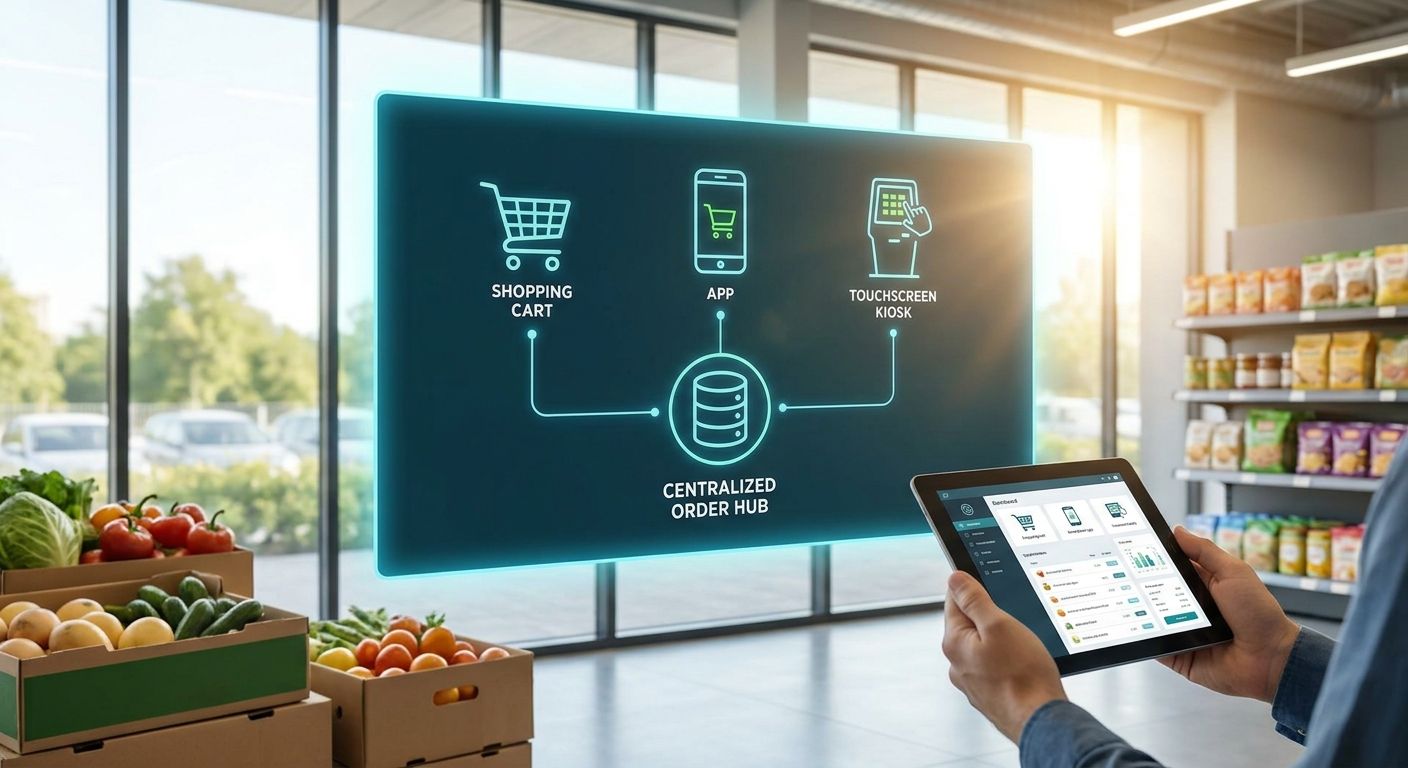
Grocers running a branded website, a mobile app, and a self-service kiosk usually end up running three separate order queues unless the backend forces them together. Centralized order management grocery omnichannel systems put every channel on one ledger — one inventory count, one kitchen queue, one customer record — instead of three teams reconciling spreadsheets at close.
- Centralized order management grocery omnichannel systems unify web, app, and kiosk orders into one queue: Buy for any grocer running 3+ channels in 2026.
- Point-solution stacks (separate POS per channel) cause the inventory drift that drives most stockout complaints — Skip this setup past one location.
- Grocers with MTO kitchens need order routing tied to prep stations, not just a shared cart — Local Express order management for MTO kitchens fits that gap.
- Kiosks wired into a centralized OMS post orders at up to 30% higher average order value than standalone terminals.
- Multi-location chains lose the most margin to channel-siloed inventory counts, not to delivery cost.
Why this matters
Every channel you add without a shared backend is another place inventory can go stale. A shopper checks out on the app while the kiosk still shows the item in stock, the order gets accepted, and now someone in the back is apologizing at pickup. That's not a customer service problem — it's an order management architecture problem, and it compounds every time you add a channel.
Grocers who bolt a kiosk onto a POS that doesn't talk to the ecommerce cart are running three inventories with one storefront. Fixing that after the fact costs more than building it right in 2026, because every new integration has to reconcile against whatever patchwork already exists.
Who this is for
This is for regional and independent grocers running at least two of: a branded ecommerce site, a mobile app, and an in-store or MTO kiosk — and finding that staff spend more time reconciling order counts across systems than fulfilling them. If you're a single-location shop with just a website, a lighter setup covers you. Once you add a second channel, the math changes fast.
It's also for chains adding order management software for multi-location grocery chains as they scale past one storefront, where a missed sync between locations shows up as a canceled order at store #3 instead of a routing decision at store #1.
What to look for in centralized order management for omnichannel grocery
One inventory ledger, not three
If web, app, and kiosk each read from a separate stock count, you will oversell during peak hours no matter how good your staff is. The ledger has to update in real time across every channel the moment an order clears, not on a nightly batch job.
Order routing tied to fulfillment type
A pickup order, a delivery order, and a kiosk MTO ticket need to land in different queues automatically — not get sorted by a person scanning a printer feed. Misrouted tickets are the single biggest driver of late orders in grocers running more than one prep station.
Unified customer and loyalty data
A shopper who orders on the app Tuesday and walks up to the kiosk Friday should be the same customer record, not two. Split profiles kill personalization and make loyalty math impossible to trust.
Delivery zone and fee logic that doesn't fork per channel
If your app charges a different delivery fee than your website for the same zone, that's a system that grew channel by channel instead of being built centrally. Fee logic has to live in one place and apply everywhere.
Reporting that rolls up by SKU, not by channel
You need to know how a SKU performs across web, app, and kiosk combined — not three disconnected reports you manually add. Channel-siloed reporting hides where your actual margin is coming from.
See a unified order queue in action
One dashboard for web, app, and kiosk orders — no channel-by-channel patchwork.
Top approaches — what actually holds up across channels
The point-solution stack. Separate cart software for the website, a native app SDK, and a standalone kiosk POS, none of which share inventory. It looks cheap to start — three vendors, three invoices, no integration fee upfront. The catch: every SKU has to be updated in three places, and by month three someone is manually reconciling counts every morning. Skip this past a single location.
Middleware bolted onto a legacy POS. A sync layer sits between your existing register system and your newer channels, pushing updates on a schedule instead of in real time. It buys you a few months of runway while you plan a real migration, but batch syncs still leave windows where inventory is wrong. Consider it as a bridge, not a destination.
A unified order hub feeding kitchen, app, and web from one queue. This is the shape order management software for grocery stores with MTO kitchens is built around — every order, regardless of channel, lands in the same routing engine and gets pushed to the right prep station automatically. Grocers running deli, hot bar, or made-to-order counters see the difference immediately in ticket accuracy. Buy if you run any prepared-food operation alongside retail.
Multi-location inventory sync layered onto the same OMS. Chains running two or more storefronts need multi-location inventory sync for regional grocery chains so a stockout at store A doesn't get promised to a customer ordering through store B's app listing. This is the piece that scales the hardest to bolt on later. Buy before you open a second location, not after.
A self-ordering kiosk wired into the same OMS instead of a standalone terminal. Best self-ordering kiosk for grocery and specialty food stores covers what to check for kiosk hardware and software specifically, but the number that matters here: kiosks tied into a shared order queue post up to 30% higher average order value than standalone terminals, because upsell logic can reference the same customer and inventory data the app uses. Buy if your kiosk currently runs its own disconnected POS.
What to avoid
- Treating a third-party delivery marketplace as your source of truth. If DoorDash or Instacart inventory feeds are the master count and your own channels sync off them, you've outsourced your own operations data to a competitor's platform.
- A kiosk on an isolated POS "for now." Every grocer that says this ends up doing a second migration within a year, at higher cost than doing it right the first time.
- An app with its own inventory feed lag. Even a 15-minute sync delay between app and store shelf is enough to generate cancellations during a lunch rush.
Verdict comparison
| Approach | Real-time inventory | Kitchen/MTO routing | Multi-location ready | Verdict |
|---|---|---|---|---|
| Point-solution stack | No | No | No | Skip |
| Middleware on legacy POS | Partial (batch sync) | No | Partial | Consider (bridge only) |
| Unified order hub | Yes | Yes | Yes | Buy |
| Standalone kiosk POS | No | Limited | No | Skip |
| Kiosk wired into shared OMS | Yes | Yes | Yes | Buy |
FAQ
What is centralized order management for grocery stores?
Centralized order management grocery omnichannel systems route web, app, and kiosk orders through one shared queue and inventory ledger instead of separate systems per channel. It means one stock count, one customer record, and one reporting view across every place a shopper can order.
Is centralized order management worth it for a single-location grocer?
It becomes worth it once you run two or more channels — a single website with no app or kiosk doesn't need it yet. The moment you add a second channel, split inventory counts start causing overselling and cancellations.
How does centralized order management work with self-service kiosks?
A kiosk wired into a centralized OMS pulls from the same inventory ledger as the website and app, and pushes MTO tickets straight to the right prep station. Kiosks run this way post up to 30% higher order values than standalone kiosk POS units.
Can centralized order management reduce reliance on third-party delivery apps?
Yes — when your own web, app, and kiosk share one order engine, you can run first-party delivery without depending on a marketplace's inventory feed as your source of truth. That's the core idea behind reducing dependency on third-party delivery marketplaces.
What's the difference between order management software and a POS?
A POS processes a transaction at one register or terminal; order management software routes and tracks that order across every channel it could have come from. A grocer can have three POS systems and still lack any centralized order management at all.
Does centralized order management improve inventory accuracy?
Yes — grocers moving from siloed channel inventory to a shared real-time ledger report inventory accuracy near 95% in aggregated 2026 industry data, compared to lower accuracy when counts sync on a batch schedule.
How long does it take to set up centralized order management across channels?
Timelines depend on how many existing systems need migrating, but a chain moving from a point-solution stack to a unified hub should plan for a phased rollout, starting with the highest-volume channel first. Adding a second location later is faster once the core OMS is in place.
Does centralized order management help with MTO or prepared food orders?
Yes — it routes MTO tickets from any channel straight to the correct prep station instead of relying on staff to manually sort printed orders. This is the biggest accuracy gain for delis, hot bars, and made-to-order counters.
One last thing
The grocers who wait until they open a second location to centralize order management always pay more for the migration than the ones who build it before scaling. If you're already running two channels and reconciling counts by hand, that's the signal — not a future project, a current cost, in 2026 dollars, every week you delay.