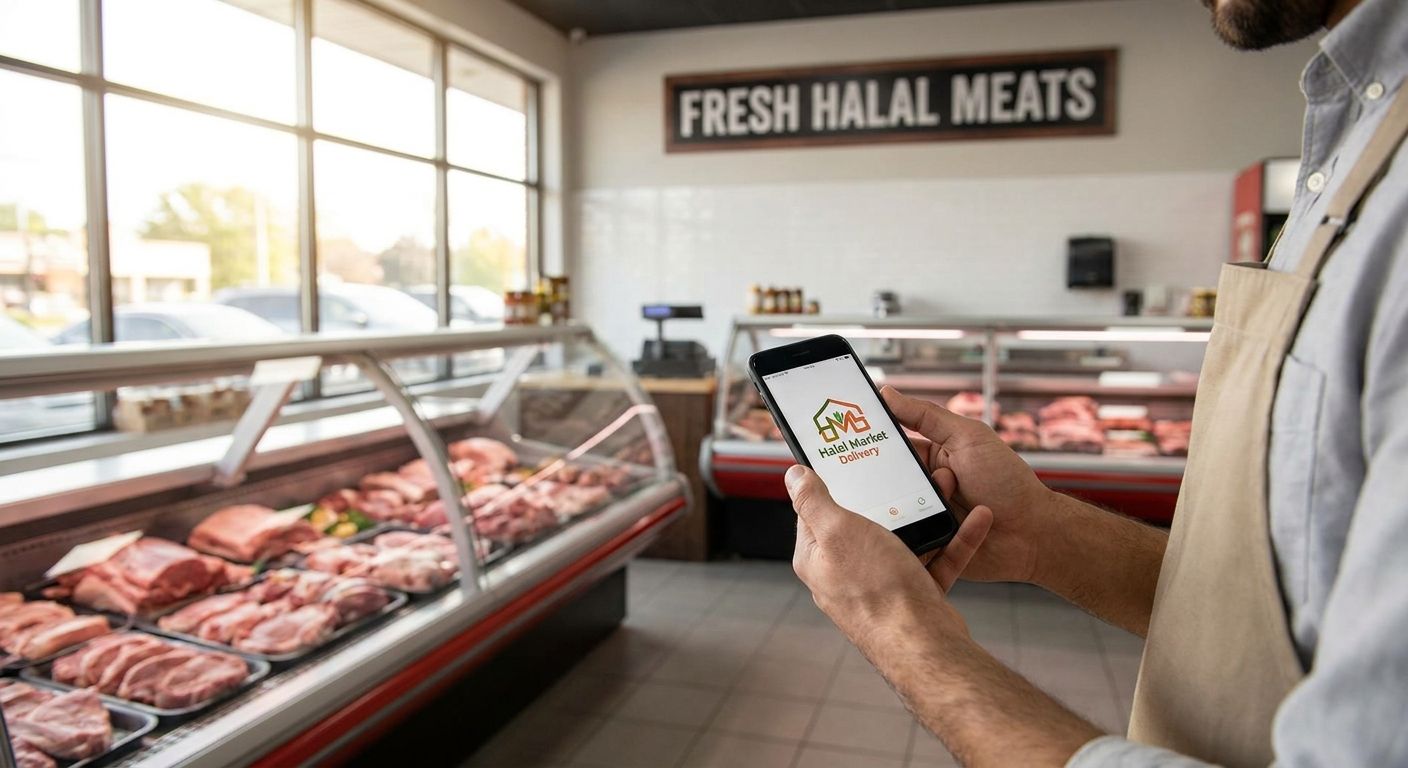
Halal meat markets lose sales every week to shoppers who default to whatever grocery app is already on their phone — and that app is rarely the one carrying zabiha-certified lamb or fresh halal chicken. A branded delivery app for halal meat markets fixes that by putting your certification, your cuts, and your checkout in front of the customer instead of a marketplace algorithm.
- A delivery app for halal meat markets needs certification-visible listings and cut-level detail that generic marketplace apps hide.
- The online ordering platform for halal and Middle Eastern grocers ties certification tagging to branded checkout: Buy.
- Branded mobile apps lift repeat orders for halal meat markets when paired with push notifications and loyalty: Buy.
- White-label delivery apps skip the long build timelines third-party marketplaces impose on independent grocers: Consider.
- SNAP EBT online ordering matters for halal meat markets serving food-assistance-heavy neighborhoods in 2026: Consider.
Why this matters
Third-party delivery marketplaces treat a halal meat market the same way they treat a convenience store: a tile in a grid, sorted by rating and delivery speed, with no room for a certification badge or a butcher's note on the cut. That's a problem for a customer base that shops on trust first and price second.
Grocers running their own branded ordering flow through the online ordering platform for halal and Middle Eastern grocers see the difference show up in the numbers: AI-driven grocery ecommerce platforms post an average $3.50 return per $1 invested in 2026, with cart abandonment running 18% lower than generic marketplace checkouts. Order accuracy on weight-based items like halal cuts hits 99% when the app is tied to real-time inventory instead of a static marketplace listing.
That's the gap a delivery app for halal meat markets needs to close: certification trust, cut-level accuracy, and a checkout the store actually owns.
Who this is for
This guide is built for independent and regional halal meat market owners — one to twenty locations — who are either stuck paying commission to third-party marketplaces or running a bare-bones website with no real ordering flow. If you're weighing a branded app, a white-label storefront, or both, the criteria below apply whether you're a single butcher shop or a multi-location halal grocery chain.
What to look for in a delivery app for halal meat markets
Certification and cut-level product data
A generic grocery template treats meat as one SKU category. Halal shoppers need to see zabiha certification, cut type, and whether the item is fresh or frozen before they add to cart — hide that and you lose the sale to a competitor who shows it upfront.
Delivery windows built around perishables
Fresh halal meat can't sit on a porch for four hours in a delivery queue built for shelf-stable groceries. The app needs delivery zone logic that treats perishable orders differently from pantry orders, with tighter windows and clear handoff instructions.
Payment flexibility, including SNAP EBT
Many halal meat markets serve neighborhoods where SNAP and EBT acceptance drives real order volume. An app that can't process EBT online in 2026 is turning away a customer base that's already loyal to the store in person.
Branded ownership vs. marketplace listing
A listing on a third-party halal delivery marketplace means the platform owns the customer relationship, the data, and the repeat-order trigger. A branded app puts your name on the home screen and lets you send push notifications when fresh lamb comes in.
Delivery zone and fee structure control
Halal meat markets often serve a tighter radius than a full-service supermarket because of freshness constraints. The app needs to let you set zone-specific fees and cutoffs rather than applying one flat delivery rule store-wide.
Top picks for halal meat markets
The core storefront — Buy. The online ordering platform for halal and Middle Eastern grocers referenced above handles certification tagging, cut-level listings, and fresh/frozen splits out of the gate. It's the foundation every other pick below builds on, and it's the right starting point for a single-location halal butcher shop.
The loyalty play — Buy. A branded mobile app for a regional grocery chain turns one-time delivery customers into repeat shoppers through push notifications on new cuts, Ramadan and Eid stock alerts, and order history that a marketplace app will never share with you. If you've got two or more locations, this is where the loyalty math starts working in your favor.
The fast alternative — Consider. Not every operator wants to build a fully custom app from scratch. Best white-label grocery delivery apps for regional chains covers pre-built branded apps that launch faster than a custom build — the tradeoff is less design flexibility, which matters less if your priority is getting off third-party marketplaces this quarter.
The compliance add-on — Consider. SNAP EBT online ordering is a separate setup step, not a default feature on most grocery ecommerce platforms in 2026. If your customer base leans on food assistance, treat this as a required build item rather than a nice-to-have.
Build a branded halal grocery app
See how the platform handles certification tagging and delivery zones.
What to avoid
- Generic grocery templates with no halal-specific fields. They force certification info into a description field nobody reads before checkout.
- Flat delivery fees across your whole service area. A butcher shop delivering fresh lamb five miles out shouldn't charge the same as a two-mile pantry order — it erodes margin on your highest-cost SKUs.
- Marketplace-only listings with no owned checkout. You'll get orders, but you'll never build the repeat-customer data that makes a halal meat market's second and third sale cheaper than the first.
Verdict comparison
| Pick | Best for | Verdict |
|---|---|---|
| Halal & Middle Eastern ordering platform | Single-location halal butcher shops | Buy |
| Branded mobile app | Multi-location halal grocery chains | Buy |
| White-label delivery app | Fast launch, limited dev resources | Consider |
| SNAP EBT online ordering | Food-assistance-heavy neighborhoods | Consider |
FAQ
What's the best delivery app for halal meat markets in 2026?
A branded app built on a halal-specific ordering platform beats a generic grocery template because it surfaces certification and cut-level detail at checkout. The online ordering platform for halal and Middle Eastern grocers is built around that exact requirement.
Is a branded app better than listing on a third-party halal delivery marketplace?
Yes, for repeat business — a branded app keeps the customer relationship and order data with the store instead of the marketplace. Third-party listings still generate one-time orders but rarely convert into loyal repeat customers.
How much does a white-label grocery delivery app cost?
Pricing varies by feature set, location count, and whether you need kiosk or SNAP EBT integration bundled in. Check current plans directly rather than assuming a flat rate applies across grocery categories.
Can halal meat markets accept SNAP EBT online?
Yes, but it requires a separate setup process beyond standard credit card checkout in 2026. Stores in food-assistance-heavy neighborhoods should treat SNAP EBT as a required build item, not an optional add-on.
Do delivery apps for halal meat markets need certification badges?
Yes — certification visibility at the product and cart level is the single biggest trust signal for halal shoppers online. Apps that bury this in a description field see lower conversion than apps that surface it upfront.
How long does it take to launch a branded delivery app?
A white-label build launches faster than a fully custom app because the core ordering flow is already built. Custom branded apps take longer but offer more control over design and feature sequencing.
What delivery radius works best for a halal meat market?
A tighter radius than a full-service supermarket, because fresh halal meat has narrower time-and-temperature tolerance than pantry goods. Delivery zone tools that let you set perishable-specific cutoffs matter more here than raw delivery range.
Does a delivery app help compete with big grocery chains?
Yes — a branded app lets an independent halal meat market match the convenience of a national chain without losing the certification trust that chains can't replicate. That combination is what pulls repeat customers away from bigger, less specialized competitors.
One last thing
The operators who get this right treat the delivery app as an extension of the counter, not a replacement for it — certification badges, cut descriptions, and fresh/frozen labels carry the same weight online that they do when a customer is standing at the case. Skip that translation and the app becomes just another commission line item instead of a growth channel.