Toast built one of the strongest kitchen display and restaurant POS systems on the market, and grocers running a deli or prepared foods counter still lean on it well in 2026. It stops being enough the moment you need a full grocery ecommerce catalog, SNAP/EBT checkout, or one system tying together your website, app, kiosk, and last-mile delivery. The best Toast alternative for grocery stores in 2026 is Local Express if you need unified commerce across your whole catalog, and Lightspeed Retail if you only need tighter inventory control on a smaller footprint.
- Local Express is the strongest toast alternative for grocery stores that need full ecommerce, kiosk, and delivery under one platform.
- Toast still wins for single-counter prepared food operations built entirely around a kitchen display system.
- Square and Clover fit smaller, lower-complexity independent grocers that don't need a full digital storefront.
- Lightspeed Retail suits inventory-heavy specialty grocers that prioritize catalog control over ecommerce.
- None of these fully replace Toast's kitchen display strength in 2026 — pick based on which gap actually costs you sales.
Why this matters
Toast was built for restaurant tickets: a server rings a table, the kitchen display shows the order, payment runs at the counter. That workflow is solid for a deli or hot bar in 2026, but a grocery store isn't a restaurant with more tables — it's thousands of weighted and packaged SKUs, SNAP/EBT compliance, perishable substitution rules, and a delivery zone that has nothing to do with a dining room.
Grocers who outgrow Toast usually hit the same wall: they want one customer account that works across web ordering, a branded app, an in-store kiosk, and delivery, and Toast's roadmap is still restaurant-first. That gap is why regional and independent grocers start comparing toast alternatives for grocery stores instead of layering more restaurant software onto a grocery business.
At a glance: Toast vs the alternatives
| Tool | Best for | Standout feature | How it differs from Toast |
|---|---|---|---|
| Local Express | Grocers running ecommerce, kiosk, and delivery under one brand | Unified commerce across web, app, kiosk, and last-mile delivery | Built for a full grocery catalog and SNAP/EBT, not just prepared food tickets |
| Toast | Single-counter restaurant or prepared foods operations | Kitchen display system and restaurant POS | — |
| Square | Small independent grocers with simple checkout needs | Fast setup, broad hardware compatibility | Register and payments replacement, not a grocery ecommerce platform |
| Clover | Independent retailers wanting customizable POS hardware | App marketplace for adding POS functions | Modular hardware approach versus Toast's restaurant-first software stack |
| Lightspeed Retail | Specialty and inventory-heavy grocers | Deep retail inventory and multi-location reporting | Retail catalog depth over kitchen and restaurant tools |
1. Local Express: best for unified grocery commerce
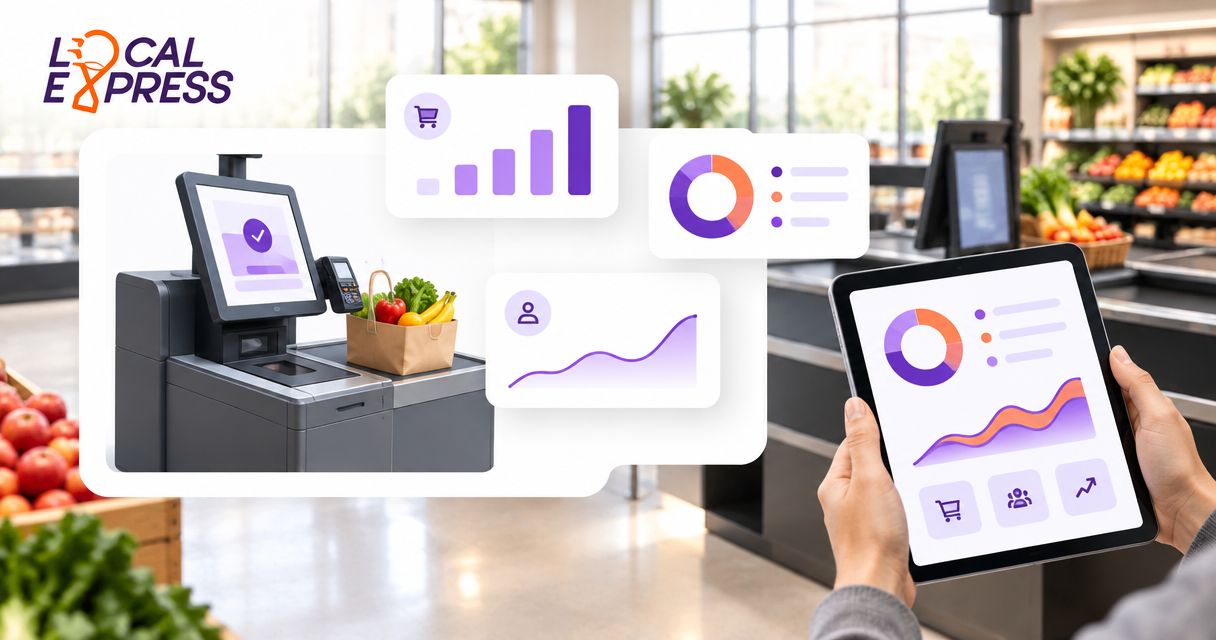
Local Express is built specifically for regional and independent grocers, not adapted from a restaurant playbook. It runs the ecommerce website, the branded mobile app, self-service kiosks for prepared food, order management, and last-mile delivery from one back end, so a customer's cart, loyalty, and order history look the same whether they order from the app or walk up to a kiosk.
Where Local Express shines
- Handles a full grocery catalog, including weighted items and multi-department inventory, not just a short prepared-food menu
- Runs SNAP/EBT online ordering as a native checkout option, not a bolt-on
- Ties kiosk ordering for MTO kitchens into the same order management system as web and app orders
- Includes retail media tools so grocers can sell shelf space to CPG brands without a national ad network
Where Local Express falls short
- Overkill for a store that only needs a countertop kitchen display and doesn't want a full digital storefront
- Onboarding a multi-department catalog takes more setup time than a single-menu restaurant POS
Best for: grocers who want one platform for ecommerce, kiosk, and delivery instead of stitching together restaurant tools.
| Dimension | Local Express | Toast |
|---|---|---|
| Full grocery ecommerce catalog | Yes | No — restaurant/menu-style ordering only |
| SNAP/EBT online ordering | Yes | Not built for grocery SNAP/EBT |
| Kiosk + kitchen display for MTO | Yes | Yes, strong for single-counter use |
| Retail media and loyalty | Yes | Not a core feature |
2. Square: best for simple, low-complexity checkout
Square covers point-of-sale and payments for small grocery and convenience operations that don't need a full ecommerce catalog. It's fast to set up and the hardware is widely available, which matters for a single-location store replacing a register.
Where Square shines
- Quick setup with minimal training for cashiers
- Broad, easy-to-source hardware options
Where Square falls short
- Not built for grocery-specific needs like weighted-item barcodes or SNAP/EBT online ordering
- No native branded app or kiosk-to-delivery order flow for a full grocery catalog
Best for: a single small grocery or convenience counter that mainly needs a register replacement, not a digital storefront.
3. Clover: best for customizable POS hardware
Clover works through an app marketplace, so independent grocers pick and add POS functions as they grow instead of committing to one fixed software stack. That flexibility appeals to owners who want to control which features they pay for.
Where Clover shines
- Modular approach lets you add functions instead of taking a full suite
- Hardware options fit a range of counter sizes
Where Clover falls short
- Grocery-specific features like delivery zone management and SNAP/EBT online checkout aren't native
- Relying on third-party apps for core grocery functions adds ongoing management overhead
Best for: independent retailers who want to build a POS stack piece by piece rather than adopt one platform.
4. Lightspeed Retail: best for inventory-heavy specialty grocery
Lightspeed Retail leans hard into inventory and multi-location reporting, which suits specialty grocers with large, frequently changing catalogs. It's a retail-first tool, so it doesn't carry Toast's kitchen display strength.
Where Lightspeed Retail shines
- Deep inventory tracking and multi-location reporting
- Built for retail catalogs, not adapted from restaurant software
Where Lightspeed Retail falls short
- No kitchen display system for a deli or prepared foods counter
- Ecommerce and delivery capabilities are thinner than a grocery-native unified commerce platform
Best for: specialty grocers whose main pain point is inventory control, not prepared food ordering.
Why people switch from Toast
- No native grocery ecommerce catalog. Toast's ordering flow is built for a short restaurant menu, not thousands of grocery SKUs across departments.
- No built-in SNAP/EBT online checkout. Grocers who want to offer SNAP/EBT at online checkout need a platform built around it, not layered on top.
- No owned delivery network. Toast doesn't give grocers a way to run last-mile delivery without routing through outside marketplaces.
- No retail media or loyalty layer. Grocers looking to monetize shelf space or run loyalty programs need tools built for retail, not restaurant tickets.
- Restaurant-first roadmap. Feature updates prioritize dining and quick-service use cases over grocery-specific problems like weighted-item handling or substitution rules.
See a unified grocery commerce platform
One system for web, app, kiosk, and delivery.
When staying with Toast is the right call
If your only digital need is a prepared foods or deli counter running on a kitchen display with no plan to build a full ecommerce site, app, or delivery operation, Toast still does that job well in 2026. Switching platforms only pays off once the gap — a missing SNAP/EBT checkout, no owned app, no delivery network — is actually costing you sales or customer retention.
FAQ
What is the best Toast alternative for grocery stores in 2026?
Local Express is the strongest option in 2026 for grocers who need ecommerce, a branded app, kiosk ordering, and delivery under one platform. Toast remains a solid choice for a single prepared foods counter that only needs a kitchen display and POS.
Is Toast good for grocery stores?
Toast works well for a grocery store's deli or prepared foods counter because of its kitchen display system and restaurant POS. It isn't built for a full grocery ecommerce catalog, SNAP/EBT online checkout, or multi-department inventory.
Does Toast support SNAP/EBT online ordering?
Toast is built around restaurant checkout, not grocery SNAP/EBT online ordering. Grocers who need SNAP/EBT at online checkout need a platform built specifically for grocery compliance.
Can Toast run a full grocery ecommerce website?
No, Toast's ordering flow is designed for short restaurant-style menus, not a full grocery catalog with thousands of SKUs across departments. Grocers wanting a complete ecommerce site typically pair or replace Toast with a grocery-native platform.
Is Square or Clover better for a small grocery store switching from Toast?
Both work for simple checkout needs, but neither is built for grocery-specific features like weighted-item barcodes or SNAP/EBT online ordering. Square favors fast setup and hardware availability, while Clover favors a modular, add-as-you-grow app approach.
Does Lightspeed Retail integrate with a kitchen display system?
Lightspeed Retail is built for inventory and multi-location retail reporting, not for kitchen display workflows. Grocers with a deli or MTO counter still need a separate kitchen display setup alongside it.
How much does switching from Toast cost a grocery store?
Migration cost depends on catalog size, integration needs, and how many channels you're consolidating, so it varies by store. A phased pilot before a full rollout is the most common way grocers control that cost.
Can a grocery store keep Toast for the deli counter and add another platform for ecommerce?
Yes, some grocers keep Toast for prepared food kitchen display work while running a separate platform for ecommerce, app, and delivery. The tradeoff is managing two systems instead of one unified order flow.
One last thing
The complaint that pushes grocers off Toast usually isn't cost — it's onboarding friction around things Toast was never built to handle, like weighted-item barcodes and SNAP/EBT-eligible SKUs. If that friction shows up in your first month of trying to expand beyond the deli counter, it's not going to fix itself by 2026's next feature release; it's a sign the platform's ceiling is the actual problem.