Loyalty programs live or die on where the points actually show up — cart, kiosk, delivery order, or nowhere at all. This guide walks through how to integrate loyalty rewards into a grocery app that's white-labeled, so points, redemption, and customer data stay yours instead of a marketplace's.
- Define the reward structure (points, tiers, or punch-card) before any integration work starts in 2026.
- Loyalty data has to sync across web, app, and kiosk or customers stop trusting the balance.
- Push notification and SMS nudges convert redemption 2-3x better than in-app banners alone.
- Pilot with one store group for 30-60 days before rolling loyalty fleet-wide.
- A white-label grocery app that owns loyalty data beats a marketplace app every time on repeat-order economics.
Why this matters
A loyalty program bolted onto a third-party marketplace app benefits the marketplace, not the grocer — the data, the customer relationship, and the margin all flow somewhere else. When loyalty rewards live inside a white-label grocery app you control, every redemption event becomes a data point you own: what customers buy, how often, and what actually gets them back in the next week.
Grocers running their own branded mobile app in 2026 are doing it specifically to reclaim that margin and that customer record. Loyalty is the mechanism that keeps shoppers ordering direct instead of drifting back to a delivery marketplace that takes a cut of every basket.
What you'll need
- A decided reward structure — points-per-dollar, tiered spend thresholds, or a punch-card model
- A customer profile system that can hold loyalty balances alongside order history
- Integration points across your branded mobile app, ecommerce website, and any in-store kiosk
- A checkout flow that can apply and display point redemption in real time
- A push/SMS tool for redemption reminders and expiring-points alerts
- Staff training so front-of-store teams honor the same point balance the app shows
- A pilot store or region to test before a full rollout
The steps
1. Define the reward structure before writing a line of code
Decide whether you're running points-per-dollar, spend tiers, or a punch-card model before any developer touches an integration. This single decision drives everything downstream — the database schema, the checkout logic, the redemption rules.
Most regional grocers land on a simple points-per-dollar model (1 point per $1, redeemable at a fixed threshold) because it's easy to explain at checkout and easy to audit. Punch-card models work better for single-category retailers — a cheese shop or a coffee roaster — where the reward ties to a specific product, not total spend. Pick one and resist stacking multiple structures at launch; that's how redemption math breaks in month two.
2. Map loyalty data to your customer profile system
Every loyalty transaction needs to attach to a single customer record, not a device ID or a guest checkout session. If your app lets people order without an account, loyalty accrual quietly leaks — points get earned by a session that disappears the moment the app closes.
Require account creation (or at minimum phone-number matching) before a point can accrue. This is also the moment to decide how loyalty data feeds your broader customer profile — order frequency, average basket, and category preference all get more useful once loyalty ties them to a real identity.
3. Wire loyalty into checkout and cart flow
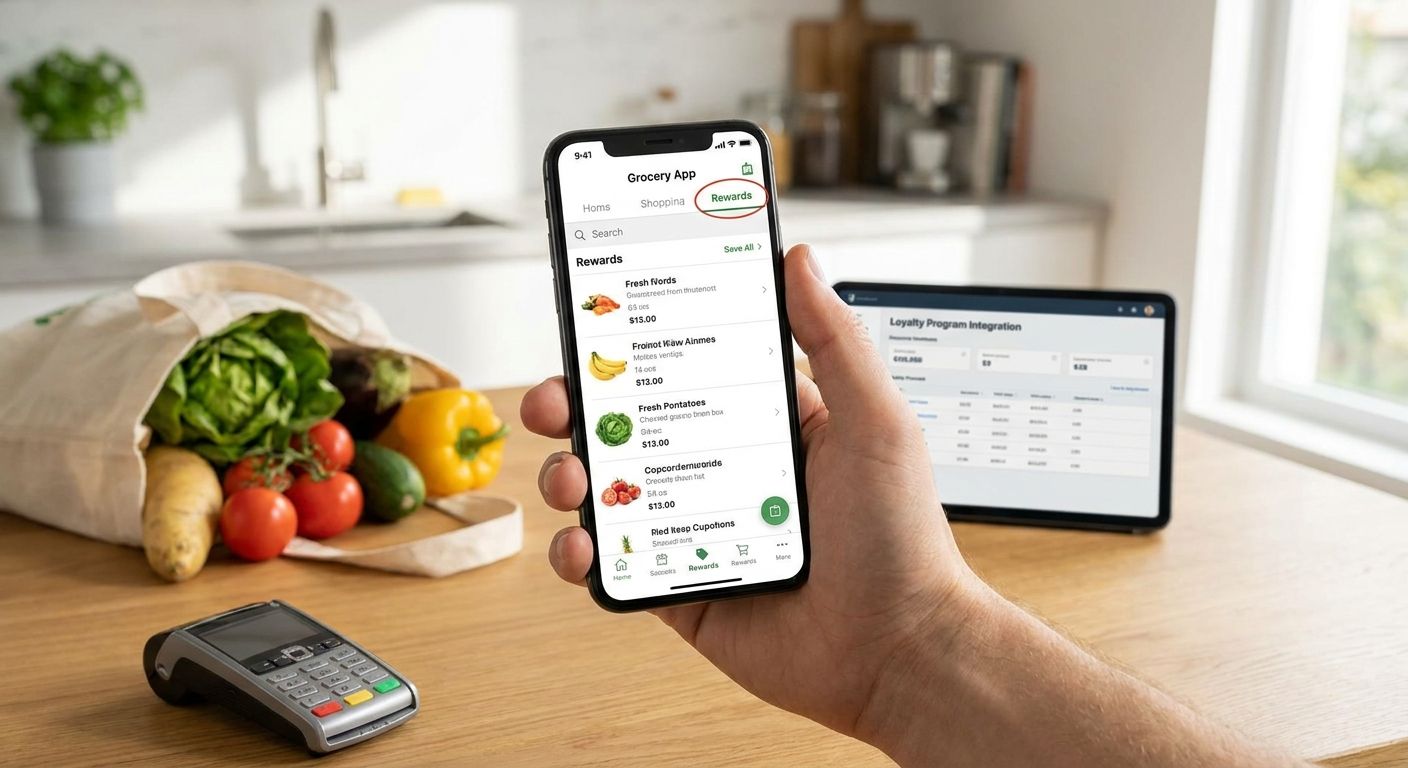
The checkout screen has to show the current balance, the points this order will earn, and the redemption option, all in one view. Hiding redemption behind a separate "rewards" tab kills usage — customers redeem when it's visible at the moment of payment, not when they have to go looking for it.
Build the redemption toggle so it recalculates the order total instantly. A half-second lag between tapping "redeem" and seeing the discount apply reads as broken, and shoppers abandon carts over exactly that kind of friction.
4. Connect points to the kiosk and in-store POS
A shopper who earns points online and can't redeem them at a self-service kiosk or checkout counter loses trust in the whole program fast. Loyalty has to run through centralized order management across web, app, and kiosk channels so the balance is identical no matter where the order originates.
This is the integration step most grocers underestimate. Web-to-app sync is straightforward; web-to-kiosk-to-POS sync is where loyalty programs actually break in production if the systems weren't built to talk to each other from day one.
5. Trigger push and SMS nudges for redemption
A point balance sitting unused in an app is a missed order, not a saved reward. Set up automated triggers — "you have 450 points, redeem them on your next order" — through push notification and SMS marketing tools built for grocery apps.
Time these around natural reorder windows: three days after a typical grocery cycle, or 48 hours before points are set to expire if you're running an expiration policy. Skip the daily blast — loyalty nudges lose effectiveness fast when they show up more than once or twice a week.
6. Test the redemption math end to end
Run a full test cycle before launch: earn points on a web order, redeem half of them on an app order, confirm the balance updates instantly, then redeem the rest at a kiosk. If any leg of that chain shows a different balance than the others, the integration isn't ready.
Check edge cases specifically — a refunded order should claw back the points it earned, and a canceled redemption should restore the points that were spent. These are the scenarios that surface in customer support tickets, not in a demo environment.
7. Launch to a pilot store group before rolling fleet-wide
Pick one store or a small regional cluster and run loyalty there for 30 to 60 days before extending it across every location. This surfaces sync issues, staff training gaps, and redemption abuse patterns while the blast radius is small.
Track basket size and repeat-order rate for the pilot group against a control group without loyalty active. That comparison is the number that justifies (or kills) a fleet-wide rollout in 2026.
Build loyalty into your own branded app
See how a white-label grocery platform handles loyalty, kiosk, and order sync in one system.
Troubleshooting
- Points don't match between app and kiosk — usually a sign that the kiosk is running on a separate order system instead of a shared order management layer. Fix the sync point, not the display.
- Customers report points disappearing — check for a refund or cancellation that clawed back points without a customer-facing notice. Add an automated alert for any point deduction.
- Redemption abuse from duplicate accounts — cap loyalty accrual per verified phone number or payment method, not per app install.
- Staff won't honor points at checkout — this is a training gap, not a technical one. Loyalty balances need to be visible on the same POS screen cashiers already use.
- Redemption rate stays flat despite a healthy point balance — the nudge cadence is probably too quiet or badly timed; revisit the push/SMS triggers before touching the reward structure itself.
- Cart abandonment spikes when redemption is applied — the discount recalculation is likely too slow; test it against the checkout flow directly.
Tools and resources
- A branded mobile app with account-based checkout, not guest-only ordering
- A centralized order management layer that spans web, app, and kiosk
- Push notification and SMS tooling with trigger-based (not just blast) sending
- POS or kiosk hardware that reads the same customer record as the app
- A pilot store group and a control group for measuring lift
What to do next
Once loyalty is live and stable, the next lever is checkout friction itself. If redemption isn't moving the needle on repeat orders, look at reducing cart abandonment on your grocery ecommerce website — loyalty and abandonment are two sides of the same checkout experience, and fixing one without the other leaves basket value on the table.
FAQ
What's the best way to integrate loyalty rewards into a grocery app?
Start with one reward structure — points-per-dollar is the simplest to launch — and sync it across web, app, and kiosk before adding tiers or promotions. Grocers that launch with a single structure in 2026 see fewer redemption errors in the first 90 days than those launching multiple reward types at once.
Do loyalty points need to sync across web, app, and kiosk?
Yes — a balance that differs by channel breaks customer trust immediately. Route loyalty through a centralized order management system so every channel reads the same number.
Is a punch-card loyalty program better than a points system for grocery?
Punch-cards work best for single-category retailers like a deli or coffee shop; points-per-dollar suits general grocery better because it scales across a full basket. The right choice depends on whether your store sells one category or hundreds.
How long does it take to launch loyalty rewards in a grocery app?
A pilot rollout typically runs 30 to 60 days in a single store or small cluster before expanding fleet-wide. That window is enough to surface sync issues and measure repeat-order lift against a control group.
Can loyalty rewards work alongside SNAP/EBT orders?
Loyalty points can accrue on the non-SNAP portion of a mixed-payment order, but redemption rules need to route around SNAP-eligible items specifically, since federal program funds can't be discounted through a loyalty redemption.
What happens to loyalty points when a customer shops in-store versus online?
Points should accrue and redeem identically regardless of channel, provided the in-store kiosk or POS reads the same customer record as the app. If it doesn't, the point balance splits and customers lose trust in the program fast.
Do loyalty rewards actually reduce dependency on delivery marketplaces?
Loyalty rewards give shoppers a reason to order direct instead of through a third-party marketplace, since points only accrue inside the grocer's own app or site. Grocers moving off marketplace apps in 2026 often pair loyalty launch with a broader migration plan.
One last thing
The grocers who get the most out of loyalty in 2026 aren't the ones with the richest reward tiers — they're the ones who made redemption effortless at the exact moment a customer is checking out, whether that's on the app, the website, or a kiosk. Complexity kills loyalty programs faster than a stingy reward ever will.