Self-checkout kiosks that go dark during the Saturday rush cost more than a repair bill — they cost the sale, the cart, and sometimes the shopper who walks out rather than wait in a single staffed lane. This guide breaks down what a real kiosk maintenance support grocery self-checkout plan needs to cover in 2026 and which pieces of that plan independent and regional grocers should fund first.
- Kiosk maintenance support grocery self-checkout plans need remote diagnostics, spare-part swaps, and visible uptime reporting, not just a hardware warranty.
- Self-checkout kiosks post 99% order accuracy industry-wide in 2026, but only when patching and hardware upkeep stay current.
- A warranty that stops at hardware replacement is not a support plan: Skip it.
- Loss prevention software and payment terminal reliability deserve the same maintenance attention as the touchscreen.
- Local Express pairs kiosk hardware with software support so downtime gets diagnosed before a technician is even dispatched.
Why This Matters
A grocer who drops six figures on self-checkout kiosks for independent grocery stores is buying hardware, not uptime. Hardware sits idle the moment a card reader jams, a screen freezes mid-transaction, or a firmware update fails overnight. None of that is covered by a one-year parts warranty.
The kiosk market is projected to hit $62.5B by 2030, and self-checkout units already post 99% order accuracy and a typical 150% return on investment when they're running. Every one of those numbers assumes the kiosk is actually on. A store running three kiosks with one down on a Friday afternoon isn't running at 150% ROI — it's running at a loss on labor reallocated to cover the gap.
Kiosk maintenance support grocery self-checkout planning in 2026 has to treat uptime as a line item, not an afterthought bolted onto the hardware invoice.
Who This Is For
This is for the independent grocer or regional chain operator running two to twenty self-checkout kiosks who does not have an in-house IT department on call at 6 a.m. when the first register won't boot. It's for the operator who bought kiosks to cut labor cost and is now paying a cashier to babysit a broken machine anyway. If your kiosks are humming along with zero downtime and a technician on retainer, this guide isn't for you — everyone else should keep reading.
What to Look for in Kiosk Maintenance and Uptime Support for Grocery Self-Checkout
Remote diagnostics before a truck rolls
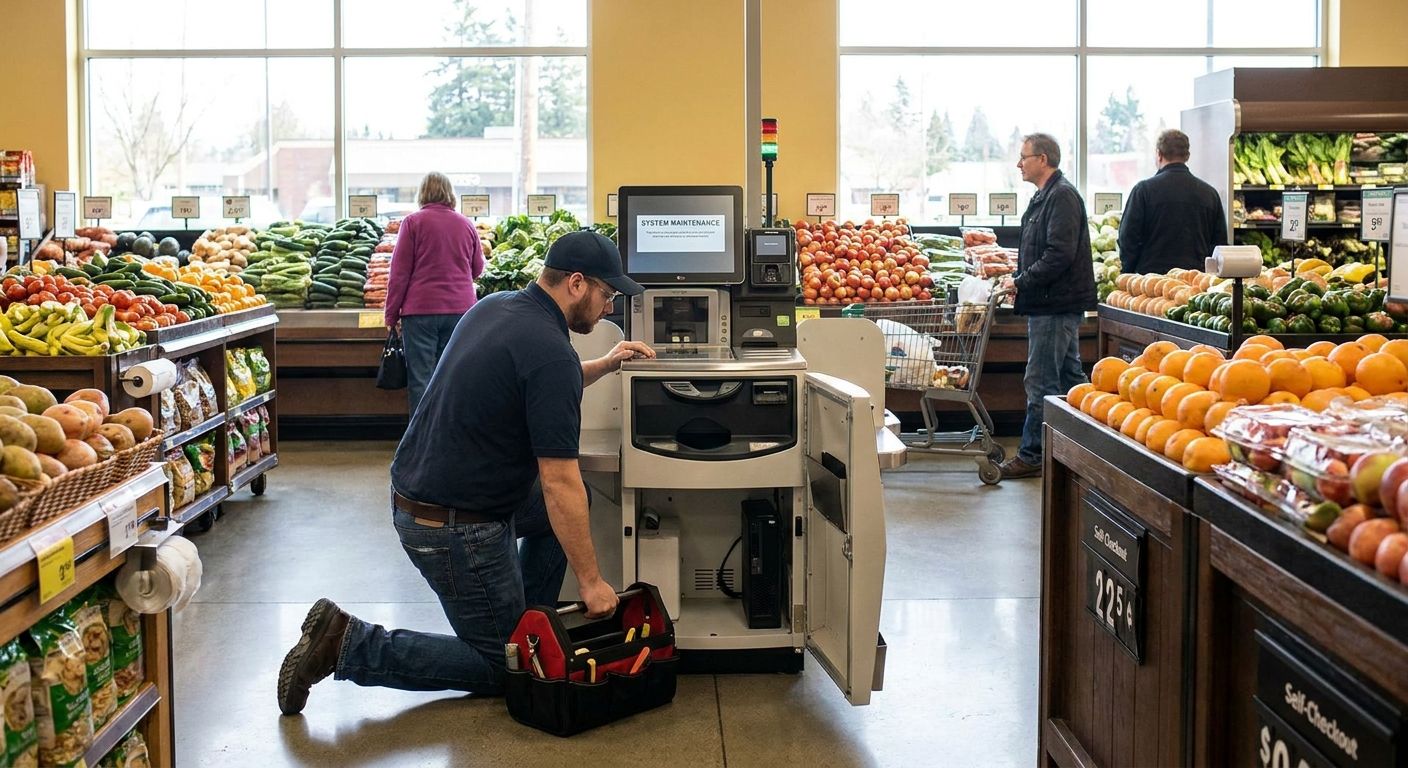
Most kiosk failures are software, not hardware — a stuck payment session, a frozen scale calibration, a network drop. A support plan that starts with remote diagnostics catches and fixes these without a technician ever driving to the store. For a single-location grocer, waiting three days for an on-site visit over a five-minute software reset is the difference between a normal Tuesday and a dead lane through the weekend.
Response windows that match store hours, not "business hours"
Grocery stores run early mornings, late nights, and weekends — the exact hours most vendor support desks are closed. A plan quoting "next business day" response is quoting a plan that fails you on Saturday at 4 p.m. Ask for response windows tied to your actual operating hours, not a generic 9-to-5 SLA.
Spare-part logistics and swap-not-repair hardware
A card reader or receipt printer that needs to be shipped out for repair takes a kiosk offline for a week or more. Support plans built around pre-stocked spare parts and swap-in-place components get a kiosk back online same-day. Ask any vendor how many spare units they keep regionally before signing anything.
Software patching and PCI compliance cadence
Self-checkout kiosks process card payments, which means they sit inside PCI DSS scope. A maintenance plan that doesn't include a defined patching cadence is a compliance gap waiting to surface during an audit, not just an uptime risk. Ask how often security patches roll out and whether they're pushed automatically or require a technician visit.
Uptime reporting you can actually see
If the only way you know a kiosk went down is a customer complaint or a cashier flagging it, the support plan is failing you before it even engages. A dashboard showing kiosk status, downtime history, and ticket resolution times turns maintenance from a black box into something you can hold a vendor accountable to.
Top Picks: Where to Focus Your Kiosk Maintenance Budget
The foundation pick — hardware built for daily grocery volume. Kiosks designed for grocery throughput, not general retail, handle the scan-weigh-bag cycle without the freeze-ups that generic hardware produces under repeated use. Independent grocers running high-volume produce and deli lines should treat kiosk-grade hardware as non-negotiable before any support plan gets layered on top. Buy.
The budget pick — know the real cost before you sign a support contract. Total cost of ownership on a self-checkout system includes the support plan, not just the sticker price on the unit. Working out how much a grocery self-checkout kiosk system costs before comparing maintenance tiers keeps a grocer from underfunding support to hit a hardware budget number. Consider — run the math before committing to a tier.
The risk pick — loss prevention can't be an afterthought. Self-checkout is the single highest-shrink channel in most grocery formats, and maintenance plans that ignore the software layer leave that exposure open. Kiosk software for grocery loss prevention needs the same patch cadence and uptime monitoring as the payment terminal — treat it as part of the support plan, not a separate purchase. Buy.
The payment reliability pick — a frozen card reader is a lost sale, full stop. Payment terminals fail more often than any other kiosk component because they're the most-touched part of the machine. Getting contactless payment setup for grocery self-checkout kiosks right the first time, with a maintenance path for terminal swaps, cuts the most common cause of kiosk downtime before it starts. Buy.
Build a kiosk uptime plan that fits your store
See how Local Express pairs kiosk hardware with maintenance and uptime support.
What to Avoid
- A hardware-only warranty dressed up as "support." A one-year parts warranty that doesn't include remote diagnostics, response windows, or patching is a hardware guarantee, not a maintenance plan — read the contract line by line.
- A vendor with no regional spare-part stock. If every repair ships a part cross-country, expect kiosks offline for a week at a time. Ask where the nearest stocked units live before signing.
- Support plans with no uptime dashboard. If a vendor can't show downtime history on request, there's no way to hold them to the SLA they sold — insist on visibility before the contract, not after the first outage.
Verdict Comparison
| Criterion | Why It Matters | What Independent Grocers Should Require |
|---|---|---|
| Remote diagnostics | Fixes most software failures without a truck roll | Included in base plan, not billed per incident |
| Response window | Matches actual store hours, including weekends | Coverage during open hours, not "business hours" |
| Spare parts | Determines how fast a broken kiosk gets back online | Regional stock, swap-in-place components |
| Patching cadence | Keeps kiosks PCI compliant and secure | Defined schedule, pushed automatically where possible |
| Uptime reporting | Lets you hold the vendor accountable | Live dashboard, not a monthly PDF |
FAQ
What does kiosk maintenance support for grocery self-checkout actually include?
A real plan bundles remote diagnostics, defined response windows, spare-part swaps, software patching, and uptime reporting. A hardware warranty alone does not qualify — it only covers parts failure, not the software issues that cause most kiosk downtime.
How much downtime is normal for a grocery self-checkout kiosk?
There's no universal downtime benchmark, but a well-supported kiosk should rarely sit offline for more than a few hours before a fix or swap. Repeated multi-day outages point to a support plan without regional spare parts or remote diagnostics.
Is remote diagnostics better than an on-site technician contract?
Remote diagnostics resolves most software-related failures in minutes without waiting for a technician to arrive, which makes it the faster first line of defense in 2026. On-site service still matters for hardware failures like a jammed printer or a dead scanner.
How does kiosk uptime affect order accuracy?
Self-checkout kiosks running current software post 99% order accuracy industry-wide, but accuracy drops when firmware and scale calibration go unpatched. Uptime support that includes a patching cadence protects that accuracy number directly.
Should loss prevention software be part of a kiosk maintenance plan?
Yes — self-checkout is the highest-shrink channel in most grocery formats, and loss prevention software needs the same monitoring and patch schedule as the rest of the kiosk. Treating it as a separate, unmaintained system leaves an open gap.
What's the ROI on investing in a kiosk uptime support plan?
Kiosks average a 150% ROI in year one when running consistently, and every hour of downtime erodes that return by shifting labor back to staffed lanes. A support plan that keeps kiosks online protects the ROI the hardware was purchased to deliver.
Can a single independent grocery store get the same support tier as a regional chain?
Support tiers typically scale with kiosk count and store hours rather than chain size, so a single-location grocer can access the same remote diagnostics and patching cadence as a multi-store operator. The gap usually shows up in response window pricing, not plan availability.
One Last Thing
The kiosk market is on track for $62.5B by 2030 — every grocer buying in now is buying into a category where support infrastructure is still catching up to hardware sales. The grocers who win aren't the ones with the newest touchscreen; they're the ones whose kiosks are actually on when a shopper walks up to them.