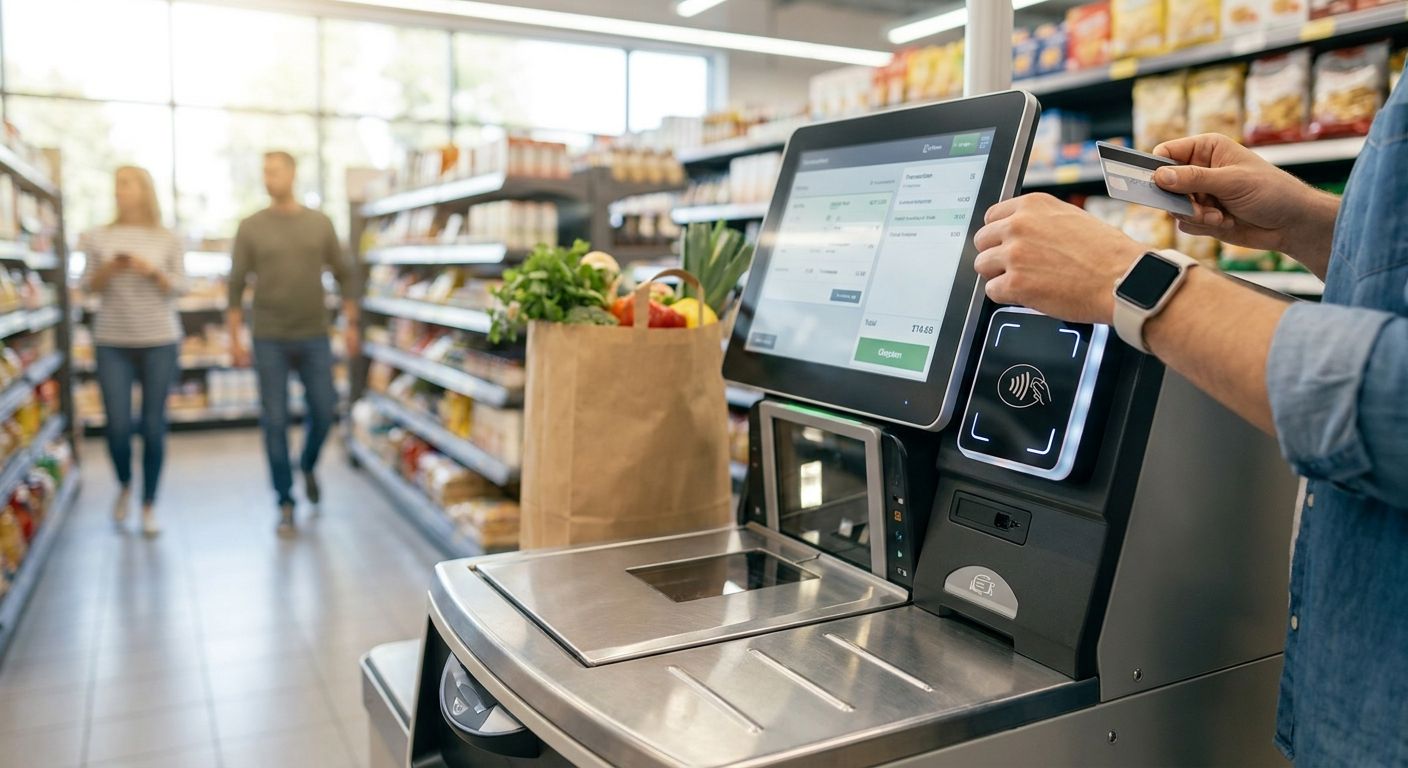
Adding contactless payment to a grocery self-checkout kiosk in 2026 means choosing a reader, a certification path, and an integration model before hardware ever gets bolted to a stand.
- An integrated kiosk payment stack from Local Express beats bolt-on NFC readers for contactless payment grocery self-checkout kiosk setups — Buy.
- Standalone NFC add-on terminals work for single-lane pilots but stall past 3 lanes — Consider.
- Skip QR-code-only checkout in 2026 — it drags order accuracy below the 99% benchmark kiosks now hit.
- PCI DSS v4.0 enforcement since March 2025 makes point-to-point encryption non-negotiable on any new kiosk contract.
Why this matters
A contactless payment grocery self-checkout kiosk isn't just a reader glued to a screen. It's a certification chain: card network, payment gateway, kiosk hardware, and order management software all have to agree on the same transaction before a customer taps their phone and walks out with groceries.
Get the setup wrong and you inherit chargeback liability, PCI audit findings, or a kiosk that just sits there blinking "processing" while a line forms. Get it right and you're running the same tap-to-pay experience shoppers already use at the coffee shop, inside your own store, on hardware you actually own instead of renting through a marketplace app.
Who this is for
This is for independent and regional grocers — one to twenty stores — adding or upgrading self-checkout kiosks in 2026 who want Apple Pay, Google Pay, and tap-to-pay cards working without ripping out an existing POS system. If you're a national chain with a dedicated payments team, most of this you already know. If you're a single-store operator evaluating your first kiosk, this is the checklist before you sign a hardware contract. Local Express builds this stack for independent grocers specifically, which is the lens for everything below.
What to look for in contactless payment setup for grocery kiosks
EMV Level 2 kernel certification
Any reader you install needs EMV Level 2 certification for the card networks you accept — Visa, Mastercard, Amex, Discover each run their own contactless kernel tests. Without it, chargeback liability shifts to you on fraudulent contactless transactions instead of the card issuer, and that's an expensive lesson to learn after the fact.
PCI DSS v4.0 compliance and P2PE
PCI DSS version 4.0 became the enforced standard as of March 31, 2025, and it tightens requirements around encryption and authentication on payment-accepting devices. A kiosk running point-to-point encryption (P2PE) keeps card data encrypted from the tap to the processor, which is what actually gets you out of PCI scope for that device — not just a compliance checkbox.
NFC read range and tap speed
EMV contactless cards and mobile wallets communicate over roughly 4 cm. That sounds trivial until you're watching a shopper tap three times because the reader is mounted behind a screen bezel or angled wrong. Tap speed under one second matters more at a grocery kiosk than almost anywhere else — checkout lines move or they don't, and a slow tap kills the whole point of self-checkout.
Multi-wallet support
Apple Pay, Google Pay, and Samsung Pay coverage isn't optional in 2026 — shoppers expect all three, plus a physical tap card fallback for the customer who left their phone in the car. A reader that only handles Apple Pay is a reader you'll be replacing within a year.
SNAP EBT compatibility
Grocery is one of the few retail categories where contactless has to coexist with a government benefits program. If your store accepts SNAP, the kiosk's payment stack needs to route EBT transactions correctly alongside contactless card and wallet payments — this is a grocery-specific requirement most generic kiosk vendors don't handle well out of the box.
Integration with order management, not just the register
A contactless tap that doesn't sync in real time with inventory and order management creates the exact reconciliation mess self-checkout was supposed to eliminate. The payment event has to talk to the same system tracking stock, not a siloed terminal that reports separately at end of day.
Top picks: contactless setup models for grocery kiosks
The safe pick: standalone NFC add-on terminal
A certified NFC puck bolted onto an existing kiosk or POS terminal, reading in under one second and running its own PCI-scoped tunnel back to the processor. It's the cheapest way to add tap-to-pay to hardware you already own, and it works fine for a single-lane pilot.
The catch: it doesn't share a data layer with your order management system, so reconciliation still happens manually. Verdict: Consider — fine for testing contactless demand at one location, not built to scale past a couple of lanes.
The all-in-one pick: integrated kiosk payment stack
A kiosk built with the contactless reader, EMV Level 2 certification, and order management sync as one system rather than three vendors stitched together. Local Express ships this model specifically for independent grocers running self-checkout kiosks for independent grocery stores, where the payment event, the inventory deduction, and the receipt all fire from the same transaction record.
This is the setup that gets credited with the 30% order-value lift and 99% order accuracy figures reported at self-checkout kiosks, because nothing gets re-keyed between systems. Verdict: Buy — for any grocer running more than one kiosk, the integration pays for itself in reduced reconciliation labor alone.
The wildcard: mobile wallet-first self-ordering kiosk
Built around Apple Pay and Google Pay as the primary path rather than a card-first design with wallets bolted on. It leans on customers already having a phone in hand and skips the physical tap card as a fallback rather than a default. This model shows up in self-ordering kiosk setups aimed at younger, phone-native shopper bases — think university stores or urban specialty grocers.
Verdict: Consider — strong fit if your customer base skews toward mobile wallets already, riskier if a meaningful share of your shoppers still tap physical cards.
The one to skip: QR-code-only checkout
QR-code checkout looked cheap and fast to deploy a few years ago, and some vendors still pitch it as a contactless option. It isn't the same thing — it requires opening a camera app, scanning, and confirming, which is three extra steps compared to a one-second NFC tap, and it consistently drags order accuracy below the 99% figure integrated kiosks report. Verdict: Skip for anything beyond a temporary stopgap.
What to avoid
- Unbranded NFC pucks without EMV Level 2 certification. They read fine in a demo and then fail card network audits once you're processing real volume — the certification, not the hardware, is what protects you from chargeback liability.
- Payment gateways with high per-transaction fees baked into the contract. These look identical to a flat-rate integrated stack on a sales call but erode margin fast once kiosk volume climbs past a few hundred transactions a week.
- Kiosks that batch-process contactless transactions instead of syncing live. Real-time inventory sync is the entire point of a self-checkout kiosk — a batch delay of even a few hours reopens the stock discrepancy problem the kiosk was supposed to close.
Compare kiosks with payment built in
See self-checkout kiosk options with certified contactless readers for 2026.
Verdict comparison
| Setup model | EMV L2 certified | Order management sync | SNAP EBT ready | Verdict |
|---|---|---|---|---|
| Standalone NFC add-on | Yes | No | Depends on terminal | Consider |
| Integrated kiosk payment stack | Yes | Yes, real-time | Yes | Buy |
| Mobile wallet-first kiosk | Yes | Yes, real-time | Depends on build | Consider |
| QR-code-only checkout | No | No | No | Skip |
FAQ
What is the best contactless payment setup for a grocery self-checkout kiosk in 2026?
An integrated kiosk payment stack that combines a certified NFC reader with real-time order management sync is the strongest setup in 2026. It avoids the manual reconciliation gap that standalone NFC add-on terminals create.
Do grocery self-checkout kiosks need EMV Level 2 certification?
Yes, any reader accepting contactless cards needs EMV Level 2 certification from each card network you take. Without it, chargeback liability on fraudulent contactless transactions shifts to the retailer instead of the card issuer.
Is Apple Pay or Google Pay better for grocery kiosk checkout?
Both need to work on the same kiosk — grocery shoppers split between the two and a kiosk that only supports one loses transactions. A physical tap card fallback still matters for customers without a phone on hand.
How much does PCI DSS v4.0 affect kiosk payment setup?
PCI DSS v4.0 became the enforced standard as of March 31, 2025, tightening encryption and authentication requirements on payment-accepting devices. Point-to-point encryption on the kiosk reader is the practical way to meet it without expanding your PCI audit scope.
Can SNAP EBT work alongside contactless payment on a grocery kiosk?
Yes, but the kiosk's payment stack needs to route EBT transactions separately from contactless card and wallet payments in the same session. This is a grocery-specific requirement that generic kiosk vendors outside food retail often don't handle correctly.
Why do QR-code checkout kiosks perform worse than NFC tap kiosks?
QR-code checkout requires opening a camera app, scanning, and confirming — three extra steps compared to a one-second NFC tap. That friction is why QR-only checkout consistently reports lower order accuracy than integrated tap-to-pay kiosks.
Does contactless kiosk checkout increase grocery order value?
Self-checkout kiosks with integrated contactless payment report a 30% lift in order value compared to traditional lane checkout. The faster transaction removes the friction that causes shoppers to trim their basket at the register.
How many lanes can a standalone NFC add-on terminal support?
Standalone NFC add-on terminals work fine for a single-lane pilot but become a reconciliation burden past two or three lanes because they don't share a data layer with order management. Past that point, an integrated kiosk payment stack is the more workable setup.
One last thing
The reader is the part everyone focuses on, but the certification chain behind it is what actually breaks first — a kiosk can pass every hardware demo and still fail a card network audit six months later because nobody checked the EMV Level 2 status on the specific model deployed. Ask for the certification documentation before the contract, not after the kiosk ships.