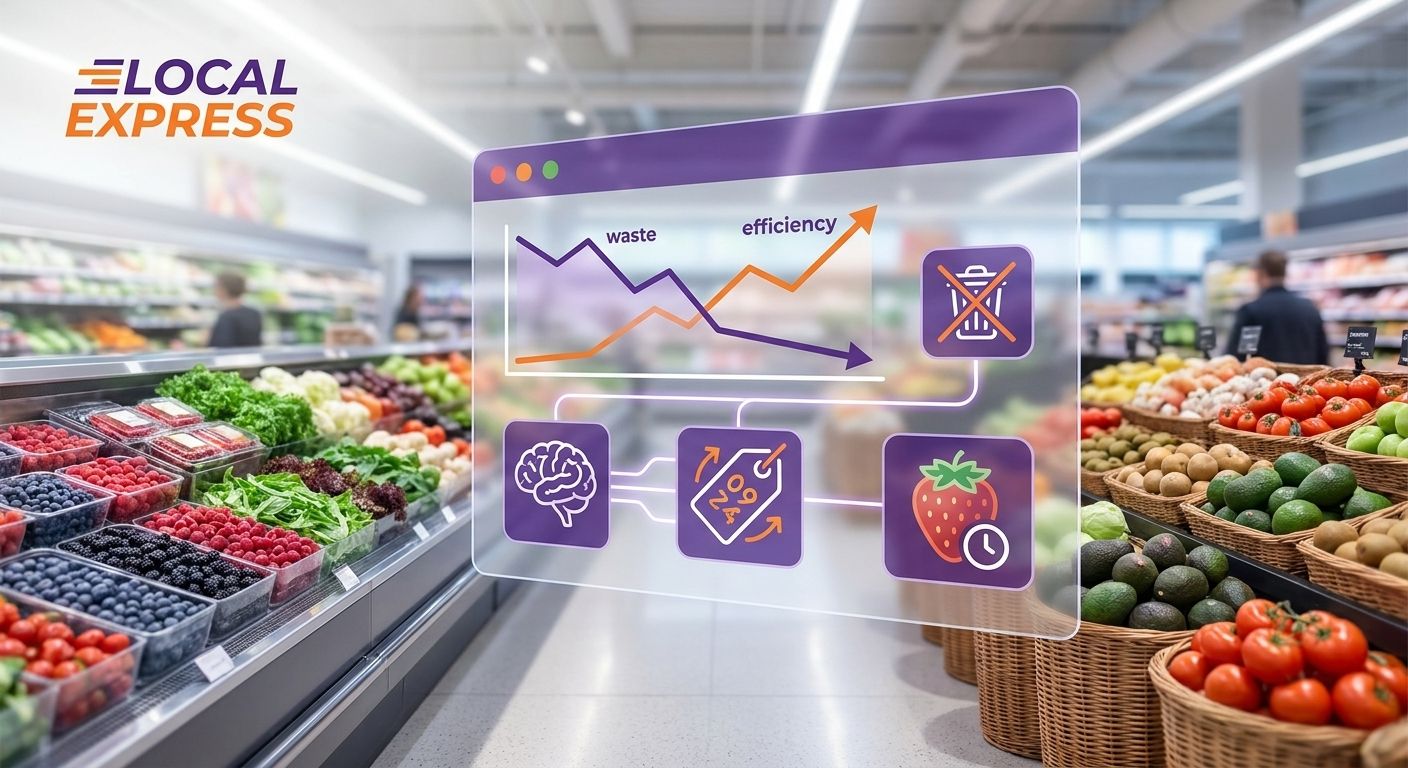
AI dynamic pricing for perishable grocery works by automatically discounting produce, meat, dairy, and prepared food as they approach their sell-by date, using live inventory and expiration data instead of a manager's daily walk-through. The system cuts waste because the price drops the moment shelf life data says it should, not a day or two later when a staff member finally notices.
- AI dynamic pricing perishable grocery systems trigger markdowns automatically as sell-by dates approach, closing the gap manual checks miss.
- USDA estimates 30-40% of the U.S. food supply goes to waste, and perishable stock sitting past its ideal sell window drives a large share of that.
- Produce and meat shrink commonly runs 5-10% of sales at independent grocers, well above the 1-2% typical for center-store dry goods.
- Local Express and comparable unified commerce platforms tie pricing logic to real-time inventory and expiration data across web, app, and in-store channels.
- Manual markdown schedules react a day or two late; AI pricing reacts within hours of a shelf-life or demand signal changing.
Why this matters for regional and independent grocers
Shrink on perishables is a margin problem before it's a sustainability problem. When produce, meat, and prepared food sit past their ideal sell window, the loss shows up directly on the P&L, and independent grocers don't have the buying scale to absorb it the way national chains do.
Manual markdown routines depend on someone walking the deli case or produce section and deciding what to discount, usually once or twice a day. A perishable inventory forecasting tool closes part of that gap by flagging what's likely to go unsold before it happens, but forecasting alone doesn't move price. AI dynamic pricing is the layer that acts on the forecast automatically, in 2026 increasingly built directly into the same platform that runs your ecommerce site, app, and kiosks.
The payoff shows up fastest in categories with the shortest shelf life: fresh produce, seafood, deli meat, bakery, and prepared meals from a hot bar or MTO kitchen. These are exactly the categories where shrink runs 5-10% of sales at many independent stores, compared with 1-2% for shelf-stable dry goods.
How AI dynamic pricing cuts perishable grocery waste
The mechanics are consistent across most unified commerce platforms, though the sophistication of the pricing logic varies. Here's the sequence:
- Real-time inventory and expiration tracking. Every SKU gets tagged with a shelf-life window, either from a receiving date, a pack date, or a sell-by date scanned at intake.
- Demand and velocity signals feed the pricing engine. The system tracks how fast a SKU is actually selling against how much is left and how many hours or days remain before it expires.
- Automated markdown triggers fire by category and shelf life. Fast-spoiling categories like berries or fresh fish get triggers set at 24-48 hours before expiration; slower categories like packaged deli meat get longer windows.
- Price updates sync across every channel at once. The discounted price shows up in-store, on the ecommerce site, in the branded app, and at the self-checkout kiosk simultaneously, so a customer never sees two different prices for the same item.
- The forecast retrains on what actually sold. Every markdown outcome feeds back into the demand model, so the system gets sharper at predicting which SKUs need earlier intervention next cycle.
Manual markdowns vs. rule-based schedules vs. AI dynamic pricing
| Approach | How discounts are triggered | Labor required | Best for |
|---|---|---|---|
| Manual markdowns | Staff judgment during a shelf walk, once or twice daily | High — someone has to check every case | Single-location stores with a hands-on produce or deli manager. Verdict: Wait if waste is already a recurring line item. |
| Rule-based schedules | Fixed discount on a fixed day (e.g., 30% off on day 3) | Low, but rigid | Stores wanting predictability over precision. Verdict: Hold as a stopgap, not a long-term fix. |
| AI dynamic pricing | Live inventory, velocity, and expiration data trigger price changes automatically | Low after setup | Multi-category perishable operations, multi-location chains, or any grocer running ecommerce alongside a physical store. Verdict: Buy for stores serious about cutting shrink in 2026. |
For grocers already running AI inventory replenishment workflows, dynamic pricing is usually the next logical layer — the replenishment side controls what comes in, the pricing side controls what moves out before it spoils.
“If a markdown isn't triggered until the sell-by date, the waste already happened — the discount is just paperwork at that point.”
Why perishable waste happens in the first place
AI pricing fixes the symptom faster, but it's worth knowing what causes the waste it's cutting:
- Overordering to avoid empty shelves. Grocers stock heavier than actual demand to protect the visual merchandising of a full case, and the surplus becomes waste.
- Static markdown days. A fixed "30% off on day 3" rule ignores that some SKUs sell fast and others sit — one schedule can't fit both.
- No shared visibility between channels. A store running separate systems for in-store POS, ecommerce, and a self-checkout kiosk can't apply one consistent price in real time.
- Inconsistent shelf-life data at intake. If receiving doesn't log pack dates accurately, the pricing engine has nothing reliable to trigger against.
- Deli and MTO kitchen output isn't tracked the same way as packaged goods. Prepared food waste often gets written off instead of discounted, because there's no pricing mechanism built for it.
- Staff bandwidth. Even a well-trained produce team can't manually reprice hundreds of SKUs across dozens of categories every few hours.
See dynamic pricing on your own catalog
Local Express runs pricing, inventory, and ecommerce on one platform.
How does AI dynamic pricing work in a grocery store?
AI dynamic pricing works by connecting inventory data, expiration dates, and sales velocity to a pricing engine that adjusts prices automatically, without a manager entering a discount by hand. The engine checks shelf-life windows against how fast each SKU is moving, then triggers a markdown when the item is at risk of going unsold before its sell-by date. Local Express and similar unified commerce platforms push that price change across web, app, and in-store channels at the same time, so pricing never fragments across touchpoints.
Is AI dynamic pricing better than manual markdowns for cutting waste?
AI dynamic pricing beats manual markdowns because it reacts within hours of a shelf-life or demand change instead of waiting for the next scheduled shelf walk. Manual markdowns depend on staff catching the problem in time, which works for a single store with a dedicated produce manager but breaks down across multiple locations or multiple channels. For stores running ecommerce, an app, and a physical location at once, manual pricing almost always lags behind what the data already knows.
Which perishable categories benefit most from AI dynamic pricing?
Fresh produce, meat, seafood, dairy, bakery, and prepared or MTO food benefit most from AI dynamic pricing because they carry the shortest shelf life and the highest shrink, commonly 5-10% of sales versus 1-2% for center-store dry goods. Deli and hot bar items see an added benefit because dynamic pricing gives them a discount mechanism that didn't exist before — most stores were writing off unsold prepared food instead of marking it down. Categories with longer shelf life, like canned or frozen goods, see far less benefit since spoilage risk isn't the driving cost there.
For grocers running a full-service deli or MTO counter, pairing dynamic pricing with substitution logic matters too — when an item's discounted stock runs out mid-shift, having substitution rules for out-of-stock items keeps the online order from failing outright.
Local Express builds dynamic pricing logic into the same system that handles ecommerce, order management, and kiosk ordering, so a grocery retailer isn't stitching together separate tools for inventory, pricing, and checkout. That matters most for multi-location chains, where a price change has to reflect correctly at every store the moment it's triggered, not an hour or a day later.
FAQ
What is AI dynamic pricing for perishable grocery items?
AI dynamic pricing for perishable grocery items is an automated system that adjusts prices based on real-time inventory, expiration dates, and sales velocity. It replaces manual markdown decisions with triggers that fire before spoilage risk becomes actual waste.
How much food waste does AI dynamic pricing actually prevent?
AI dynamic pricing targets the portion of the 30-40% USDA-estimated U.S. food waste rate that comes from perishables sitting past their ideal sell window. The exact reduction depends on category mix, but fresh categories with 5-10% shrink see the largest opportunity.
Do small independent grocers need AI dynamic pricing, or is it only for big chains?
Independent grocers often benefit more from AI dynamic pricing because they can't absorb shrink the way larger chains with bigger margins can. A single-location store with produce, deli, and a prepared food counter has enough perishable SKUs to justify automated markdowns.
Does AI dynamic pricing work across ecommerce, app, and in-store channels at once?
Yes, on a unified commerce platform, an AI-triggered price change updates the ecommerce site, the branded app, and the in-store shelf or kiosk price simultaneously. Running separate systems for each channel means prices can fall out of sync, which creates customer trust problems.
What data does an AI dynamic pricing system need to work?
An AI dynamic pricing system needs accurate expiration or pack-date data at intake, real-time inventory counts, and sales velocity by SKU. Without clean intake data, the pricing engine has no reliable signal to trigger markdowns against.
How is AI dynamic pricing different from a fixed markdown schedule?
A fixed markdown schedule applies the same discount on the same day regardless of how fast an item is actually selling, while AI dynamic pricing adjusts in real time based on live velocity and shelf-life data. The fixed schedule is easier to set up but reacts slower and less precisely.
Can AI dynamic pricing help with prepared food and deli waste?
Yes, prepared food and deli waste benefit significantly because most stores had no discount mechanism for hot bar or MTO items before, writing them off instead. AI dynamic pricing gives these categories the same markdown-before-spoilage logic already used for produce and meat.
One last thing
The categories that lose the most to waste, prepared food and deli, are usually the ones with zero pricing logic applied to them at all in 2026 — most stores still write off unsold hot bar items rather than discounting them. Fixing that gap alone, before touching produce or meat pricing, is often the fastest way to see a shrink number move.