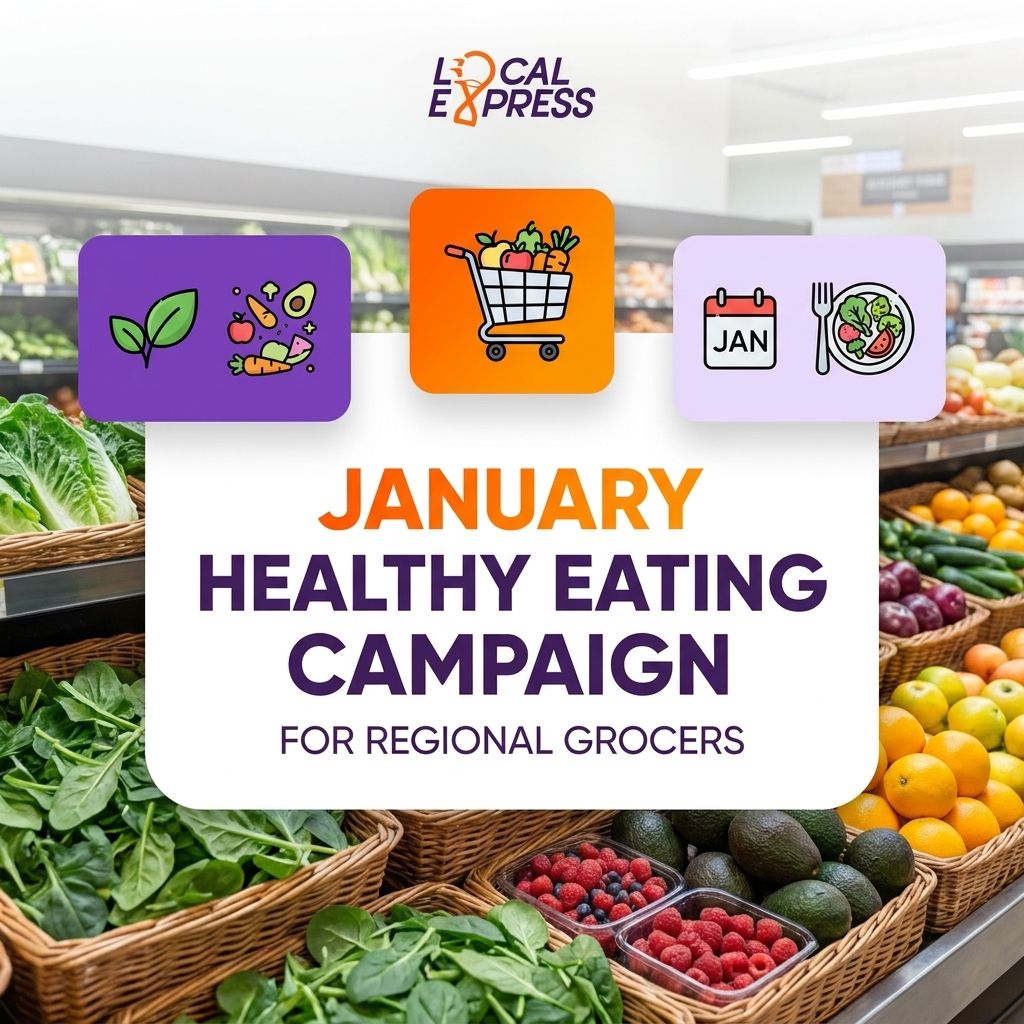
January is the single biggest window all year to move health-focused grocery categories, and most regional grocers waste the first two weeks scrambling instead of executing a plan built before Thanksgiving decorations come down. This guide breaks the campaign into steps you can run with a small marketing team and the tools already sitting inside your grocery ecommerce platform.
- A january healthy eating grocery campaign needs assortment, messaging, and media locked before January 1 — not during week one.
- SNAP/EBT online ordering removes friction for a large share of produce and staple shoppers in 2026 — turn it on before the campaign launches.
- SMS and push timed to January 1, January 15, and the Super Bowl window outperform one blast sent New Year's Day.
- Selling sponsored placements to health-focused CPG brands during January turns the campaign into a revenue line, not just a cost.
- Skip pre-order tooling for limited seasonal items and you'll oversell produce boxes by week two — Buy the fix, not the workaround.
Why This Matters
January grocery traffic skews toward produce, lean protein, and better-for-you packaged goods for roughly the first three to four weeks of the year, and shoppers who search "healthy meal ideas" or "meal prep near me" in early January are actively choosing which store earns their basket for the next 90 days. Regional and independent grocers that treat this as a one-week sale lose that basket to national chains running coordinated digital and in-store pushes.
The fix isn't a bigger discount. It's sequencing: assortment, digital merchandising, payment friction removal, and outbound messaging, all timed against the calendar instead of dropped at once. SMS and push notification tools built for grocery apps let you stage that sequence instead of guessing at a single blast date.
What You'll Need
- A defined healthy-eating assortment list (produce, lean protein, whole grains, low-sodium and reduced-sugar SKUs) pulled from current inventory, not a wish list
- A digital weekly ad or circular tool that supports themed sections, not just a flat price sheet
- SNAP/EBT online ordering enabled at checkout, if it isn't already live
- SMS or push notification capability tied to your branded app or ecommerce site
- At least one CPG or health-food vendor willing to fund a sponsored placement or feature slot
- Pre-order functionality for any limited-run items (detox boxes, meal-prep kits, produce boxes)
- Two to three weeks of lead time before January 1, 2026 to build and test the above
The Steps
1. Map Your Healthy-Eating Assortment by December 15
Pull a report of every SKU in produce, dairy alternatives, lean protein, and "better-for-you" packaged goods, then flag which ones have enough on-hand or incoming inventory to support a four-week push. This accomplishes one thing: it stops you from marketing a product you'll be out of stock on by January 8.
Common mistake: building the campaign around whatever the corporate ad planner suggests instead of what your own inventory system shows in stock. Cross-check against your actual on-hand counts, not a vendor's national assortment list.
2. Build a Themed Digital Circular
Create a dedicated "New Year, New You" or "Fresh Start" section inside your digital weekly ad and circular tool rather than scattering healthy items across the standard layout. Shoppers scanning a themed section convert faster because the decision is already made for them — they just need the price.
Run this section for the full month of January 2026, refreshing items weekly instead of running one static circular. Expected outcome: a clear, trackable click path from circular to cart that you can measure against a normal week.
3. Turn On SNAP/EBT Online Ordering Before Launch
If SNAP/EBT online ordering isn't already active at your checkout, this is the step to fix first — a healthy-eating campaign that excludes SNAP shoppers from produce and staples online is leaving real basket volume on the table. Setting up SNAP/EBT online ordering typically takes coordination between your processor and your ecommerce platform, so start this in December, not the first week of January.
Common mistake: assuming SNAP/EBT is "in progress" without confirming a live test transaction. Test it yourself before the campaign goes live.
4. Time SMS and Push Around Three Fixed Dates
Stage three messages instead of one: a January 1 launch push, a January 15 mid-month refresh highlighting a new themed item, and a late-January message tied to Super Bowl entertaining swaps (lighter dips, veggie trays, lean protein). One blast on New Year's Day gets buried under every other retailer's New Year's Day blast.
Segment the list where you can — shoppers who bought produce or meal-prep items in December 2025 are your highest-probability responders for January 2026 messaging. Expected outcome: a measurable lift in return visits within 48 hours of each send, not just the first one.
5. Sell the Sponsored Slot Instead of Giving It Away
A themed healthy-eating campaign is a natural home for in-app sponsored product placements from CPG brands in the wellness, plant-based, or lower-sugar categories. These brands already budget for January activation — the question is whether they spend it with your store or a competitor's.
Pitch the placement as a four-week package tied to your themed circular section, not a single banner. Common mistake: giving the slot away as a "favor" to a vendor relationship instead of pricing it like a media placement.
6. Cap Limited Seasonal Items With Pre-Orders
Detox boxes, meal-prep kits, and produce boxes sell fast in January and run out faster if you don't cap supply. Setting up pre-order options for these limited items keeps you from overselling on day three of a four-week campaign — a problem that's harder to fix than it is to prevent.
Expected outcome: a visible sold-out or waitlist status instead of a canceled-order email, which protects the trust you're trying to build with a new-to-you shopper.
7. Track Redemption Weekly, Not at Month's End
Pull basket data every Friday for the campaign's first three weeks: units sold on flagged healthy SKUs, SMS click-through, and sponsored placement impressions. If a themed item isn't moving by week two, swap it before week three instead of waiting for a post-mortem in February.
Get your January campaign built
See how Local Express stages assortment, SMS, and media for grocers in 2026.
Troubleshooting
- Themed items aren't converting from the circular. Check whether the price is actually visible in the themed section or buried behind a click-through — shoppers browsing a health-eating section want price up front.
- SNAP/EBT checkout is throwing errors. Confirm your processor's test environment matches production before launch; a live error on day one of the campaign kills trust with exactly the shoppers this push is meant to win.
- SMS opt-outs spike after the second send. You're likely sending too frequently or too generically — segment by December 2025 purchase history instead of blasting the full list identically.
- Sponsored placement vendor wants to pull out mid-campaign. Lock a four-week minimum commitment in writing before the campaign starts, not after week one's numbers come in soft.
- Pre-order items sell out in 48 hours. That's a demand signal, not a failure — raise the cap for week two if your supplier can support it, and communicate the sellout as a feature, not an apology.
Tools and Resources
- Digital weekly ad and circular software for the themed section
- SMS and push notification tools for the three-touch send sequence
- SNAP/EBT online ordering setup to remove checkout friction
- In-app sponsored product placements to monetize the CPG interest in January
Local Express runs all four of these inside one unified commerce platform, so the themed circular, the SMS send, the SNAP/EBT checkout, and the sponsored placement pull from the same order and inventory data instead of four disconnected systems.
FAQ
When should a regional grocer start planning a january healthy eating grocery campaign?
Start assortment and vendor conversations by December 15, with SNAP/EBT and SMS tooling tested before January 1, 2026. Waiting until the first week of January means missing the highest-intent search and shopping window of the month.
What products perform best in January healthy-eating promotions?
Produce, lean protein, whole grains, and reduced-sugar or low-sodium packaged goods drive most of the volume in January 2026. Limited items like meal-prep kits and produce boxes also perform well but need pre-order caps to avoid overselling.
Does SNAP/EBT online ordering matter for a healthy-eating campaign?
Yes — SNAP/EBT online ordering removes a real checkout barrier for shoppers buying produce and staples, and excluding it undercuts the reach of a campaign built around those categories. Set it up and test a live transaction before launch.
How many SMS messages should a January campaign send?
Three well-timed messages — a January 1 launch, a January 15 refresh, and a late-January Super Bowl-adjacent send — outperform a single blast. Segmenting by prior purchase history improves response on each one.
Can CPG brands pay for placement in a grocery healthy-eating campaign?
Yes — wellness and plant-based CPG brands regularly fund January activation through sponsored product placements inside grocery apps and ecommerce sites. Price the placement as a four-week package rather than a one-off favor.
How do independent grocers avoid overselling limited January items?
Pre-order tooling with visible caps prevents overselling detox boxes, produce boxes, and meal-prep kits during high-demand weeks. A sold-out status protects shopper trust better than a canceled-order email.
Is a themed digital circular worth building for one month?
Yes if refreshed weekly through January 2026 — a static circular loses relevance by week two, while a themed section updated weekly keeps converting through the full month.
What's the biggest mistake grocers make with January health campaigns?
Treating it as a one-week sale instead of a month-long sequence across assortment, messaging, and payment setup. The campaigns that hold shopper attention through late January are the ones planned in December.
One Last Thing
The grocers that win January aren't the ones with the biggest discount — they're the ones whose checkout, messaging, and inventory data talk to each other, so a themed circular click, a SNAP/EBT order, and a sponsored placement impression all show up in one dashboard instead of four exports you have to reconcile by hand in February.