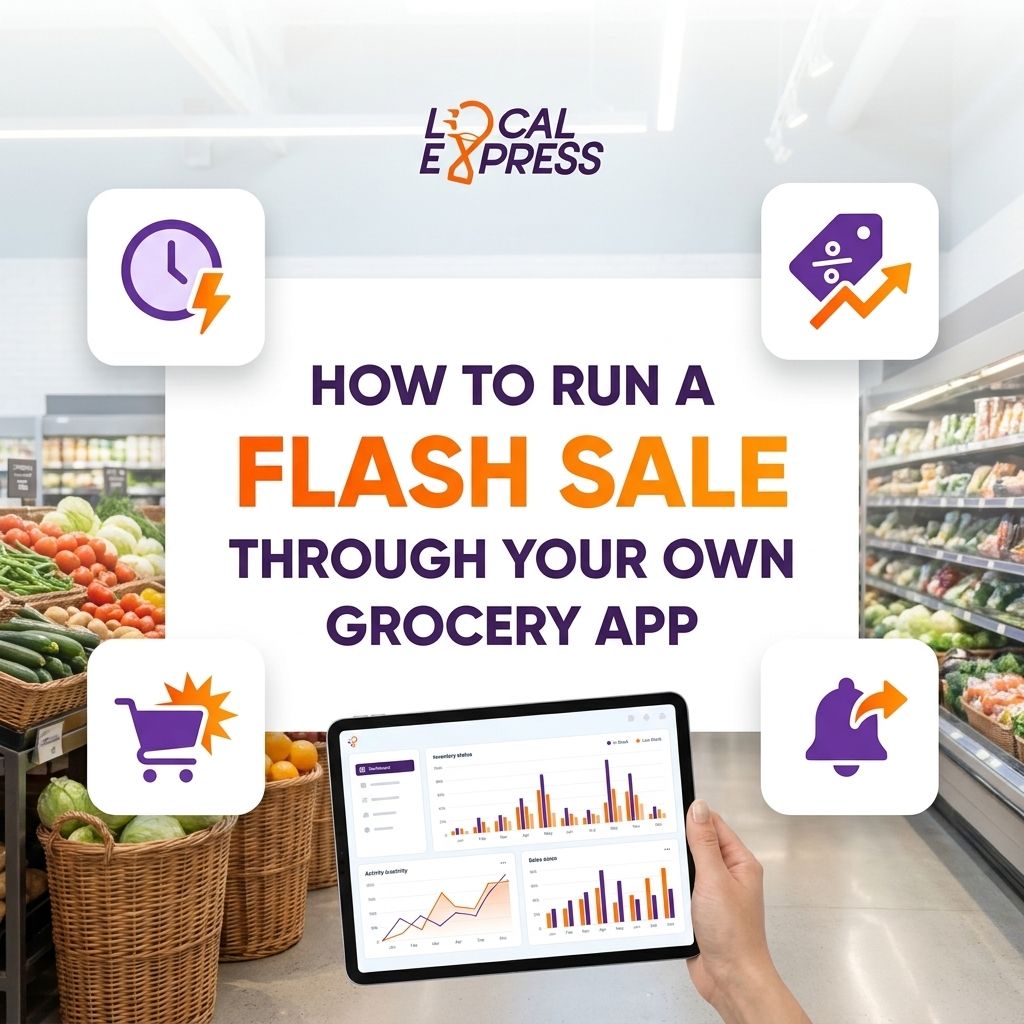
Running a flash sale through your own grocery app means setting a tight time window, capping quantities before you sell out, and pushing the offer through channels you own instead of paying a marketplace to reach your own customers. Get the mechanics wrong and you either sell out in twenty minutes with a line of angry shoppers, or the sale sits flat because nobody saw the notification in time.
- To run a flash sale grocery app promotion, cap quantities per order and sync inventory in real time across web, app, and kiosk.
- Push notifications and SMS sent 1-2 hours before launch outperform same-minute blasts because shoppers need a window to act.
- Flash sales longer than a single day lose urgency; most independent grocers run theirs in a 4-8 hour window in 2026.
- Running the sale through your own app instead of a marketplace keeps commission and customer data with your store.
- Brief delivery and pickup staff before launch — order volume spikes hardest in the first hour of a flash sale.
Why this matters
A flash sale run through a marketplace costs a commission on every redeemed item and hands your customer's data to a platform that will use it to sell you next month's ad slot. A flash sale run through your own grocery app keeps the order, the customer record, and the inventory data in one system you control.
That matters more in 2026 than it did five years ago, because regional and independent grocers are moving weekend promotions off marketplace ads and into owned channels using push notification and SMS tools built for grocery apps. The sale is easier to measure when the notification, the order, and the inventory count all sit in the same platform instead of three disconnected systems.
How to run a flash sale through your own grocery app
Here's the sequence that keeps a flash sale from turning into a stockout complaint thread or a promotion nobody noticed.
- Pick the SKU list 48-72 hours out. Perishables approaching code date, overstock, or a vendor-funded item work better than your top sellers at full margin.
- Cap quantity per order. Two to four units per SKU keeps one shopper from wiping out the whole allocation before the rest of your list even opens the app.
- Set the inventory cap inside order management, not just on the shelf tag. The sale needs to stop selling the second stock hits zero across web, app, and kiosk at the same time — that's a job for centralized order management across web, app, and kiosk channels, not a manual price change at 9am.
- Schedule the notification 1-2 hours before launch, then a reminder at the halfway point. A same-minute blast performs worse because shoppers need a window to open the app and check the list.
- Build a dedicated flash sale screen in the app. Shoppers who land on the homepage and have to search for the deal convert at a lower rate than shoppers who land directly on the offer.
- Shorten checkout for the duration of the sale. Flash sale traffic is impulse traffic — every extra field or login prompt at checkout costs redemptions, which is why cart flow matters more during a sale than on a normal Tuesday.
- Brief delivery and pickup staff the day before, not the morning of. Order volume during a flash sale front-loads into the first hour, and a kitchen or picking team that isn't staffed for the spike turns a marketing win into a fulfillment miss.
- Close the loop with a post-sale report. Redemption rate, sell-through by SKU, and repeat-customer rate tell you whether to run the same SKU list again next month.
If your flash sale can't sell through inventory in four to eight hours, it isn't a flash sale — it's a slow markdown wearing a countdown timer.
“If your flash sale can't sell through inventory in four to eight hours, it isn't a flash sale — it's a slow markdown wearing a countdown timer.”
Choosing your flash sale channels
A flash sale needs at least two notification channels firing at once. Relying on one almost guarantees a chunk of your list never sees the offer.
App push notifications
The fastest channel for shoppers who already have your app installed — delivery is near-instant and the tap-through lands them directly on the offer screen. Best for: existing app users and repeat customers on your loyalty list.
SMS and text alerts
SMS open rates beat email for time-sensitive offers because most people check a text within minutes. Best for: reaching shoppers who haven't opened the app in a while but opted into text alerts at checkout.
In-store kiosk and checkout lane signage
A kiosk screen or checkout lane banner catches shoppers already in the building who might not check their phone until they're home. Best for: driving app downloads and same-visit add-on purchases during the sale window.
Why flash sale results vary from store to store
Same SKU, same discount, wildly different sell-through — the difference usually comes down to a handful of variables:
- Sale length — shorter windows (4-8 hours) create more urgency than 24-hour windows
- Notification timing — mid-morning and late-afternoon sends outperform early morning for grocery shoppers
- SKU selection — perishables need a shorter window than shelf-stable overstock
- Quantity caps — no cap means your best customer buys everything and everyone else gets a stockout notice
- Staffing readiness — a sale that outpaces picking or kitchen capacity turns into cancelled orders
- Overlap with vendor promotions — pairing a flash sale with a manufacturer coupon or digital coupon and rebate program can lift redemption without cutting further into your own margin
Run flash sales from your own app
Launch a branded grocery app built for real-time inventory and push offers.
How long should a grocery flash sale run?
Most independent and regional grocers run a flash sale for 4 to 8 hours in 2026, not a full day. A shorter window creates the urgency that makes shoppers act now instead of bookmarking the deal for later and forgetting about it, and it limits how long a limited SKU allocation has to stretch across your customer list.
Do flash sales work on perishable grocery items?
Yes — perishable items approaching their code date are one of the strongest flash sale categories because the discount moves inventory that would otherwise become shrink. The trade-off is a tighter window than a shelf-stable SKU: a produce or bakery flash sale should run closer to 2-4 hours so fulfillment can pick and pack the order before quality drops.
Can SNAP EBT customers redeem flash sale discounts?
Yes, on eligible food items — SNAP EBT applies to the discounted price the same way it applies to a regular sale price, since the benefit is calculated on the checkout total, not the original tag. The exceptions are the same ones that already apply outside of a sale: SNAP doesn't cover hot prepared foods in most states or non-food promotional add-ons like gift cards.
FAQ
What's the best way to run a flash sale grocery app promotion in 2026?
The best approach caps quantity per order, syncs inventory in real time across web, app, and kiosk, and pushes the offer through both notifications and SMS 1-2 hours before launch. Running the sale through your own grocery app instead of a marketplace keeps the commission and the customer data with your store.
How long should a grocery flash sale last?
Most flash sales run 4 to 8 hours in 2026, with perishable items closer to 2-4 hours. Shorter windows create urgency and limit how thin a capped SKU allocation has to stretch.
Should you cap quantities during a flash sale?
Yes — capping quantity at 2 to 4 units per order prevents one shopper from buying out the entire allocation before the rest of your list even sees the offer. Without a cap, the sale ends in complaints instead of repeat business.
Do flash sales work on perishable grocery items?
Yes, perishables approaching code date are one of the strongest flash sale categories because the discount converts near-expiry stock into revenue instead of shrink. Run these with a shorter 2-4 hour window so fulfillment can pick the order before quality drops.
Can SNAP EBT customers redeem flash sale discounts?
Yes, on eligible food items — EBT is charged against the discounted checkout price the same way it applies to any other sale. The usual exclusions still apply, such as hot prepared foods in most states and non-food promotional items.
Is a flash sale better run through your own app or a marketplace?
Running the sale through your own grocery app is better for margin because you skip marketplace commission on every redeemed item and keep the customer's order history for future campaigns. A marketplace flash sale can reach new shoppers, but you don't own the data afterward.
How much notice should shoppers get before a flash sale starts?
Send the first notification 1-2 hours before launch, then a reminder at the halfway point of the sale window. A same-minute blast underperforms because shoppers need time to open the app and act.
What items sell best in a grocery flash sale?
Perishables near code date, overstock, and vendor-funded promotional items sell best because the discount doesn't erode margin on your core full-price catalog. Top sellers at full price are usually a weak choice for a flash sale SKU list.
One last thing
The step grocers skip most often isn't the notification or the discount — it's the inventory cap set inside order management before the sale goes live. A price change on the shelf tag doesn't stop the app or kiosk from still selling a SKU that's already gone; the cap has to live in the same system processing every channel, or the flash sale ends with cancelled orders instead of a clean sell-through.