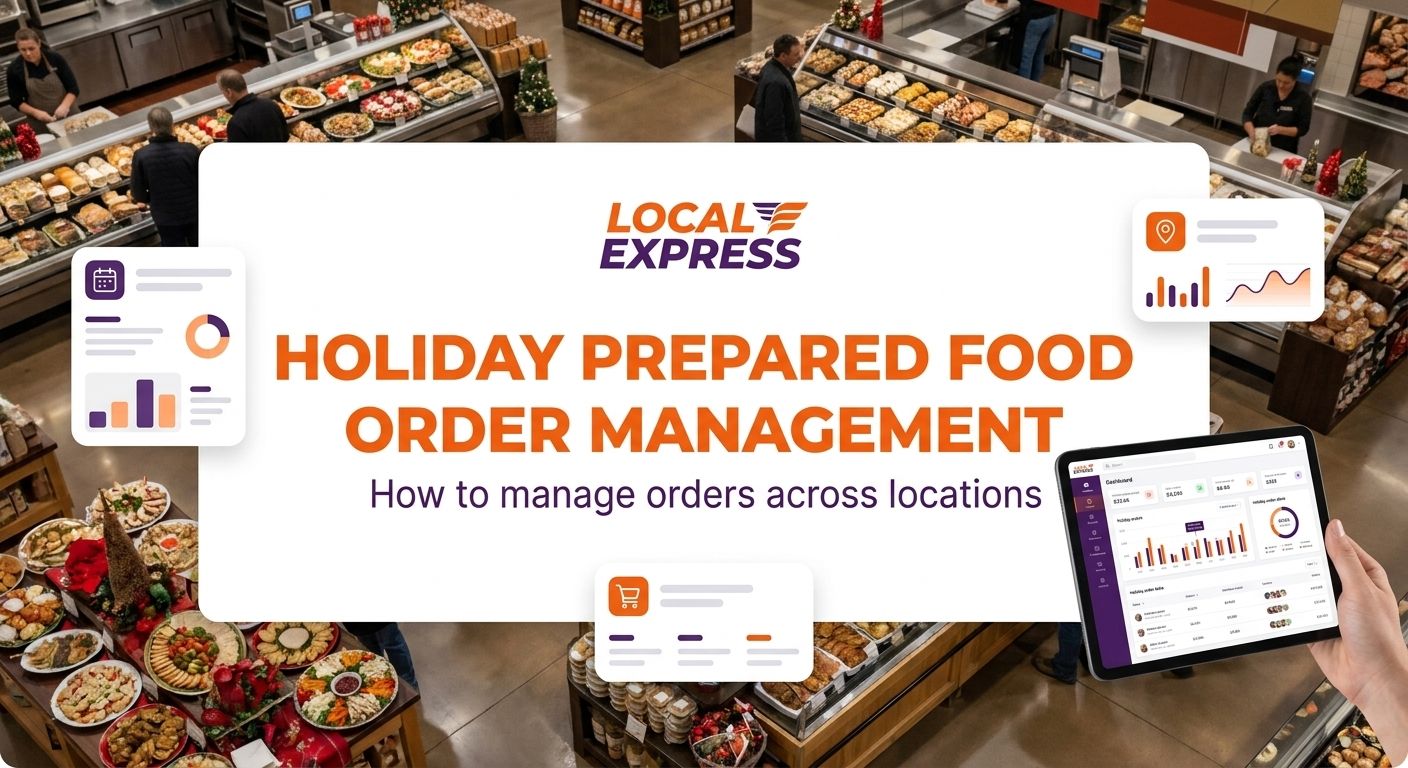
Managing holiday prepared-food orders across locations means putting every store's web orders, app orders, and kiosk orders into one shared queue instead of letting each location run its own spreadsheet or standalone tablet.
- Holiday prepared food order management works best on one shared order queue across web, app, and kiosk channels.
- Multi-location grocers that sync inventory in real time cut the odds of overselling turkey dinners and holiday platters.
- Local Express centralizes order management so no single store is stuck running its own spreadsheet during Thanksgiving week.
- Kitchen display systems keep MTO deli and bakery counters from falling behind once Christmas Eve volume hits.
- Pre-order cutoffs by location stop last-minute cancellations from spoiling a holiday order.
Why this matters
Thanksgiving week, the days before Christmas, and New Year's Eve are the three heaviest prepared-food stretches of the year for regional grocers. A deli, bakery, and hot bar that normally run on walk-in traffic suddenly get hit with pre-orders for turkey dinners, holiday platters, and party trays, all placed through different channels at once.
The problem isn't demand. It's that most independent and regional chains still run each store's prepared-food ordering as its own island: one location takes orders by phone, another through a kiosk, a third through an app that doesn't sync with either. In 2026, that gap shows up as double-booked pickup slots, sold-out items nobody flagged in time, and kitchen staff working from a printed list instead of a live queue.
How do you manage holiday prepared-food orders across locations?
The fix is a single order management layer that every store, kiosk, and channel feeds into, with clear cutoffs and inventory caps set per location. In practice that means:
- Route every channel into one queue. Web orders, app orders, and self-service kiosk orders for prepared food all land in the same system instead of three separate ones. Centralized order management across web, app, and kiosk channels is what closes this gap for multi-location grocers.
- Set per-location capacity caps. A 12-item bakery case and a 40-item deli counter can't take the same number of holiday pre-orders. Cap each SKU by store, not by chain-wide average.
- Push orders to the kitchen the moment they're placed. No batch printing at close of business. Staff need to see a Christmas Eve order the minute it's confirmed, not the next morning.
- Set pickup windows in 30-60 minute blocks per store. Holiday pickup crowds bunch up around 4-6 PM on Thanksgiving Eve and Christmas Eve. Spreading windows prevents a line out the door.
- Flag out-of-stock items across the chain, not just one store. If the honey-baked ham platter sells out at Store 3, Store 1 shouldn't keep taking orders for it if it's the same regional supplier running low.
| Approach | How it handles holiday spikes | Verdict |
|---|---|---|
| Separate system per store | Each location manages its own orders, no cross-store visibility | Skip for chains with 2+ locations |
| Shared spreadsheet or group chat | Manual, breaks down above a few dozen daily orders | Wait, only survives single-location shops |
| Centralized order management platform | One queue, live inventory caps, kitchen display sync | Buy for any chain running prepared food during peak holidays |
Centralized order management: one queue instead of five spreadsheets
The single biggest fix for holiday order chaos is collapsing every channel into one queue that every store can see. When web, app, and kiosk orders all land in order management software for multi-location grocery chains, a manager at the corporate level can see exactly how many turkey dinners are booked across the whole chain, not just their own store.
This matters most in the 10 days before Thanksgiving and the week before Christmas, when a single popular item can sell out at one location while another store still has capacity nobody's routing customers toward.
Kitchen display systems keep MTO counters from falling behind
A deli or bakery running made-to-order holiday items off a printed ticket loses time the moment volume doubles. Kitchen display systems for grocery deli and MTO kitchens put every incoming order on a screen the kitchen actually watches, with pickup time and item list visible at a glance.
The honest tradeoff: a kitchen display system requires staff training before the holiday rush, not during it. Roll it out in early November, not the week of Thanksgiving.
Why holiday order volume varies by location
Not every store in a chain sees the same holiday spike, and treating them identically wastes prep capacity at some locations while under-stocking others.
- Store size and kitchen throughput — a location with a full-service deli counter can handle more MTO holiday orders than one with a smaller prepared-foods case.
- Local demographics — stores near dense residential areas see higher pickup-order volume around Thanksgiving and Christmas than stores near office parks.
- Delivery radius — locations offering last-mile delivery on top of pickup absorb more total holiday orders per day.
- Historical sell-through by SKU — a store that consistently sells out of holiday platters by noon needs a higher cap than one that sells through the day.
- Staffing on the specific dates — Christmas Eve and the day before Thanksgiving are the two tightest staffing days of the year; capacity caps should reflect actual scheduled headcount, not average headcount.
Should each store run its own online ordering page during the holidays?
No — each store should have its own pickup window, inventory cap, and menu availability, but all of it should run through one shared platform, not separate standalone pages. A single system with store-level settings gives customers a consistent ordering experience while still respecting what each kitchen can actually produce.
How far ahead should customers place holiday prepared-food orders?
Cutoffs should be set per item and per store based on kitchen lead time, with popular items like whole turkeys or large platters needing longer lead windows than a single-serve entree. Pre-order options for limited seasonal items let a grocer set those cutoffs by SKU instead of applying one blanket deadline across the whole prepared-foods case.
Can one kiosk handle both walk-in and pre-order pickup?
Yes, a self-service kiosk can run both flows if it's connected to the same order queue as the app and website, showing walk-in customers live wait times while pulling scheduled pickups from the same system. Running the kiosk on a separate, disconnected system is the most common reason stores double-book a pickup slot during Christmas week.
Centralize holiday order management now
Sync web, app, and kiosk orders before Thanksgiving week hits.
FAQ
What is holiday prepared food order management?
Holiday prepared food order management is the process of routing web, app, and kiosk orders for deli, bakery, and hot bar items into one system so multi-location grocers can track capacity and inventory in real time. It matters most around Thanksgiving, Christmas, and New Year's Eve when order volume spikes across every channel at once.
How do you prevent overselling holiday platters across multiple stores?
Set per-store, per-SKU inventory caps inside a shared order management platform so once a location's turkey dinners or platters sell out, the system stops taking new orders for that item at that store. Chain-wide averages don't work because kitchen capacity differs store to store.
Should independent grocers use a kitchen display system during the holidays?
Yes, a kitchen display system for a deli or bakery counter shows incoming orders live instead of relying on printed tickets, which matters once holiday volume doubles or triples normal daily counts. Staff should be trained on it in early November, well before Thanksgiving week.
How early should a store set holiday pre-order cutoffs?
Cutoffs should be set per item based on kitchen lead time, with large items like whole turkeys needing longer windows than single-serve entrees. Setting one blanket cutoff for the whole prepared-foods case ignores how long each dish actually takes to prepare.
Can a grocery chain run holiday orders without a delivery marketplace?
Yes, a grocer can manage holiday pickup and delivery entirely through its own website, app, and kiosk without routing orders through outside marketplaces. This keeps customer data and order history inside the retailer's own system instead of a third party's.
What causes double-booked pickup slots during Christmas week?
Double-booked pickup slots happen when a kiosk or in-store system runs on a separate schedule from the website and app instead of pulling from one shared order queue. Connecting all channels to the same system is the fix, not adding more staff to manually check for conflicts.
Do all store locations need the same holiday order capacity?
No, capacity caps should reflect each store's kitchen size, staffing on that specific date, and historical sell-through by item rather than one chain-wide number. A location with a smaller prepared-foods case needs a lower cap than a full-service deli counter.
One last thing
The stores that struggle most in late December aren't the ones with the highest order volume — they're the ones still running two or three disconnected systems for web, kiosk, and phone orders. Fixing that before November ends matters more than any single staffing decision made during Christmas week itself.