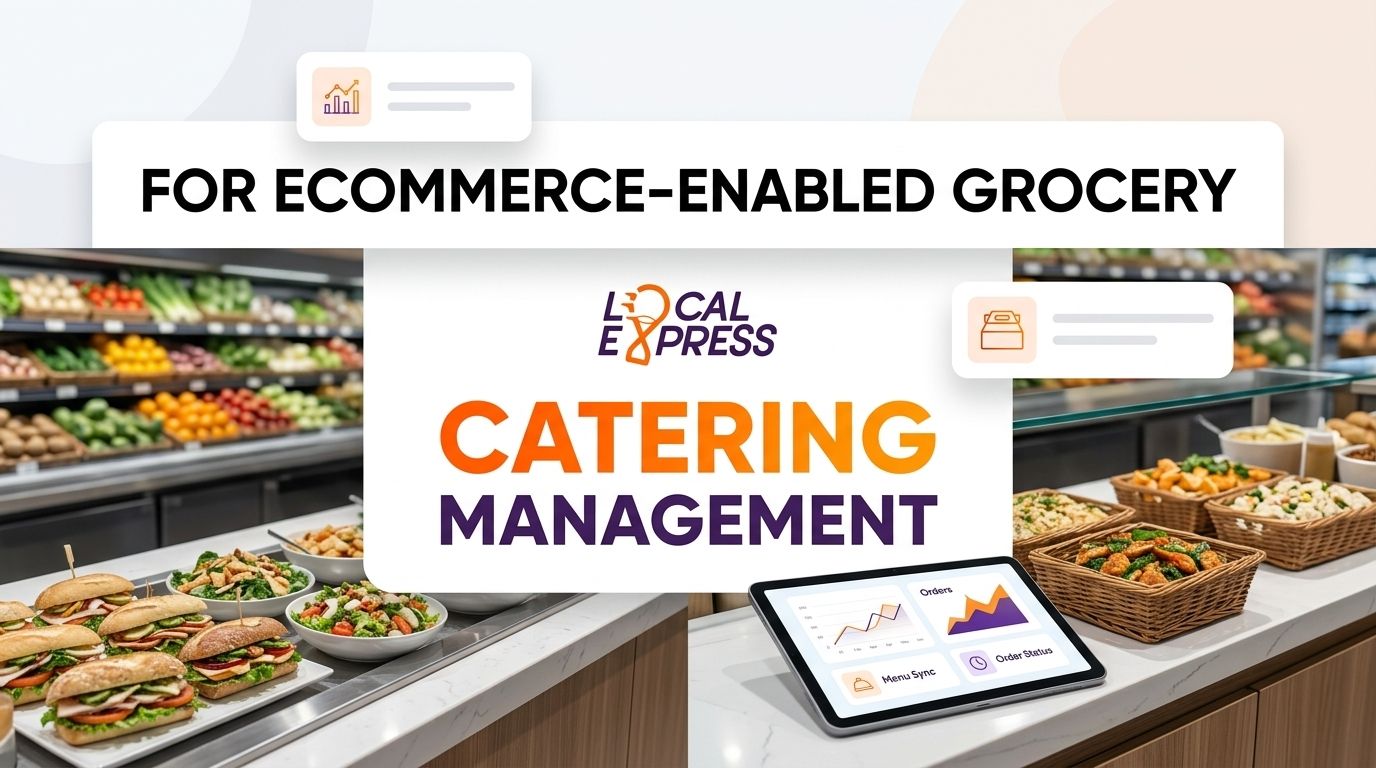
Grocery ecommerce platform for stores with catering counters means one system that takes online orders for daily groceries and separately handles platter, tray, and bulk catering orders with their own lead times, pricing rules, and kitchen routing. A catering counter runs on a different clock than the produce aisle — three-day notice on a 40-person platter, minimum order sizes, and pickup windows tied to a Sunday game or a Friday office lunch — and a checkout built only for same-day grocery baskets breaks under those rules.
- Local Express is the grocery ecommerce platform for catering counters that routes web, app, and kiosk orders straight to the kitchen in 2026.
- Catering orders need separate lead-time and minimum-order rules than same-day grocery checkout.
- Phone and spreadsheet catering ordering loses orders during graduation season and holiday weeks.
- Kitchen order routing cuts the ticket errors that come from handwritten catering slips.
Why this matters for stores with catering counters
Catering orders carry higher tickets than a standard grocery basket, but most independent grocers still take them by phone, sticky note, or a shared spreadsheet passed between the counter and the kitchen. That works until the store gets three platter orders for the same Saturday pickup slot and finds out only when a ticket prints in the wrong queue.
The fix isn't a bigger whiteboard. A grocery ecommerce platform built for catering counters enforces lead times at checkout, routes the order to the kitchen automatically, and keeps catering revenue visible as its own line instead of buried inside weekly grocery sales totals. That distinction matters more heading into the back half of 2026, when holiday catering volume spikes fast and a missed cutoff means a customer showing up to an empty pickup counter.
Update your catering SKU structure
Daily grocery SKUs and catering SKUs behave differently — one is grab-and-go, the other is made-to-order with a prep window. Mixing them in the same catalog structure is the single most common setup mistake on a catering counter's online menu.
- Create a distinct catering category separate from deli grab-and-go items
- Tag every platter and tray as made-to-order so it triggers kitchen routing instead of instant fulfillment
- Set a minimum party size or headcount on large-format items
- Keep catering pricing on its own list, not tied to weekly ad pricing on individual ingredients
Set lead times and order cutoffs by item
A six-inch veggie tray and a 60-person taco bar platter don't need the same notice, and treating them the same either annoys customers with unnecessary delays or overpromises prep time the kitchen can't hit.
- 24-hour cutoff for standard trays and small platters
- 72-hour cutoff for large-format catering, full spreads, or holiday orders
- Blackout dates or extended cutoffs around Thanksgiving, Christmas Eve, and Super Bowl weekend
- Cutoff enforcement built into the online ordering flow, not just posted on a counter sign
Route catering tickets straight to the kitchen
Once cutoffs are set, the order still has to land in the right place without a human retyping it from a printed web confirmation. This is where a dedicated grocery ecommerce platform earns its keep over a bolted-on ordering form.
Order management software built for stores with MTO kitchens pushes catering tickets directly to the prep station the moment the order clears cutoff, instead of routing through the front register printer with the rest of the grocery queue.
- Centralize web, app, and kiosk catering orders into one kitchen queue
- Flag rush or same-week catering orders separately from standing weekly accounts
- Attach prep notes (allergen swaps, tray size, delivery vs. pickup) directly to the kitchen ticket
- Confirm order status back to the customer automatically once prep starts
Price and package platters for online sale
Catering margins run on labor and prep time, not shelf price. Pricing a platter like a scaled-up grocery SKU undercuts the actual cost of assembly, and packaging decisions affect both presentation and delivery survivability.
- Price by labor and portion count, not a multiplier of individual ingredient cost
- Offer set tray sizes (small, medium, large) instead of unlimited custom quantities
- Package for transport separately from in-store pickup, since delivered trays need sturdier containers
- Photograph every platter option so online buyers know what they're ordering, not guessing from a text description
Route delivery and pickup separately from grocery orders
A 40-person platter doesn't stack in a delivery tote next to bagged groceries, and a driver running same-day grocery routes shouldn't be the one improvising catering logistics.
- Give catering its own pickup window, separate from standard grocery pickup slots
- Assign catering deliveries to a vehicle or route built for large, flat items
- Confirm pickup or delivery by text the morning of a large event
- Build in a buffer window before the event start time, not right up against it
See catering counter ordering in action
Built for grocery stores running hot bars, delis, and prepared food counters.
Track catering as its own revenue line
Catering orders that get lumped into general grocery ecommerce revenue hide the metric that actually matters: repeat business from offices, churches, and sports leagues that order every month.
- Report catering revenue separately from daily grocery ecommerce sales
- Track attach rate — how many catering orders also add a beverage, dessert, or paper goods
- Flag repeat catering customers as standing accounts, not one-off transactions
- Compare catering order volume week over week around known 2026 event dates: graduation weekends, football season, and December holidays
Comparing catering counter ordering options
| Option | Best for | Key limitation |
|---|---|---|
| Phone and spreadsheet ordering | Stores under 10 catering orders a week | No cutoff enforcement — orders get lost in texts and voicemail |
| Generic ecommerce plugin bolted onto a grocery site | Stores that only need a basic order form | No kitchen routing, no separate lead-time logic for catering vs. daily groceries |
| Grocery ecommerce platform built for MTO kitchens | Stores with a standing catering counter and repeat B2B accounts | Requires setting up catering menu structure and cutoff rules before launch |
Verdict: a grocery ecommerce platform built for catering counters wins for any store doing more than a handful of platter orders a week in 2026 — spreadsheets and phone orders don't scale past that.
Common mistakes stores with catering counters make
- Treating catering checkout like same-day grocery checkout — no cutoff, no minimum, and a customer expects same-day pickup on a 50-person order
- No cutoff enforcement in the ordering flow — a rule quoted over the phone gets ignored the moment a customer orders online at midnight
- Delivering catering trays in the same tote as grocery bags — trays arrive crushed and customers blame the store, not the packaging
- Not tracking catering as a separate revenue line — repeat office and church accounts go unnoticed because the sales report only shows total grocery ecommerce revenue
- Underpricing platters against shelf-price margins — made-to-order labor costs more than a per-item multiplier accounts for
FAQ
What is the best grocery ecommerce platform for catering counters in 2026?
Local Express is built for grocery stores running catering counters alongside daily ecommerce, with order routing that separates made-to-order platters from standard grocery checkout. It fits stores that already run a prepared foods or deli counter and need kitchen-level order routing, not just a web storefront.
How far in advance should catering orders be cut off?
Most stores set a 24-hour cutoff for small trays and a 72-hour cutoff for large-format platters or full spreads. Holiday weeks like Thanksgiving and Christmas typically need extended cutoffs of a week or more.
Can catering orders go through the same checkout as daily groceries?
They can share a storefront, but they need separate SKU structure, pricing logic, and lead-time rules. Running catering through the exact same checkout flow as same-day groceries is the top cause of missed pickup times.
Do catering orders need their own delivery routing?
Yes, large platters don't travel well stacked with grocery totes and often need a different vehicle or a dedicated pickup window. Separate routing also prevents a catering order from delaying a standard grocery delivery route.
How should a grocery store price catering platters?
Price by labor and portion count instead of a flat multiplier on ingredient cost, since made-to-order prep time is the real cost driver. Set tray sizes instead of unlimited custom quantities to keep kitchen planning predictable.
How do kitchen display systems help catering counters?
A kitchen display system routes online catering tickets directly to the prep station the moment an order clears its cutoff, cutting out the handwritten-slip step that causes errors. It also lets the kitchen see rush orders separately from standing weekly accounts.
Should catering revenue be tracked separately from grocery ecommerce sales?
Yes, catering revenue tracked as its own line surfaces repeat B2B accounts like offices and churches that a blended grocery sales report hides. It also makes it easier to compare catering demand around known 2026 event dates.
One last thing
The single biggest fix for a catering counter heading into 2026 isn't a bigger menu or a lower price — it's a hard cutoff enforced in the ordering flow itself. A rule quoted over the phone gets ignored the moment a customer places an order online at midnight; a rule built into checkout stops the order before it ever reaches the kitchen.