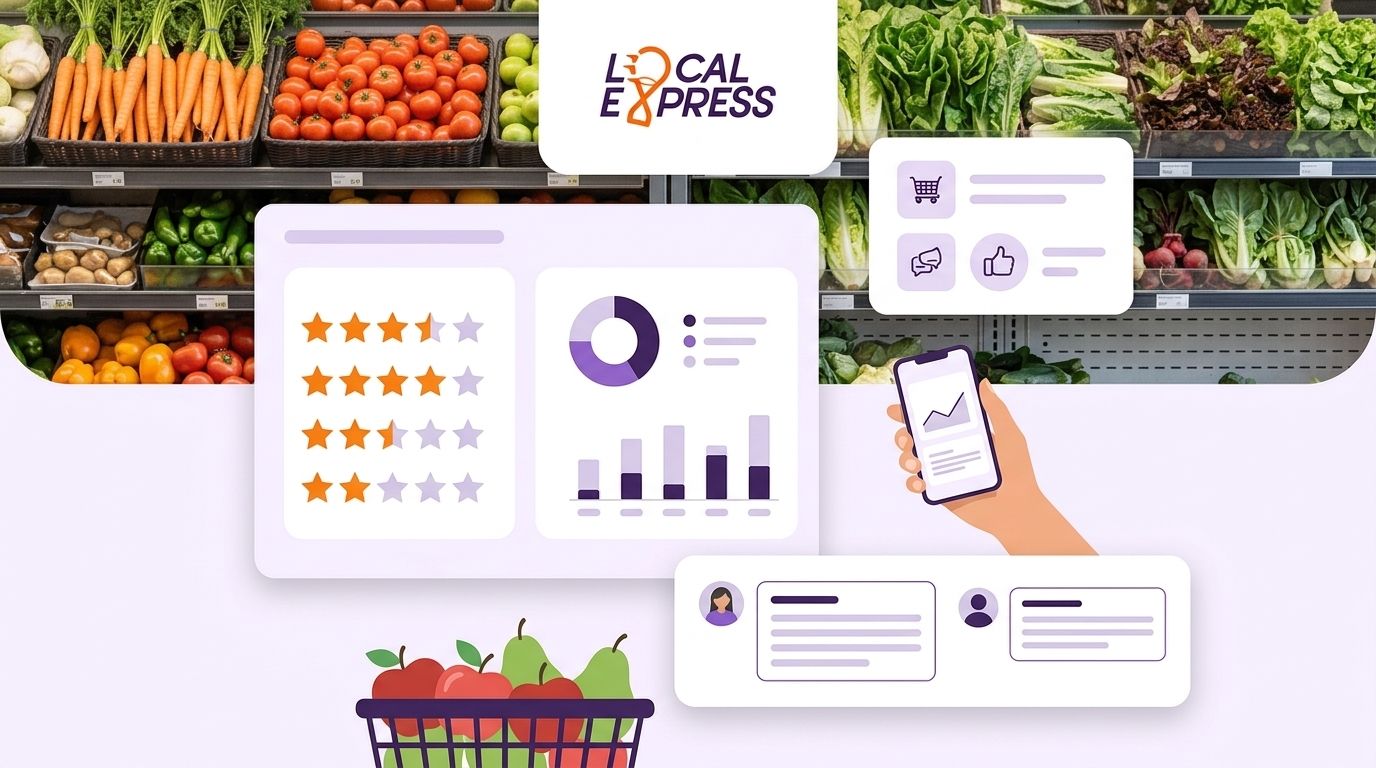
Grocery shoppers trust ratings the same way they trust a neighbor's recommendation, and in 2026 a missing or fake-looking review section costs a sale before checkout even starts. This guide ranks the review and ratings tools grocery ecommerce sites actually use, matched to store size, catalog type, and how the data needs to move across web, app, and kiosk channels.
- Bazaarvoice is the best overall product review and ratings tool for grocery ecommerce in 2026, built for CPG syndication at scale.
- PowerReviews fits regional chains running retail media programs with CPG brand partners.
- Google Business Profile reviews cost nothing to set up but only cover the store location, not individual SKUs.
- Okendo pairs reviews with loyalty in one dashboard, a fit for specialty and health food retailers.
- Trustpilot is built for storefront and delivery reputation, not per-product star ratings.
Why this matters
A five-star badge on a product page changes conversion behavior, but grocery ecommerce has a wrinkle most review platforms weren't built for: perishables, substitutions, and delivery timing all shape whether a shopper leaves a good rating. The Local Express platform ties order data to merchandising and search, and review tools sit on top of that stack rather than inside it, so picking the right one matters for how fast ratings actually reach the storefront.
The tools below cover two jobs that get conflated constantly: rating individual products (SKU-level) and rating the shopping and delivery experience (store-level). Confusing the two is the single biggest reason grocers pick the wrong platform.
What makes the best product review and ratings tool for grocery ecommerce
- Syndication reach — can ratings appear on CPG brand pages and retail media placements, not just your own site
- Verified purchase moderation — filters reviews from people who never bought the item, a real problem on high-traffic grocery catalogs
- SKU-level vs. store-level separation — perishable and substitution issues shouldn't tank a product's star rating
- Integration with existing stack — POS, loyalty, and storefront all need to read the same rating data
- Multilingual widgets — specialty and ethnic grocery catalogs need review text in more than one language
- Response and reputation tools — delivery complaints need a public reply path, not just a star count
At a glance
| Tool | Best for | Standout feature | Key limitation |
|---|---|---|---|
| Bazaarvoice | Large regional chains, CPG syndication | Retail syndication network across brand sites | Heavier implementation for single-location stores |
| PowerReviews | Retail media and CPG brand partnerships | Sampling and syndication programs | Overlaps closely with Bazaarvoice's market |
| Yotpo | Independent grocers on modern storefronts | Reviews plus visual UGC and Q&A in one app | Smaller syndication network than enterprise players |
| Trustpilot | Storefront and delivery reputation | Public review invitations and response tools | Not built for per-SKU product ratings |
| Google Business Profile | Single-location independents | Reviews surface directly in Search and Maps | Covers the store, not individual products |
| Okendo | Specialty and health food retailers | Reviews bundled with loyalty and subscriptions | Less suited to very large multi-banner chains |
| Reviews.io | Multilingual, multi-ethnic specialty catalogs | Translated widgets and video reviews | Smaller grocery-specific adoption than rivals |
1. Bazaarvoice: best product review and ratings tool for large regional chains and CPG syndication
Bazaarvoice runs an enterprise ratings and reviews network that syndicates content across a network of retail and brand partners, so a review left on your site can also surface on a CPG brand's own product page. That two-way flow is the reason large grocery banners lean on it.
Bazaarvoice pros:
- Syndication network reaches CPG brand sites, extending review visibility beyond your own catalog
- Handles high review volume across large multi-location catalogs without slowdown
- Established moderation tooling for verified purchase flags
Bazaarvoice cons:
- Implementation is heavier than most single-location independents need
- Best value shows up at chain scale, not for a single storefront
Best for: regional chains and multi-banner groups running retail media programs with CPG partners. Verdict: Buy if you're already running or planning a retail media program with CPG brands attached to it.
2. PowerReviews: best for retail media and CPG brand page syndication
PowerReviews operates a similar syndication model to Bazaarvoice, pushing reviews between retailer sites and brand partner pages, with sampling programs that seed early reviews on new SKUs.
PowerReviews pros:
- Sampling programs help new products get initial ratings faster
- Syndication partnerships with major CPG brands
- Review display widgets built for high-SKU catalogs
PowerReviews cons:
- Functionally overlaps with Bazaarvoice, so the choice often comes down to which partner network your CPG brands already use
- Not built with single-location independents in mind
Best for: chains that need new-SKU review seeding alongside syndication. Verdict: Hold — evaluate against Bazaarvoice based on which CPG brand network your suppliers already participate in.
3. Yotpo: best for independent grocers on modern ecommerce storefronts
Yotpo combines reviews, visual user-generated content, and product Q&A in a single dashboard, built to plug into modern ecommerce storefronts without a heavy IT lift.
Yotpo pros:
- Reviews, photos, and Q&A live in one interface
- Faster setup than enterprise syndication networks
- Widget customization matches most storefront themes
Yotpo cons:
- Syndication reach to outside brand pages is smaller than Bazaarvoice or PowerReviews
- Grocery-specific features (perishables, substitutions) aren't native — you'll configure moderation rules manually
Best for: independent and small regional grocers who want reviews and UGC without an enterprise contract. Verdict: Buy for single-to-few-location grocers building out a storefront from scratch.
4. Trustpilot: best for storefront and delivery reputation management
Trustpilot operates at the company and location level rather than the SKU level, collecting reviews about the overall shopping and delivery experience and giving retailers a public response tool.
Trustpilot pros:
- Public review invitations sent automatically after an order
- Response management tools for handling delivery complaints publicly
- Widely recognized badge that shoppers associate with trust
Trustpilot cons:
- Doesn't rate individual products, so it won't replace a SKU-level tool
- Grocery-specific delivery issues (late slots, substitutions) get mixed into overall store scores
Best for: grocers whose biggest reputation risk is delivery timing and substitution handling, not individual product quality. Verdict: Hold — pair with a SKU-level tool rather than using it alone.
5. Google Business Profile: best for single-location independents
Google Business Profile reviews surface directly in Search and Maps results tied to your store's physical location, which matters more for a single storefront than for a multi-banner chain running its own review widgets.
Google Business Profile pros:
- Reviews appear where local shoppers are already searching
- No separate account setup for shoppers — they use their existing Google account
- Star rating shows directly in local search results
Google Business Profile cons:
- Covers the store, not individual products, so it won't help a shopper decide between two brands of pasta sauce
- Moderation and review removal are controlled by Google, not the retailer
Best for: single-location independent grocers relying on local search visibility. Verdict: Buy as a baseline — every independent grocer should claim and maintain this regardless of what else they use.
6. Okendo: best for specialty and health food retailers combining reviews with loyalty
Okendo bundles product reviews with loyalty and subscription tools in one app, a fit for specialty grocers running both a rewards program and a review section on the same health food and natural grocery storefront.
Okendo pros:
- Reviews and loyalty data live in the same dashboard, simplifying reporting
- Quiz and visual UGC tools built for specialty and DTC-style catalogs
- Works well for smaller, curated catalogs rather than massive SKU counts
Okendo cons:
- Syndication network is smaller than the enterprise players
- Less proven at very large multi-banner chain scale
Best for: specialty, natural, and health food retailers already running or planning a loyalty program. Verdict: Buy if reviews and loyalty need to share the same customer record; otherwise a dedicated loyalty program tool plus a separate reviews tool works fine too.
7. Reviews.io: best for multilingual and multi-ethnic specialty grocery catalogs
Reviews.io supports translated review widgets and video reviews, a fit for grocers serving shoppers who search and read in more than one language.
Reviews.io pros:
- Translated widgets support multilingual storefronts
- Video review support alongside standard star ratings
- Google Seller Ratings integration for paid search
Reviews.io cons:
- Grocery-specific adoption is smaller than Yotpo or Bazaarvoice, so fewer grocery case examples exist
- Enterprise syndication reach is limited compared to Bazaarvoice or PowerReviews
Best for: ethnic and international specialty grocers running storefronts in more than one language. Verdict: Buy for multilingual specialty catalogs; Skip if your storefront is single-language and mid-size — Yotpo covers that case with a lower lift.
“A five-star badge without a verified-purchase check is a liability, not a differentiator.”
How we ranked
Each tool was weighed against the six criteria above: syndication reach, verified purchase moderation, SKU vs. store-level separation, stack integration, multilingual support, and reputation response tools. No tool scores well on all six — that's the point of matching the tool to the store type instead of picking a single "best" answer.
Which product review and ratings tool should you choose?
If you run a multi-banner regional chain with CPG brand partners in a retail media program, Bazaarvoice is the default pick for 2026. If you're an independent grocer building or rebuilding a storefront, Yotpo covers reviews and UGC without an enterprise contract. If you're a single-location store, claim Google Business Profile today regardless of anything else on this list — it costs you nothing but setup time and it's where local shoppers already look.
Specialty and health food retailers running loyalty programs should look at Okendo first; multilingual specialty catalogs should start with Reviews.io. Whatever you pick, feed the rating data into how products rank in on-site search and track the impact through your analytics dashboard — a review tool that isn't wired into search relevance is just a badge nobody reads twice.
Connect reviews to your grocery storefront
See how ratings data ties into merchandising and search on one platform.
FAQ
What's the best product review and ratings tool for grocery ecommerce in 2026?
Bazaarvoice is the best overall pick for chains running CPG syndication and retail media programs. Independent grocers on a modern storefront are better served by Yotpo, and single-location stores should start with Google Business Profile.
Is Bazaarvoice better than Yotpo for grocery stores?
Bazaarvoice wins for chains needing syndication to CPG brand pages at scale. Yotpo wins for independent grocers who want reviews and UGC without an enterprise-level setup.
How much does a grocery review and ratings platform cost?
Pricing on these platforms is typically quote-based and scales with catalog size and store count, so check current plans directly with each vendor before committing.
Can Google Business Profile reviews replace a dedicated product review tool?
No. Google Business Profile reviews rate the store location, not individual products, so a shopper can't use it to compare two brands of the same item. Pair it with a SKU-level tool like Yotpo or Bazaarvoice.
Do review tools integrate with grocery loyalty programs?
Okendo bundles reviews with loyalty and subscription data in one dashboard, which suits specialty and health food retailers running both programs at once.
What's the difference between store-level and SKU-level review tools?
Store-level tools like Trustpilot and Google Business Profile rate the overall shopping and delivery experience. SKU-level tools like Bazaarvoice, PowerReviews, and Yotpo rate individual products, which matters more for comparing brands on the same shelf.
Are multilingual review widgets available for grocery ecommerce sites?
Yes. Reviews.io supports translated widgets, useful for ethnic and international specialty grocers running storefronts in more than one language.
One last thing
The review tool that matters least in 2026 is the one that only displays a star count. The ones worth paying for feed that rating back into merchandising and search ranking — a product with a strong rating should climb, not sit static next to a lower-rated competitor on the same shelf page.