Running four specialty banners under one roof means four different checkout experiences, four inventory spreadsheets, and a margin picture nobody can see clearly until month-end. This guide breaks down what an ecommerce platform for multi-brand specialty food retailers actually needs to do in 2026, and which capabilities separate a real fix from a patch job.
- Local Express unifies inventory, orders, and delivery across every banner in a multi-brand specialty food group — Buy for groups running 3+ banners.
- Generic multi-store SaaS handles catalog sync but breaks on banner-specific checkout rules like SNAP/EBT or age verification — Consider only for single-category groups.
- Aggregated 2026 grocery ecommerce data shows 95% inventory accuracy and 18% lower cart abandonment on unified platforms versus stitched-together stacks.
- Cross-brand retail media is the fastest-growing margin line for multi-banner groups in 2026 — Skip platforms that can't monetize it.
- Delivery zone logic has to run per-banner, not per-account, or your cheese shop subsidizes your convenience store's delivery losses.
Why this matters
A multi-brand specialty food group — say a parent company running a kosher market, a Caribbean grocer, and a wine and spirits shop under separate names — usually inherits three separate ecommerce setups when the banners were acquired or launched independently. Each one has its own login, its own inventory truth, and its own delivery rules. That's not a branding problem. It's a margin problem.
The Local Express platform exists because stitching together Shopify instances, a third-party delivery app, and a spreadsheet for retail media doesn't scale past two banners. By 2026, groups running unified backends report meaningfully tighter inventory accuracy and lower abandonment than groups running per-banner stacks, based on aggregated 2026 grocery ecommerce adoption data. That gap widens every quarter you wait.
Who this is for
This guide is for operators or ecommerce leads at a regional or independent grocery group that owns two or more specialty banners — cheese and deli, halal or kosher, wine and spirits, ethnic grocery, or a mix. You're evaluating whether to keep running separate platforms per banner or consolidate onto one backend that still lets each brand look and feel distinct to the shopper. If you're a single-location shop with one storefront, most of this doesn't apply — go read the vertical-specific guide for your category instead.
What to look for in a multi-brand specialty ecommerce platform
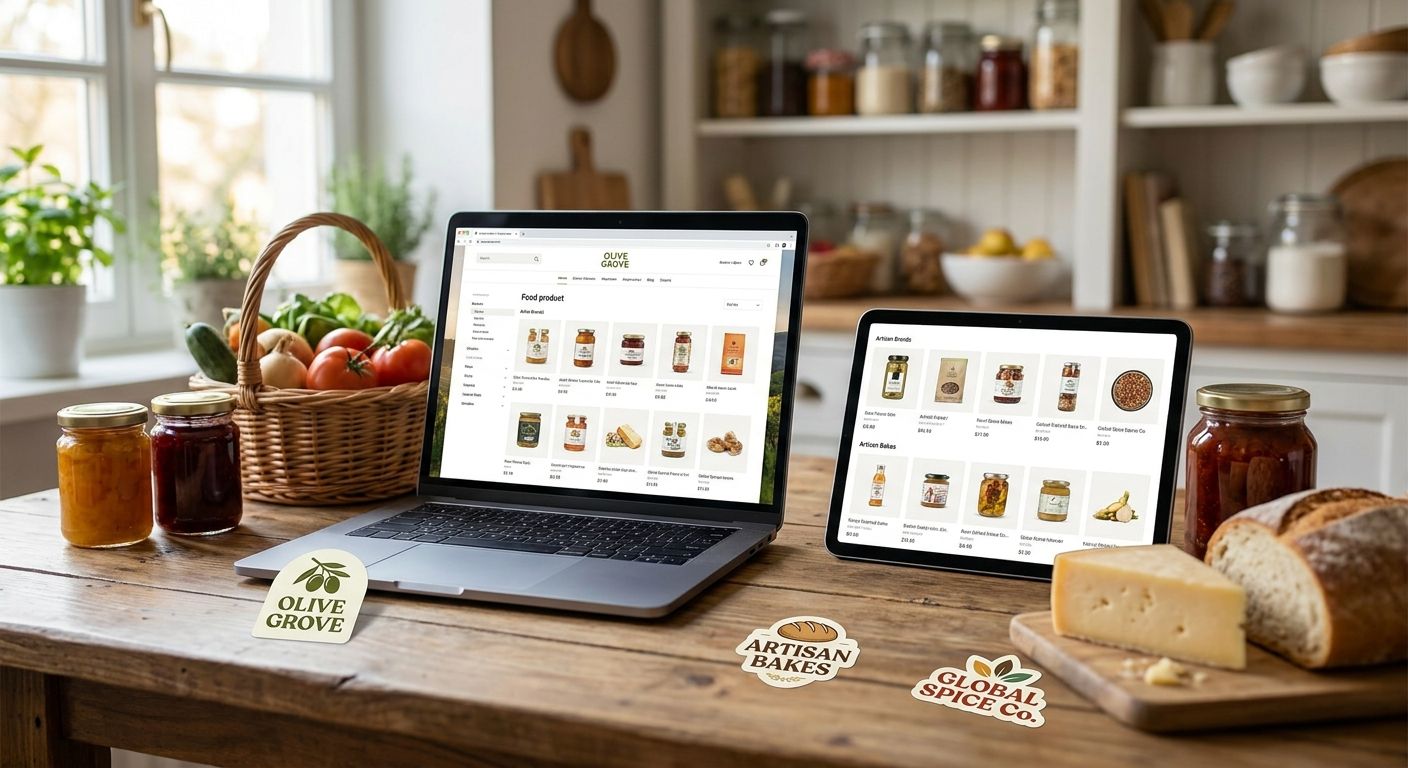
Separate storefronts, one inventory truth
Each banner needs its own domain, its own branding, and its own product mix visible to shoppers — but the backend has to see one number for stock, not three conflicting ones. Groups that keep inventory siloed per banner routinely double-order or stock out on shared SKUs like specialty cheeses or imported spices that move across multiple banners. A platform without a shared inventory layer forces someone on your team to reconcile counts by hand every week.
Banner-specific checkout rules
A kosher market needs different cutoff logic than a wine and spirits banner needs age verification, and a halal meat market needs different labeling requirements than a CSA box program. Generic multi-store SaaS treats every storefront the same, which means your compliance-heavy banners end up running manual workarounds outside the platform. That's where errors and chargebacks come from.
Delivery zones and fees per banner, not per account
A convenience store banner and a farm-to-table banner have completely different delivery economics — different radius, different basket size, different margin tolerance for a $6 delivery fee. If your platform applies one delivery logic across the whole group, one banner is always subsidizing another. Zone and fee structuring needs to happen at the banner level.
Cross-brand retail media monetization
CPG brands want shelf placement and sponsored search across your whole group, not banner by banner — that's a single retail media program that pays out across every storefront you run. Groups without this capability leave a monetization line on the table that a single national retail media network could never offer them directly, since most CPG suppliers won't build a program for a single regional banner alone.
MTO and kiosk support for prepared food banners
If any banner in your group runs a deli counter, a hot bar, or a prepared meal program, the platform needs make-to-order kiosk support baked in, not bolted on. Aggregated 2026 in-store kiosk data points to 30% higher order values and 99% order accuracy where kiosk ordering replaces manual counter tickets — that's real margin for a deli or meal-prep banner specifically.
Order management that spans locations
A shopper who orders from your Indian grocery banner in one city and your gourmet specialty shop in another shouldn't hit two different order histories, two different loyalty balances, and two different support queues. Order management needs to sit above the banners, not inside each one.
Top picks for multi-brand specialty groups
The margin-per-SKU banner — cheese and specialty deli. If your group runs a cheese counter or deli banner, the ecommerce platform built for cheese and specialty deli shops handles weight-based pricing and substitution logic that generic platforms miss entirely — a $4/lb cheese SKU sold by weight breaks most standard grocery carts. Buy this module if any banner in your group sells by weight.
The compliance-heavy banner — wine and spirits. Age verification, shipping restrictions by state, and delivery-window cutoffs are non-negotiable here. A platform that treats this banner like every other one will generate compliance headaches within the first quarter. Consider running this banner on dedicated checkout logic even if the rest of the group shares a backend.
The backend layer nobody sees — multi-location inventory sync. This is the piece that determines whether your group's numbers reconcile at month-end. Multi-location inventory sync for regional grocery chains is what keeps a shared SKU — imported olive oil, say — accurate across four banners without four separate stock counts. Buy this before adding a fifth banner to the group; the reconciliation cost only compounds.
The monetization layer — cross-brand retail media. CPG suppliers pay more for placement across a multi-banner footprint than for a single storefront. Groups that stand this up in 2026 are capturing a margin line that generic platforms don't even offer as a feature. Buy if you have three or more banners and any relationship with national or regional CPG brands.
The prepared-food banner — MTO kitchens. If one banner runs a hot bar, meal-prep counter, or kiosk-based ordering, order management needs to route those tickets differently than a standard grocery pick order. Consider this a priority upgrade the moment order volume on that banner crosses a few hundred orders a week — hand-written tickets stop scaling around there.
See the unified platform in action
One backend, every banner — inventory, orders, and delivery in sync.
What to avoid
- Generic multi-store ecommerce builders that treat every banner identically — they look cheaper upfront but push every compliance and delivery exception back onto your team manually.
- Third-party delivery marketplaces as your only channel — they own the customer relationship and the data, and margins on marketplace orders run thinner than direct orders in 2026 aggregated grocery data.
- Platforms that require a developer for every banner launch — if standing up banner number four takes a dev sprint, the platform wasn't built for multi-brand groups in the first place.
Verdict comparison
| Capability | Generic multi-store SaaS | Per-banner separate stacks | Unified multi-brand platform |
|---|---|---|---|
| Shared inventory truth | Partial | No | Yes |
| Banner-specific checkout rules | No | Yes, manually | Yes, built-in |
| Cross-brand retail media | No | No | Yes |
| Delivery zones per banner | Limited | Yes, manually | Yes, built-in |
| MTO/kiosk support | Rare | Varies | Yes |
| Verdict | Skip for 3+ banners | Skip past 2 banners | Buy for multi-brand groups |
FAQ
What is the best ecommerce platform for multi-brand specialty food retailers in 2026?
A unified commerce platform that keeps separate storefronts per banner but shares one inventory and order management backend is the best fit for 2026. Local Express is built specifically for grocery and specialty food groups running multiple banners under one operation.
Is a generic multi-store SaaS builder good enough for a specialty food group?
It works for two banners with similar compliance needs but breaks down past that. Once you add a wine, halal, or kosher banner with distinct checkout rules, generic multi-store tools push those exceptions back onto your staff manually.
How much does an ecommerce platform for a multi-brand grocery group cost?
Cost varies by number of banners, order volume, and which modules you need — inventory sync, retail media, and kiosk ordering are typically priced separately. Get a quote based on your specific banner count rather than estimating from a single-store price.
Can one platform run a kosher banner and a wine and spirits banner together?
Yes, as long as the platform supports banner-specific checkout logic — cutoff times for kosher orders, age verification for wine and spirits — rather than applying one rule set across the whole group. This is the single biggest failure point in generic tools.
Does cross-brand retail media actually generate revenue for smaller grocery groups?
Yes — CPG brands prefer placement across a multi-banner footprint over negotiating with a single regional storefront. Groups running this in 2026 are monetizing shelf space and sponsored search the same way national retailers do.
What's the biggest mistake multi-brand grocery groups make with delivery?
Applying one delivery zone and fee structure across every banner. A convenience store banner and a farm-to-table banner have different delivery economics, and one-size-fits-all zones mean one banner subsidizes another's losses.
Do I need a developer to launch a new banner on a unified platform?
No — a platform built for multi-brand specialty groups should let you launch a new banner's storefront without a development sprint. If your current platform requires one, it wasn't built for multi-brand operations.
How does order management work across multiple banners and locations?
Order management should sit above individual banners so a shopper's history, loyalty, and support tickets stay unified even when they order from different storefronts in the group. Banner-level order management alone creates fragmented customer records.
One last thing
The banner most groups underestimate is the one with the deli counter or hot bar — aggregated 2026 kiosk data puts order accuracy at 99% and ROI around 150% when that banner moves from handwritten tickets to kiosk-based MTO ordering. If your group has a prepared food banner sitting on manual order-taking in 2026, that's the fastest payback of any module on this list, not the flashiest one.