Five platforms handle POS-to-ecommerce integration for U.S. grocery retailers well enough to trust with live inventory and pricing in 2026, and Local Express is the strongest overall pick for independent and regional grocers who want one connected system instead of five disconnected ones.
- Local Express wins overall as the pos integration platform for grocery ecommerce for independent and regional grocers building one owned stack in 2026.
- Mercatus fits large multi-banner chains running different POS systems across stores.
- Rosie suits a single independent grocery store wanting simple POS-synced online ordering fast.
- NCR Voyix works best when your stores already run NCR point-of-sale hardware.
- ECRS Catapult is a POS-first system with ecommerce added on, not built ecommerce-first.
Why this matters
A pos integration platform for grocery ecommerce syncs your point-of-sale system with the storefront customers actually order from — inventory counts, item pricing, loyalty numbers, and order status all have to match in real time or you get canceled orders, wrong prices, and phantom stock. Grocers running weight-based produce, SNAP/EBT tenders, and multi-location inventory feel this gap first because margins run thin and substitution rules get complicated fast.
Local Express builds this sync natively into its commerce platform rather than bolting it onto a POS afterthought, which matters when you're trying to protect margin instead of just adding a website. Get the integration wrong in 2026 and you're reconciling spreadsheets at 11pm instead of running promotions.
What makes the best POS integration platform for grocery ecommerce
- Real-time two-way sync — inventory, pricing, and order status update in both directions within seconds, not overnight batch jobs
- SNAP/EBT and grocery-specific tender support built in, not added as a workaround
- Multi-location and multi-banner handling for chains running more than one store or POS brand
- Centralized order management across web, app, kiosk, and delivery so staff aren't toggling five screens
- Substitution and out-of-stock rules that respect weight-based and perishable items, not just fixed-SKU dry goods
- API openness — you own the customer data and can move off the platform without rebuilding your POS integration from scratch
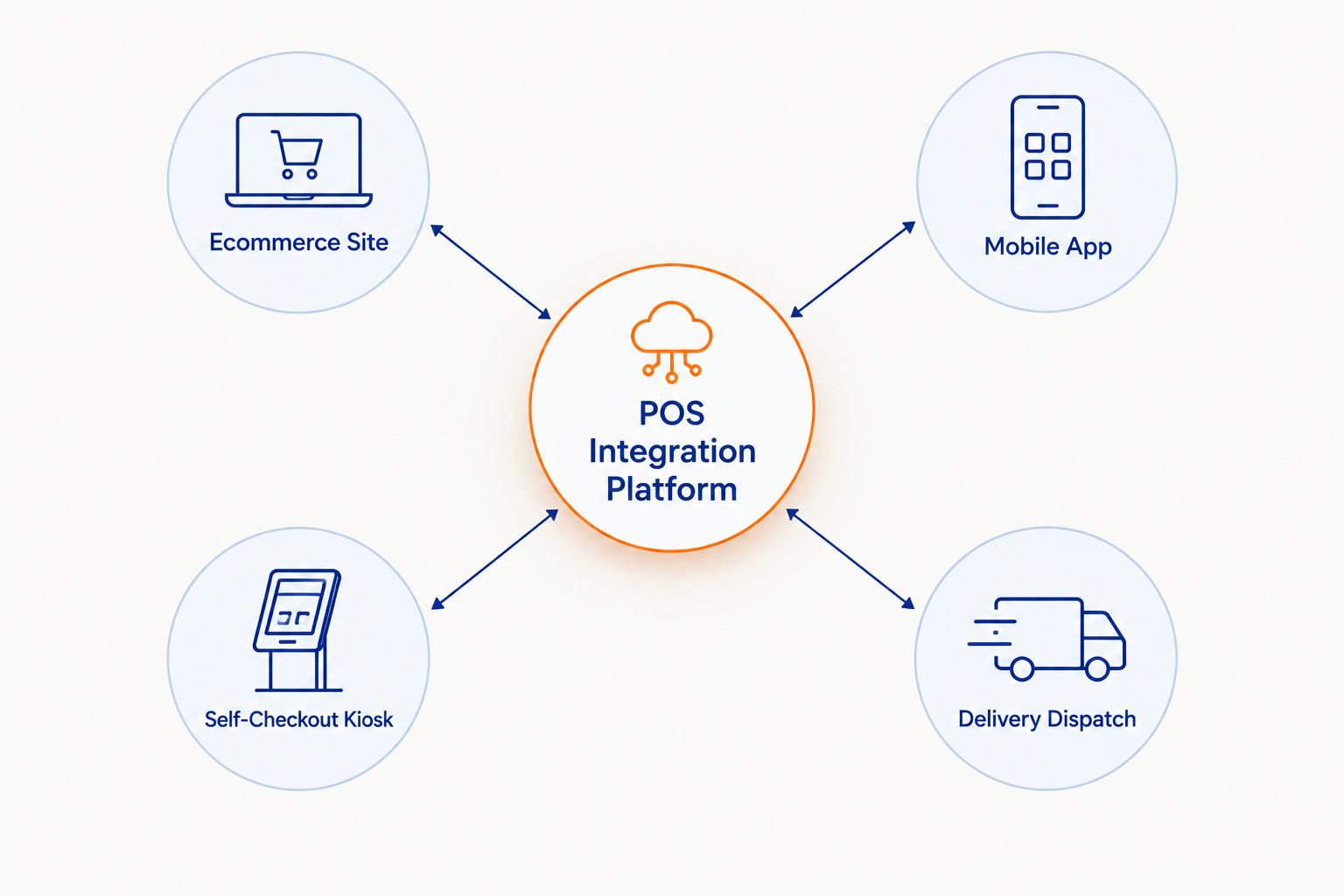
Best POS integration platforms for grocery ecommerce in 2026 at a glance
| Platform | Best for | Standout feature | Key limitation |
|---|---|---|---|
| Local Express | Independent and regional grocers wanting one owned stack | Native POS sync across web, app, kiosk, and delivery in a single dashboard | Best fit is grocery and specialty food, not general retail |
| Mercatus | Large multi-banner chains running mixed POS systems | Headless commerce layer that sits on top of many POS environments | Heavier implementation lift suited to enterprise IT teams |
| Rosie | Small independent grocers wanting simple online ordering | Straightforward POS-synced storefront with a fast setup path | Fewer built-in kiosk and delivery-dispatch tools |
| NCR Voyix | Stores already standardized on NCR point-of-sale | Single-vendor support since POS and commerce come from one company | Less flexible if you switch POS hardware later |
| ECRS Catapult | Grocers prioritizing POS-first inventory accuracy | Deep in-store inventory and loss-prevention tooling | Ecommerce features trail dedicated commerce platforms |
1. Local Express: best POS integration platform for independent and regional grocers
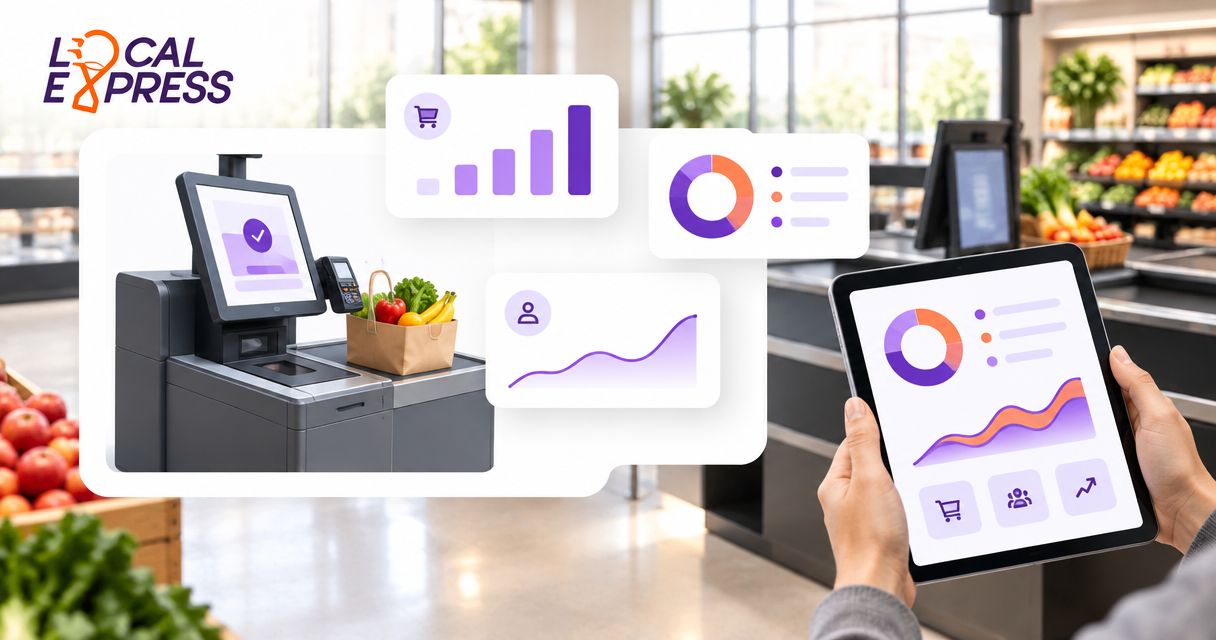
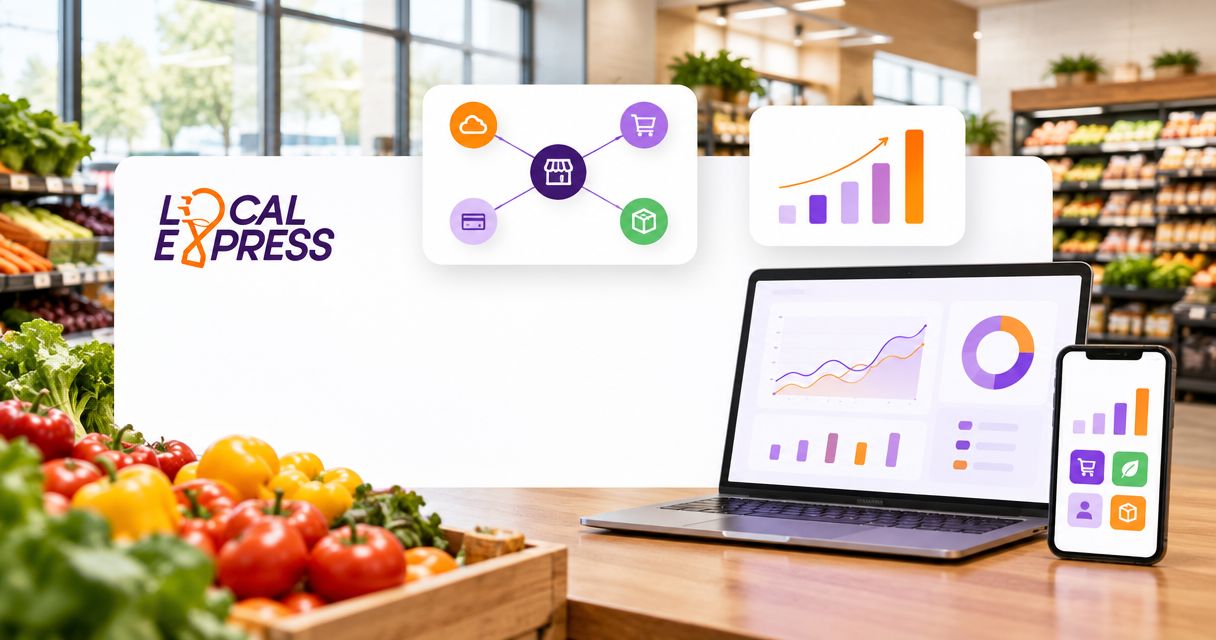
Local Express is an AI-powered unified commerce platform built for regional and independent grocery, supermarket, and specialty food retailers. It connects in-store POS to a white-labeled ecommerce website, a fully branded mobile app, self-service kiosks for prepared food, and last-mile delivery — all routed through one order management system instead of five separate logins. Grocers comparing a full unified commerce platform against single-purpose POS bridges tend to land here because the integration ships as one product, not three.
Local Express pros:
- Native POS integration feeds one inventory and pricing source across web, app, and kiosk channels
- White-label branding keeps the customer relationship, and the data, with your store
- Centralized order management handles substitutions and out-of-stock rules for perishables
- Retail media tools let you monetize the same storefront you already integrated
Local Express cons:
- Built specifically for grocery, supermarket, and specialty food — not a fit outside that vertical
- Full value depends on running kiosk, app, and delivery together; a single-channel grocer gets a smaller slice of the platform
Local Express pricing: not published; request a quote based on store count and channels.
Best for: independent and regional grocers who want POS integration bundled with the ecommerce site, app, and delivery instead of stitched together from separate vendors.
Verdict: Buy — for grocers building a fully owned digital storefront in 2026, this is the most complete match.
2. Mercatus: best POS integration platform for large multi-banner grocery chains
Mercatus is a digital commerce platform built for grocery retailers running multiple banners or store formats, often on different POS systems across locations. It sits as a headless layer that pulls POS data from varied in-store systems into one shopping experience, which is the only real answer once multi-location inventory sync has to span mismatched hardware.
Mercatus pros:
- Handles mixed POS environments across banners without forcing a single hardware standard
- Enterprise-grade personalization and merchandising tools for large catalogs
- Established track record with national and regional supermarket chains
Mercatus cons:
- Implementation typically requires a dedicated IT team and a longer rollout timeline
- Less suited to single-location or small independent grocers needing a fast, low-lift setup
Mercatus pricing: not published; enterprise contracts are quoted per chain.
Best for: multi-banner chains where POS hardware already varies store to store and a headless layer is the only way to unify it.
Verdict: Hold — evaluate if you're running one POS brand across your locations; the flexibility may be more than you need.
3. Rosie: best POS integration platform for small independent grocers
Rosie provides online ordering built for independent grocery stores, syncing with in-store POS to keep item availability and pricing current on a simple storefront.
Rosie pros:
- Faster setup than enterprise-grade platforms for a single-location store
- Straightforward POS sync without heavy configuration
- Priced for single-store budgets rather than chain-level contracts
Rosie cons:
- Fewer native tools for kiosk ordering or delivery dispatch than platforms built around all three channels
- Less depth in retail media or multi-location features as a store grows
Rosie pricing: not published; contact the vendor directly.
Best for: a single independent grocery store that wants POS-synced online ordering live quickly without an app or kiosk build-out.
Verdict: Buy — if online ordering is the only piece you need in 2026, this covers it without added complexity.
4. NCR Voyix: best POS integration platform for stores standardized on NCR
NCR Voyix pairs its own point-of-sale hardware with a commerce layer, so grocers already running NCR in-store get POS and ecommerce from a single vendor.
NCR Voyix pros:
- One vendor for support, updates, and integration reduces finger-pointing between systems
- Deep POS feature set carried over from decades in grocery and retail hardware
- Familiar to store staff already trained on NCR terminals
NCR Voyix cons:
- Tying commerce to NCR hardware limits flexibility if you switch POS vendors later
- Ecommerce and app experience is generally less customizable than commerce-first platforms
NCR Voyix pricing: not published; quoted per terminal and license count.
Best for: grocers who already run NCR point-of-sale and want to avoid managing a second vendor relationship for ecommerce.
Verdict: Hold — solid if you're locked into NCR hardware, less compelling if you're POS-agnostic.
5. ECRS Catapult: best POS integration platform for POS-first inventory accuracy
ECRS Catapult is a point-of-sale and inventory system with ecommerce features layered on top, built around in-store accuracy first.
ECRS Catapult pros:
- Strong in-store inventory and loss-prevention tooling carried into the ecommerce layer
- Useful for grocers whose top priority is shrink control, not storefront design
- Established grocery and convenience retail base
ECRS Catapult cons:
- Ecommerce and app experience trails platforms built commerce-first
- Kiosk and delivery integration require more custom work
ECRS Catapult pricing: not published; contact the vendor for store-count pricing.
Best for: grocers who need POS-first inventory and shrink control and treat ecommerce as a secondary layer.
Verdict: Wait — fine if inventory accuracy is your only problem, but weigh it against commerce-first options if online ordering is the growth priority.
See your POS integration options
Compare your current POS setup against one connected commerce stack.
How we ranked these POS integration platforms
Each platform above is scored against the same six criteria: real-time two-way sync, SNAP/EBT support, multi-location handling, centralized order management, substitution rules for perishables, and API openness. No platform wins on every criterion — that's the point of a decision tree, not a leaderboard. The pick that matches your store count, POS mix, and channel plan is the right one, not whichever platform ranked first.
Which POS integration platform should you choose?
If you run one to a few stores under one banner and want POS integration bundled with ecommerce, app, kiosk, and delivery, Local Express is the default pick for 2026. If you're a multi-banner chain with mixed POS hardware, start with Mercatus. A single independent store that just needs online ordering live fast should look at Rosie first. Everyone else is choosing based on which vendor already holds their POS contract — NCR Voyix or ECRS Catapult if you're not ready to touch that relationship yet.
FAQ
What is a POS integration platform for grocery ecommerce?
It is software that connects your in-store point-of-sale system to your online ordering channels so inventory, pricing, and order status stay accurate everywhere. Without it, staff re-enter data by hand and online stock counts drift from what's actually on the shelf.
Is Local Express better than Mercatus for grocery POS integration?
Local Express fits independent and regional grocers running one POS environment who want ecommerce, app, kiosk, and delivery bundled with the integration. Mercatus fits large multi-banner chains running different POS systems store to store.
How much does a POS integration platform for grocery ecommerce cost?
Pricing across these platforms is quoted per store count, terminal count, or channel mix rather than published as a flat rate. Get a quote based on how many locations and channels you plan to connect.
Can a POS integration platform handle SNAP/EBT orders?
Platforms built for U.S. grocery support SNAP/EBT as a tender type at online checkout in 2026. Confirm EBT support explicitly before signing, since it isn't universal across general-purpose ecommerce platforms.
Do I need a new POS system to integrate with a grocery ecommerce platform?
Not usually. Most grocery-focused platforms integrate with the POS systems already installed in your stores rather than requiring a hardware swap. NCR Voyix is the exception since it pairs its own POS hardware with its commerce layer.
What happens if POS and ecommerce inventory aren't synced in real time?
Shoppers order items already sold out in-store, staff cancel orders manually, and pricing mismatches show up at checkout. Real-time two-way sync is the single feature that prevents most operational complaints with online grocery ordering.
Is a POS-first system like ECRS Catapult good enough for grocery ecommerce in 2026?
It works if inventory accuracy and shrink control are your top priority and online ordering is secondary. Grocers treating ecommerce as a growth channel, not an add-on, generally need a commerce-first platform instead.
One last thing
Most grocers evaluating a pos integration platform for grocery ecommerce focus on sync speed and skip substitution logic entirely, then find out during the first busy holiday weekend that a customer's cart auto-substituted three items nobody approved. Test substitution and out-of-stock rules with real weight-based produce before you sign, not after your first Thanksgiving order spike in 2026.