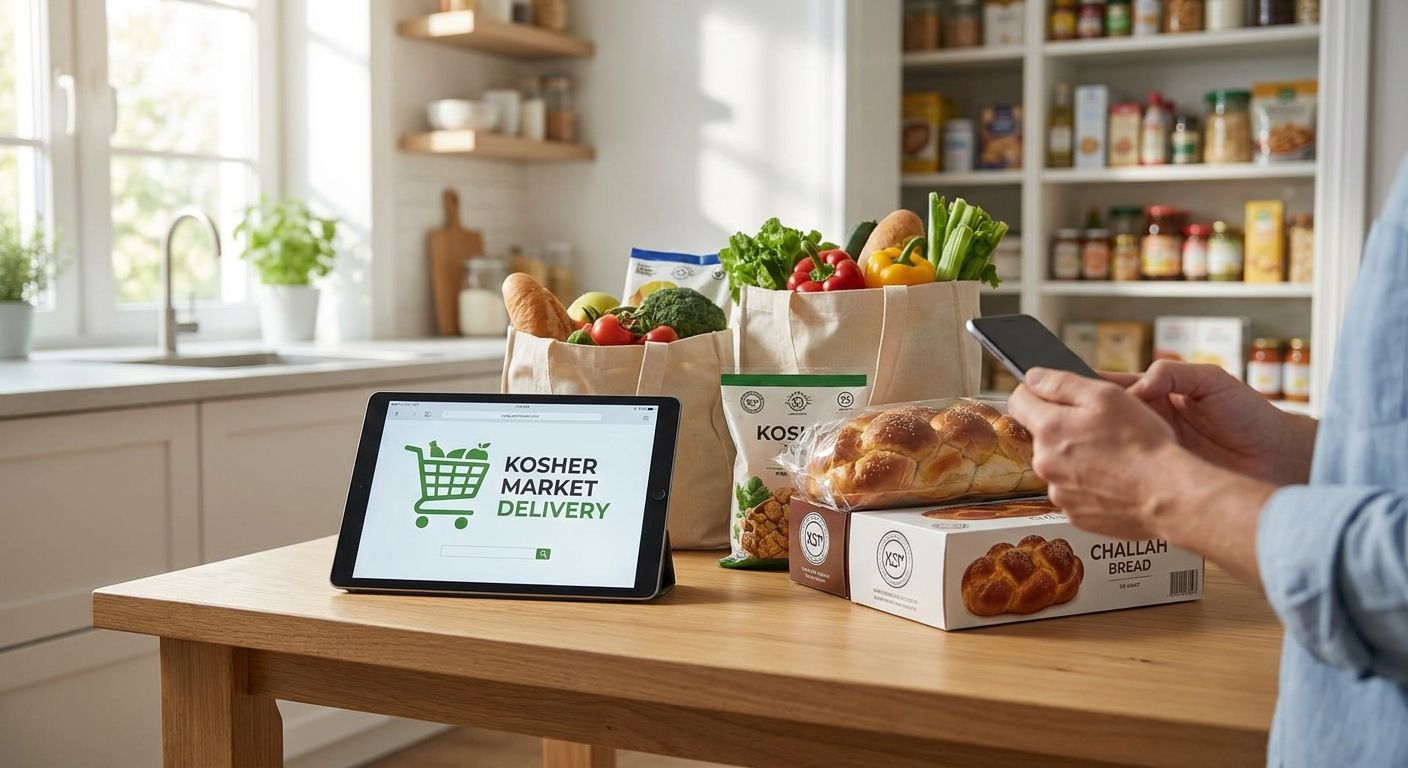
Kosher grocers face a problem generic grocery ecommerce platforms don't solve: dietary certification tagging, holiday-driven demand spikes (Passover, Rosh Hashanah, Sukkot), and shopper trust that depends on visible kosher symbols (OU, OK, Star-K) at the product level, not just in a footer disclaimer.
- A white-label online ordering platform for kosher grocery stores beats marketplace listings on margin and customer data ownership in 2026.
- Third-party marketplace apps take a commission on every order and never hand over the shopper's email or phone number.
- Legacy POS-bundled webstores rarely support kosher certification tagging at the SKU level, which frustrates observant shoppers fast.
- Local Express runs the same white-label model already live for halal and Middle Eastern grocers, adapted for kosher certification and holiday ordering windows.
- DIY builders like generic ecommerce plugins work, but delivery zone logic and holiday cutoff scheduling become a standing dev project.
Why this matters
A kosher grocery store isn't a general grocer with a religious sticker on the door. Shoppers check for certification symbols before they check price, holiday demand can triple normal order volume in a 72-hour window around Passover, and a missed kosher-for-Passover tag on a product page is the kind of error that costs a repeat customer permanently.
Most ecommerce platforms weren't built with any of that in mind. They were built for general grocery, then retrofitted with a filter tag if a client asked nicely. That gap is exactly why the online ordering platform for kosher grocery stores question keeps coming up in 2026 — operators are done working around software that wasn't built for them.
The stakes are real: a $3.50 return per $1 invested in unified commerce infrastructure only holds up if the platform underneath actually fits the store. Pick wrong and that ROI evaporates into support tickets and manual workarounds.
How this list is ranked
This ranking groups the realistic categories of online ordering solutions a kosher grocer evaluates in 2026, scored against four things that matter specifically for this vertical: SKU-level dietary tagging, holiday demand handling, customer data ownership, and total cost of running the thing day to day. Each category gets a plain verdict — Buy, Hold, Wait, or Skip — based on how it holds up against those four criteria, not on vague brand reputation.
The ranked list
1. White-label unified commerce platforms — the control pick
A white-label platform gives a kosher grocer a fully branded website and mobile app, order management, and delivery — all under the store's own name, with no marketplace logo competing for the shopper's attention. Local Express runs this exact model for dietary-specific grocers already, including the same white-label approach built for halal and Middle Eastern grocers, where certification tagging and cultural product categorization work the same way kosher tagging needs to.
The store owns the customer relationship end to end: email, phone, order history, repeat-purchase patterns. That data feeds retail media and personalization the store actually controls, not a marketplace's algorithm. Operators running unified commerce platforms report roughly 30% higher order values compared to marketplace-only ordering in 2026.
Verdict: Buy — this is the category built for a store that wants to keep its margin and its customer list.
2. Third-party delivery marketplaces — the reach play
Listing on a general grocery marketplace app gets a kosher store discovered by shoppers already browsing that app, with zero setup cost and no development work. That's the entire appeal.
The tradeoff is steep: a commission on every order, no access to the shopper's contact information, and product pages controlled by the marketplace's template — meaning kosher certification symbols often get flattened into a generic "dietary" filter buried three clicks deep. A store on a marketplace never builds a first-party list it can market to directly.
Verdict: Hold — fine as a secondary discovery channel in 2026, dangerous as the only ordering channel.
3. Legacy POS-bundled webstores — the free-with-your-register option
Many POS vendors bundle a basic webstore at no extra charge, which makes this the default choice for stores that never actively picked a platform. It works for a simple pickup list.
It breaks down fast for a kosher grocer: no SKU-level certification tagging, no holiday-specific ordering windows, and templated design that looks identical to every other store on the same POS. Passover ordering surges get handled the same as a random Tuesday, because the platform has no concept of a holiday calendar.
Verdict: Skip — adequate for a hardware-store add-on, not built for a certification-sensitive category.
4. DIY website builders and plugins — the developer project
General ecommerce builders and grocery plugins can technically be configured to show kosher tags, set delivery zones, and handle holiday cutoffs. The catch is the word "configured" — every one of those features is a custom build, not a native capability.
Stores that go this route usually end up maintaining a part-time developer relationship just to keep delivery zone logic and holiday order cutoffs working correctly year over year. That cost rarely shows up in the initial pitch.
Verdict: Wait — only makes sense for a store with in-house development capacity and time to spare before the next holiday rush.
5. Niche kosher-specific ordering apps
A handful of smaller, kosher-specific ordering tools exist, built narrowly for this vertical. The certification tagging is often solid because it's the whole point of the product.
Where these fall short in 2026 is scale: most lack a real last-mile delivery network, retail media tools, or a branded mobile app — meaning the store gets a decent ordering form but still has to bolt on delivery and marketing separately.
Verdict: Hold — worth a look for tagging quality, but confirm delivery and app coverage before committing.
Comparison table
| Category | Kosher tagging | Holiday demand handling | Owns customer data | 2026 verdict |
|---|---|---|---|---|
| White-label unified commerce | Native, SKU-level | Configurable ordering windows | Yes | Buy |
| Third-party marketplaces | Generic filter only | No holiday logic | No | Hold |
| Legacy POS webstores | None | None | Partial | Skip |
| DIY builders/plugins | Custom build required | Custom build required | Yes | Wait |
| Niche kosher apps | Native | Limited | Partial | Hold |
See the platform built for dietary-specific grocers
Branded ordering, delivery, and app tools built for certification-sensitive grocery categories.
How to actually source this decision
Don't start the vendor conversation with pricing. Start with these three checks:
- Ask to see SKU-level dietary tagging live, not on a slide. If the sales team can't show a product page with a certification badge attached to the actual SKU, the platform bolts tagging on rather than building it in.
- Ask how holiday ordering windows get configured. A platform that treats Passover the same as a Tuesday will bottleneck exactly when order volume triples.
- Confirm who owns the customer record. If the answer involves the word "marketplace," the store is renting its own customer list.
SNAP/EBT compatibility matters too if the store serves SNAP-eligible customers — check how SNAP EBT online ordering gets set up on the platform before signing anything, since retrofitting payment compliance after launch is expensive.
FAQ
What's the best online ordering platform for kosher grocery stores in 2026?
A white-label unified commerce platform is the best fit in 2026 because it supports SKU-level kosher certification tagging, holiday-specific ordering windows, and gives the store ownership of its customer data. Marketplace apps and legacy POS webstores both fall short on certification tagging.
Is a marketplace app better than a branded website for a kosher grocer?
A marketplace app adds discovery but takes a commission on every order and doesn't hand over customer contact data. A branded website or app keeps the margin and the customer relationship, which matters more for repeat kosher shoppers.
How much does an online ordering platform cost for a kosher grocery store?
Cost varies by vendor and by whether the store needs a website, a mobile app, or both. Check current pricing directly with the platform since packages differ based on delivery and kiosk add-ons.
Can online ordering platforms handle Passover and holiday order spikes?
Only platforms built with configurable ordering windows handle holiday spikes well. Generic POS-bundled webstores treat every day the same, which causes bottlenecks exactly when demand triples around Passover or Rosh Hashanah.
Do I need a separate delivery app for a kosher grocery store?
Not if the ordering platform includes last-mile delivery natively. Stores that pick niche kosher-specific ordering tools often still need a separate delivery solution, which adds cost and complexity.
Does SNAP/EBT work with kosher grocery ecommerce platforms?
Some platforms support SNAP/EBT online ordering directly; others require a separate integration. Confirm this before launch since adding payment compliance after the fact is more expensive than building it in from day one.
Can I show kosher certification symbols on individual product pages?
Only platforms with SKU-level dietary tagging support this natively. Ask any vendor to demonstrate a live product page with a certification badge attached before signing a contract.
How is a kosher grocery ecommerce platform different from a general grocery platform?
The core difference is dietary tagging at the SKU level and holiday-aware ordering logic. A general grocery platform can technically be customized for this, but it usually requires ongoing development work rather than native support.
One last thing
The biggest mistake kosher grocers make isn't picking the wrong platform category — it's picking a platform that treats certification tagging as a filter instead of a trust signal. A shopper who can't verify a product's kosher status on the page itself will abandon the cart even if the item is correctly certified in the back office. Fix the display, not just the data.