Gourmet and specialty food shops sell margin, not just groceries — and the wrong ecommerce platform for gourmet food shops flattens that margin down to marketplace commodity pricing. This guide breaks down what actually matters for cheese counters, seafood markets, wine shops, spice merchants, and prepared-food delis shopping for a storefront in 2026.
- Local Express fits gourmet shops needing lot tracking, case-cut pricing, and age verification — Buy for specialty perishables.
- Generic Shopify themes lack cold-chain and by-weight logic; skip them for cheese, seafood, and deli operations.
- Kiosk ordering lifts order values 30% and hits 99% accuracy, per aggregated 2026 retail data.
- Wine and spirits retailers need license-based delivery zones built into the ecommerce platform for gourmet food shops, not bolted on.
Why This Matters
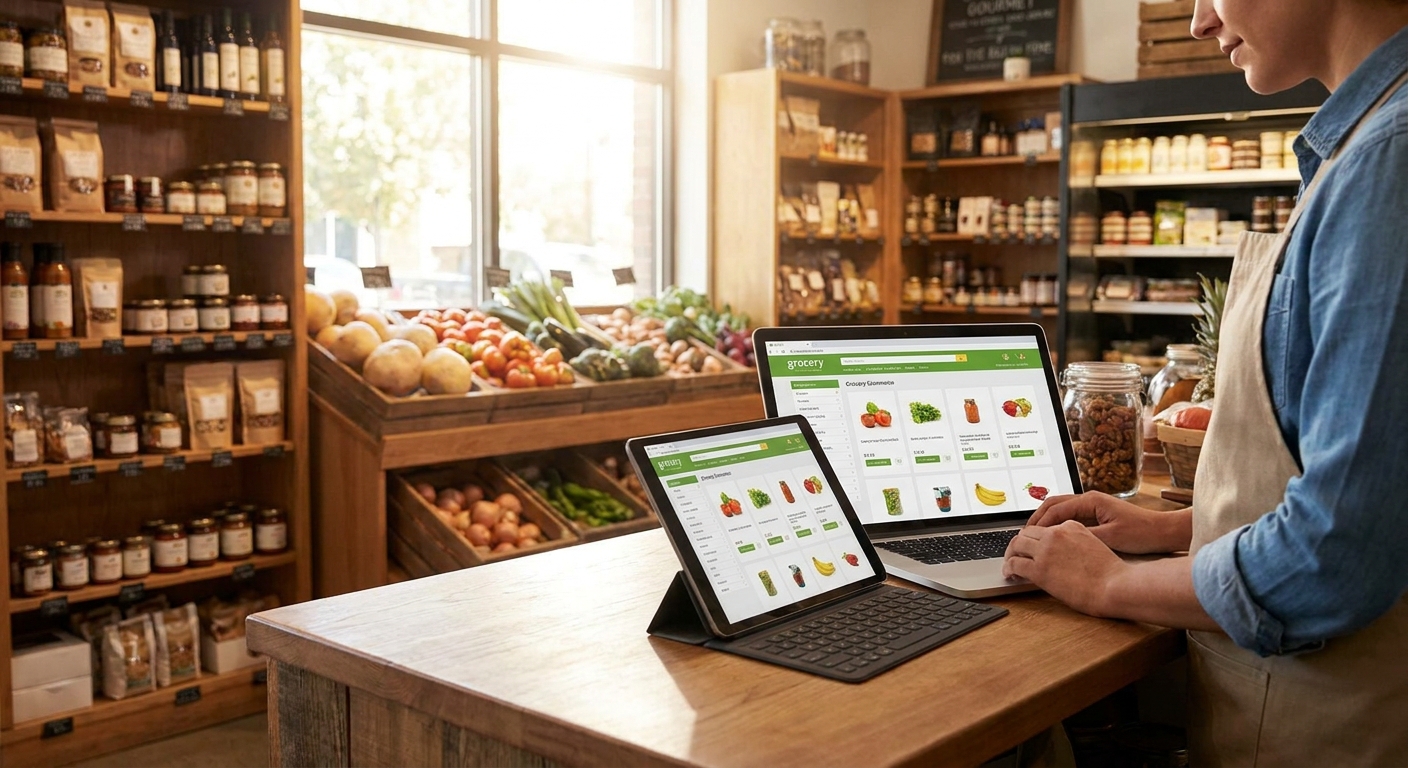
Specialty grocers don't compete on price — they compete on curation, freshness, and trust in every cut of cheese or catch of the day. Marketplace apps strip that trust into a commission line and a stranger's delivery bag. Local Express builds white-labeled storefronts that keep the shop's name on the box and the shop's margin in the bank, and aggregated 2026 industry data puts the return on AI-driven grocery ecommerce at $3.50 per $1 invested.
That gap between a marketplace listing and a branded storefront is exactly what a gourmet or specialty shop is shopping for when it evaluates an ecommerce platform for gourmet food shops in 2026. Add retail media on top — CPG brands paying to feature a local roaster's beans or a regional cheesemaker's wheel — and the storefront becomes a second revenue line, not just a sales channel.
Who This Is For
This guide is built for owner-operators running cheese counters, seafood markets, wine and spirits shops, spice and international grocers, and prepared-food delis — typically single-location or small multi-store operations doing $1M to $15M in annual revenue. You're not shopping for a generic template with a grocery plugin taped on.
You need lot-level expiration tracking, case-cut and by-weight pricing, age verification at checkout, and a mobile app that looks like your storefront instead of a third-party marketplace. If your current setup is a phone order line, a Facebook form, and a delivery app taking 25-30% off every order, this is the upgrade path for 2026.
What to Look for in an Ecommerce Platform for Gourmet Food Shops
1. By-Weight and Case-Cut Pricing
Cheese, deli meat, and seafood rarely sell in fixed units — a platform that only handles flat SKU pricing forces you to round every order and eat the difference. Look for variable-weight pricing that lets customers order roughly a pound and get billed on the actual cut. Without it, you're manually adjusting invoices or absorbing shrink on every single order.
2. Lot and Expiration Tracking
Perishables carry lot numbers and use-by dates that need to sync from your point of sale to the storefront in real time, not overnight. A platform that can't push expiration data live risks selling product that's already been pulled from the shelf. This matters more in 2026 as AI-driven inventory tracking hits 95% accuracy in aggregated retail data — that accuracy only holds if the ecommerce layer talks to inventory continuously.
3. Age Verification and License-Based Delivery Zones
Wine, spirits, and some specialty imports need age gates at checkout and delivery zones that respect state and local licensing, not just a shipping radius. A platform without built-in age verification puts the compliance burden back on your delivery drivers. Get this wrong once and you risk the license, not just a chargeback.
4. Prepared Food and Self-Service Ordering
Delis, hot bars, and made-to-order counters need a kiosk or app flow that handles modifiers — extra cheese, no onions, gluten-free bread — without a staffer re-keying every order by hand. Aggregated 2026 kiosk data shows a 30% lift in order values and 99% order accuracy when self-service ordering replaces verbal orders at the counter. That's the difference a kiosk-ready platform makes during a Saturday lunch rush.
5. SNAP/EBT and Payment Flexibility
A large share of gourmet and specialty grocery baskets still get paid partly with SNAP/EBT, especially in shops carrying staple goods alongside specialty items. If your ecommerce platform can't split-tender a SNAP payment against a non-eligible bottle of wine in the same cart, you lose that customer's entire basket, not just the SNAP portion of it.
6. Retail Media and First-Party Data
Once a storefront is live, the customer data behind it is worth as much as the orders themselves — purchase history lets a shop run its own retail media program instead of handing that data to a marketplace. A platform that can onboard a local roaster or regional distributor into a sponsored-placement program turns the storefront into a second revenue stream, on top of the order itself.
Top Picks for Gourmet and Specialty Food Ecommerce
The Specialist Pick: Cheese and Specialty Deli Shops
Local Express's build for cheese and specialty deli shops handles lot-tracked perishables, case-cut pricing, and modifier-heavy prepared orders in one storefront. The standout spec is real-time weight-based pricing synced to your scale system, not a flat per-unit charge. For a deli doing $2,000-plus in daily counter orders, that alone closes the gap between marketplace commission math and actual margin. Buy for any counter-service cheese or deli operation ready to go direct-to-consumer in 2026.
The Perishables Pick: Seafood Markets
The build for seafood markets is tuned for same-day and next-day fulfillment windows on live and fresh catch, where inventory expires in hours, not weeks. The key spec here is delivery-zone cutoff times tied to catch schedules, so customers never order fish that hasn't landed yet. Buy if your current online orders regularly get canceled because inventory moved faster than your website did.
The Compliance Pick: Wine and Spirits Retailers
Wine and spirits shops carry the heaviest compliance load of any specialty category — age verification, license-bound delivery zones, and shipping restrictions that change at the state line. A platform built for wine and spirits retailers bakes those checks into checkout instead of leaving them to a driver's judgment call. Consider this path if you're already licensed for delivery and want to stop losing margin to third-party alcohol marketplaces; skip it if your state still restricts most direct wine delivery, since no compliance module fixes a licensing gap.
The In-Store Multiplier: Self-Ordering Kiosks
A self-ordering kiosk for grocery and specialty food stores extends the same storefront logic to the physical counter — modifiers, case-cut pricing, and loyalty data all flow into the same order management system as the website. Aggregated 2026 kiosk data shows 99% order accuracy and 150% ROI within typical payback windows. Buy if your prepared-food or deli counter still runs on handwritten tickets.
Get Your Gourmet Storefront Live
See how the platform handles case-cut pricing and age verification.
Verdict Comparison
| Pick | Best For | Standout Spec | Verdict |
|---|---|---|---|
| Cheese & Specialty Deli | Counter-service cheese/deli shops | Real-time weight-based pricing | Buy |
| Seafood Markets | Live and fresh catch retailers | Catch-schedule delivery cutoffs | Buy |
| Wine & Spirits Retailers | Licensed delivery operators | Age verification + license zones | Consider |
| Self-Ordering Kiosks | Prepared food/deli counters | 99% order accuracy | Buy |
What to Avoid
Generic ecommerce themes with a grocery plugin bolted on. They handle flat-price SKUs fine but fall apart on by-weight pricing, lot tracking, and age gates — you'll spend more on customization than the platform costs.
Third-party delivery marketplaces as your only storefront. A 25-30% commission on every order isn't a channel, it's a tax on your margin, and you own none of the customer data behind it.
Ignoring recurring-order logic for consumables. Coffee, spice blends, and wine clubs are natural subscription categories — a specialty coffee roaster running a coffee subscription service proves repeat orders lift lifetime value without new acquisition spend, and a gourmet shop's ecommerce platform should support the same reorder logic for cheese boxes and spice kits.
FAQ
What's the best ecommerce platform for gourmet food shops in 2026?
Local Express is the strongest fit for cheese, seafood, wine, and deli shops needing by-weight pricing, lot tracking, and age verification in one storefront. Generic ecommerce builders can list products but can't natively handle variable-weight checkout or license-based delivery zones that specialty categories require.
Is a white-label platform better than Shopify for a specialty food shop?
For perishables and age-restricted categories, yes — a white-label grocery platform handles lot tracking, case-cut pricing, and compliance gates that generic apps bolt on imperfectly. Shopify still works for shelf-stable, single-SKU gourmet goods with no weight variability or age restrictions.
How much does an ecommerce platform for gourmet food shops cost in 2026?
Cost depends on store count, modules chosen (kiosk, delivery, retail media), and order volume, so get a direct quote rather than assuming a flat rate. Budget for the storefront plus at least one fulfillment or kiosk module if you run prepared foods.
Do gourmet food shops need SNAP/EBT support online?
Yes, if the shop carries any SNAP-eligible staple goods alongside specialty items, since customers expect to split-tender a cart between eligible and non-eligible items. A platform that can't split-tender SNAP against a bottle of wine or a gift basket loses the whole order, not just the ineligible part.
Can a self-service kiosk pay for itself in a specialty deli?
Aggregated 2026 kiosk data shows 150% ROI and a 30% lift in order values, which typically covers the kiosk's cost within a year for a busy prepared-food counter. Payback is faster in shops with long lunch-rush lines where staff time is the bottleneck, not ingredient cost.
How do wine and spirits retailers handle delivery compliance online?
Compliant platforms build age verification into checkout and restrict delivery zones to licensed areas automatically, rather than relying on a driver to check ID. Retailers still need the underlying state and local delivery license — the platform enforces the rules, it doesn't grant the license.
What's the difference between a marketplace app and a branded grocery app?
A marketplace app puts a third party's name on the order and takes a 25-30% commission; a branded grocery app keeps the shop's name on every screen and the shop keeps the customer data. For a gourmet shop competing on curation, owning that relationship matters more than the extra reach a marketplace offers.
How long does it take to launch a gourmet grocery ecommerce site?
Timelines vary by catalog size and how many modules (kiosk, delivery zones, retail media) launch alongside the storefront, so confirm a schedule during setup rather than assuming a fixed number of weeks. Shops migrating off a marketplace app typically move faster since product data already exists digitally.
One Last Thing
Most gourmet shops evaluating an ecommerce platform for gourmet food shops in 2026 focus on the website and skip the kiosk — but aggregated 2026 data puts self-service kiosk ROI at 150%, often a faster payback than the website itself. If budget forces a choice between launching the storefront first or the counter kiosk first, and your prepared-food counter already has a line out the door on weekends, start with the kiosk. The website converts new customers over months; the kiosk fixes the line you already have this week.