Checkout upsell tools decide whether a $42 grocery cart closes at $42 or $54 — and most cart-upsell plugins built for general ecommerce ignore the things that make grocery carts different: SNAP eligibility, substitution logic, and weight-based SKUs.
- AI cart recommendation engines top the checkout upsell tools grocery ecommerce list for 2026 — buy.
- In-app sponsored product placements turn checkout into a CPG revenue line, not just a UX feature.
- SNAP/EBT-aware bundling is mandatory for any grocer running EBT online ordering, not a nice-to-have.
- Generic bolt-on upsell plugins built for general retail skip weight-based and substitution logic — skip them.
- Self-service kiosk upsell prompts lift order values in stores running a deli or prepared food counter.
Why this matters
A checkout upsell that recommends an out-of-stock item costs you the sale and the trust — that's why inventory accuracy sits at the center of every tool on this list. Aggregate 2026 grocery ecommerce data puts the return on AI-driven commerce tools at $3.50 per $1 invested, but that number assumes the recommendation engine is reading real-time stock, not yesterday's feed.
Cart abandonment runs 18% lower when checkout logic is AI-driven rather than static, and kiosk-based upsell prompts push order values up 30% in stores with a prepared food or deli component. None of that works if the underlying platform can't hit 95% inventory accuracy across web, app, and kiosk at once.
The AI-powered grocery ecommerce platform you run checkout on matters more than which upsell widget you bolt onto it. A recommendation engine sitting on top of a disconnected POS is guessing. One sitting on unified order data is not.
How we ranked these
Each tool category is ranked on four factors pulled from 2026 grocery ecommerce adoption patterns: fit for grocery-specific catalogs (weight-based items, perishables, substitutions), compliance handling for SNAP/EBT carts, whether it runs across web, app, and kiosk channels or just one, and whether the upsell logic reads live inventory or a stale feed. Tools that only work in a single channel or that ignore SNAP-eligible item splits get marked down regardless of how polished the UI looks.
The ranked list
1. AI-powered cart recommendation engines — the compounding engine
These read purchase history, current cart contents, and live stock to surface cross-sells at the point a shopper is already committed to buying. The 2026 aggregate return of $3.50 per $1 invested comes largely from this category, because the recommendation compounds on every order instead of running as a one-off promotion.
The catch: accuracy depends entirely on inventory data quality. If your stock feed lags by more than a few hours, the engine will recommend items you can't fulfill, and that erodes trust faster than no upsell at all. Buy — but only after inventory sync is solid.
2. In-app sponsored product placements — the revenue tool disguised as UX
This is retail media at checkout: CPG brands pay to place products in the cart flow, and the retailer keeps a cut without touching margin on the core basket. It's the fastest-growing checkout upsell category in grocery for 2026 because it monetizes shelf space that was previously free.
Done right, in-app sponsored product placements look like a relevant suggestion, not an ad unit. Done wrong, they look exactly like an ad unit and shoppers tune them out within two visits. Buy for any grocer with more than one banner or enough basket volume to interest CPG partners.
3. Self-service kiosk upsell prompts — the physical checkout's answer
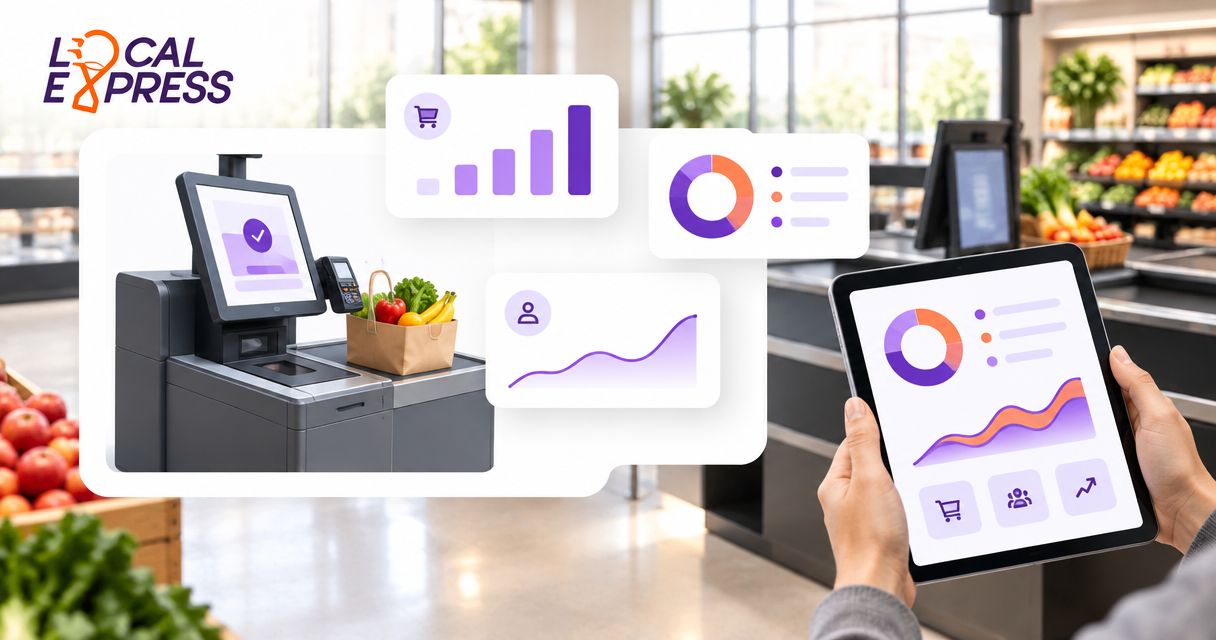
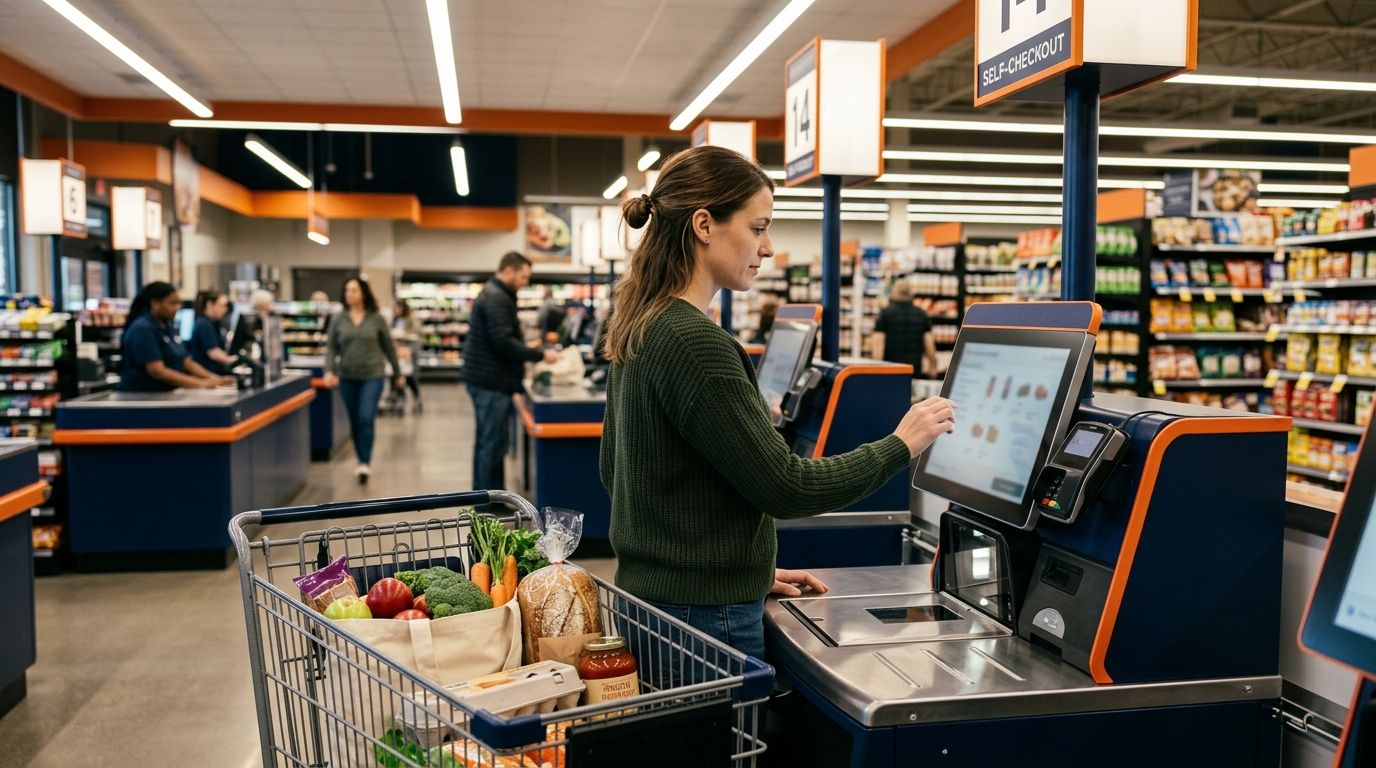
Kiosks selling made-to-order food or deli items can prompt add-ons at the point of order confirmation — a side, a drink, a size upgrade. Kiosk-driven order value lifts of 30% in 2026 come almost entirely from prepared food counters, not packaged grocery.
This category only earns its keep if the store has an MTO kitchen, deli, or hot bar. A packaged-goods-only store running kiosk upsell prompts is solving a problem it doesn't have. Consider for stores with a food-service counter; Skip for pure packaged-goods locations.
4. SNAP/EBT-aware bundling — the compliance trap most tools ignore
Bundling a SNAP-eligible item with a non-eligible one at checkout can break split-tender logic if the tool doesn't separate the two at the cart level. This is the category most general-ecommerce upsell plugins fail outright, because SNAP/EBT handling isn't a feature they were built to solve.
Any grocer running SNAP EBT online ordering needs upsell logic that checks eligibility before it suggests a bundle, not after. Getting this wrong doesn't just cost a sale — it creates a compliance problem. Buy, and treat it as a requirement rather than an optional add-on.
5. Digital weekly ad and circular triggers — the old tool getting a second life
Surfacing this week's circular deals at checkout, timed to the promo cycle, is a decades-old grocery tactic rebuilt for digital carts. It works because shoppers already expect weekly deals from their grocer — the trigger just moves the discovery moment from the mailer to the cart.
The limitation: it's promotion-driven, not personalization-driven, so it lifts basket size less consistently than AI recommendation engines. Consider as a layer on top of AI upsells, not a replacement for them.
6. Loyalty-linked bundle upsells — the retention play
Tying a checkout bundle to bonus loyalty points instead of a straight discount protects margin while still moving the basket up. It's a slower build for order value than sponsored placements but a stronger build for repeat visits.
The tradeoff is complexity — it requires a loyalty program with real point-redemption logic behind it, which smaller independents may not have running yet. Consider if loyalty infrastructure already exists; Wait if it doesn't.
7. Generic pop-up upsell plugins — the wildcard that backfires
Most cart-upsell plugins on the market were built for apparel and general retail carts, not grocery. They don't understand weight-based pricing, substitution rules for out-of-stock produce, or SNAP-eligible splits — three things that show up in nearly every grocery cart.
Installing one of these on a grocery-specific catalog usually means manually excluding half your SKUs to avoid broken recommendations. Skip for grocery carts unless the vendor explicitly supports weight-based and perishable inventory.
Comparison table
| Tool category | Best for | Channel coverage | Verdict |
|---|---|---|---|
| AI cart recommendation engines | Any grocer with live inventory sync | Web, app, kiosk | Buy |
| In-app sponsored placements | Multi-brand or high-basket-volume stores | Web, app | Buy |
| Kiosk upsell prompts | Stores with MTO/deli counters | Kiosk | Consider |
| SNAP/EBT-aware bundling | Any store running EBT online ordering | Web, app | Buy |
| Weekly ad/circular triggers | Promo-driven independents | Web, app | Consider |
| Loyalty-linked bundles | Stores with existing loyalty programs | Web, app | Consider |
| Generic pop-up plugins | General retail, not grocery | Web only | Skip |
Where to buy
- Prioritize native platform features over bolt-on plugins. A recommendation engine built into your order management system reads the same inventory feed as fulfillment — a third-party plugin usually doesn't.
- Verify SNAP/EBT compliance before licensing anything. Ask the vendor directly whether the tool separates eligible and non-eligible items at the bundle level, not just at checkout.
- Test across web, app, and kiosk before committing. A tool that only works on desktop web misses the channel where most 2026 grocery order volume is happening — mobile and kiosk combined.
See checkout upsells built for grocery carts
AI recommendations, SNAP-aware bundling, and kiosk prompts on one platform.
FAQ
What are the best checkout upsell tools for grocery ecommerce in 2026?
AI cart recommendation engines and in-app sponsored product placements rank highest for 2026 because they read live inventory and monetize checkout without discounting the core basket. SNAP/EBT-aware bundling is required, not optional, for any grocer taking EBT orders online.
Do generic ecommerce upsell plugins work for grocery stores?
Most don't, because they aren't built for weight-based pricing, perishable substitutions, or SNAP-eligible item splits. A plugin built for apparel or general retail will misfire on a significant share of a typical grocery cart.
How much can checkout upsells increase grocery order value?
Kiosk-based upsell prompts lift order values by roughly 30% in stores with a prepared food or deli counter, based on aggregate 2026 grocery data. Web and app upsells driven by AI recommendations add smaller, more consistent gains across every order.
Is SNAP/EBT compatibility a real requirement for upsell tools?
Yes — any grocer running EBT online ordering needs upsell logic that checks item eligibility before suggesting a bundle. Bundling an EBT-eligible item with a non-eligible one incorrectly can break split-tender checkout entirely.
Do checkout upsells reduce cart abandonment?
AI-driven checkout experiences run about 18% lower cart abandonment than static checkout flows, based on 2026 aggregate grocery ecommerce data. The gain comes from relevance, not from adding more prompts — irrelevant upsells increase abandonment instead.
Are sponsored product placements worth it for independent grocers?
Yes, if basket volume is high enough to interest CPG brands in paying for placement. Independent and regional chains running a retail media program without a national network can still capture this revenue with the right placement tooling.
Should kiosk upsells be different from app or web upsells?
Yes — kiosk upsells work best at order confirmation for made-to-order food, while app and web upsells work best earlier in the cart flow with AI-driven recommendations. Running the same logic across all three channels usually underperforms.
One last thing
The checkout upsell category that gets skipped most often — SNAP/EBT-aware bundling — is also the one with the highest downside if it's wrong. A recommendation engine that misses a cross-sell just leaves revenue on the table; a bundling tool that breaks EBT split-tender creates a compliance problem on top of a lost sale. Rank compliance fit above conversion lift when you're evaluating checkout upsell tools grocery ecommerce vendors pitch you in 2026 — the flashy recommendation demo means nothing if it can't handle a real SNAP cart.