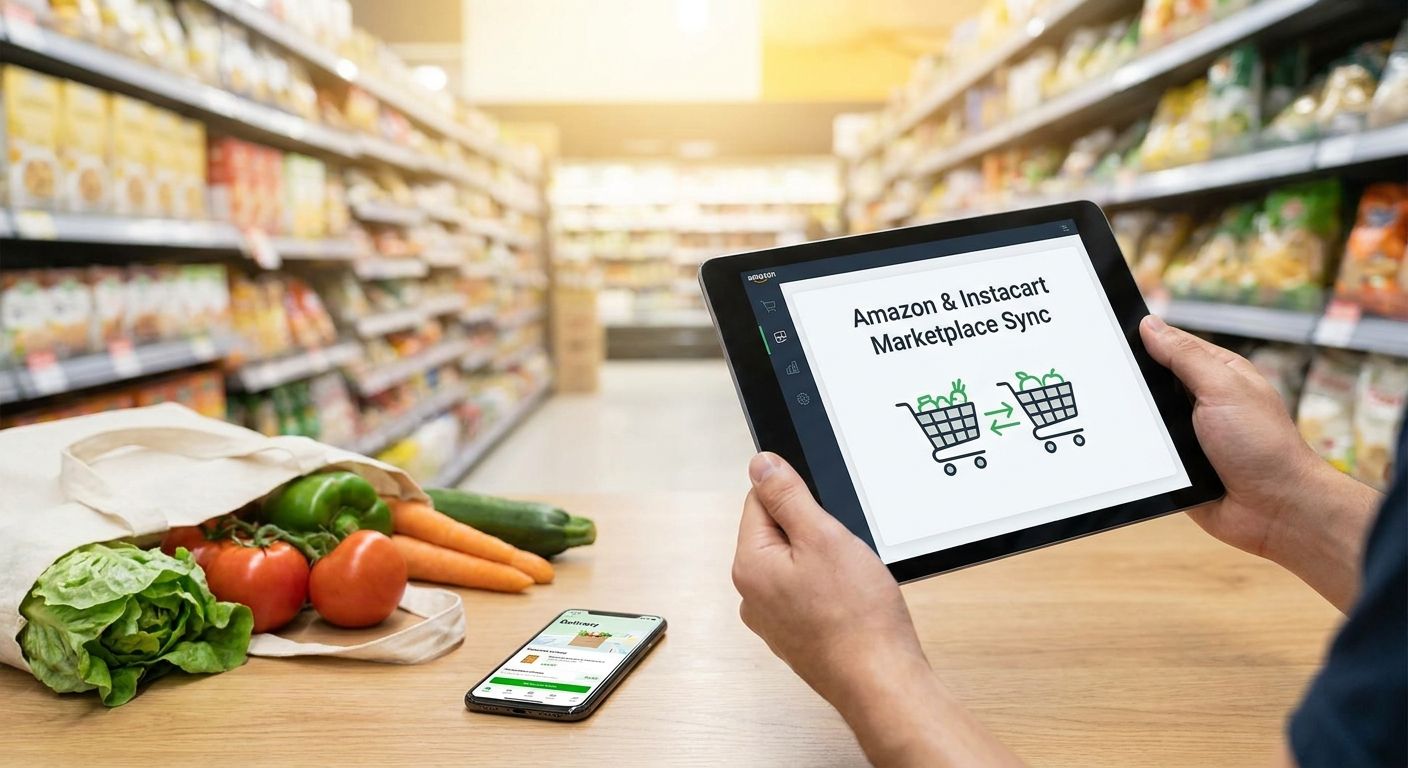
Grocers running orders through Amazon and Instacart while also trying to sync inventory to a POS and a branded app usually end up with three versions of the truth and one shrinking margin. This guide breaks down what marketplace sync actually requires, which sync models hold up in 2026, and when the smarter move is routing volume off the marketplace entirely.
- Native marketplace-only sync (Amazon Storefront, Instacart Connect) works for reach but leaks margin and customer data — Consider, not Buy.
- Middleware sync tools patch inventory gaps between POS and marketplaces but add a monthly fee layer — Consider for high-SKU stores only.
- Migrating core repeat orders to an owned app with centralized order management wins on margin and data ownership in 2026 — Buy.
- Grocery already runs on 1-3% net margins, so marketplace commission and ad fees hit harder than they do in other retail categories.
Why this matters
Grocery is a volume business with a margin problem: net margins for supermarkets typically sit in the 1-3% range, which means every commission point taken by a marketplace comes straight out of what's left after payroll, shrink, and rent. Amazon and Instacart both built fast, convenient ordering experiences that customers already trust — that's real distribution. But sync between those marketplaces and your own systems is rarely as clean as the sales deck implies, and the data you get back from a marketplace dashboard is not the same as owning a customer record you can market to directly.
The question isn't whether Amazon and Instacart matter for grocery ecommerce in 2026. It's which parts of your order volume should live there, which parts belong in a system you control, and how much manual reconciliation you're willing to tolerate in between.
Who this is for
This is for independent and regional grocers already listed on Amazon, Instacart, or both, who are trying to decide whether to invest in tighter marketplace sync or start moving volume to their own ecommerce site and app. If you're running multiple store locations and watching inventory drift between what the marketplace shows and what's actually on the shelf, the criteria below apply directly to you. Stores considering how to migrate from a delivery marketplace to your own app should read the "what to avoid" section closely before signing another marketplace integration contract.
What to look for in marketplace sync
Real-time inventory sync frequency
A sync that updates every few hours instead of continuously creates a gap where you sell out-of-stock items on Amazon or Instacart, then eat the cancellation and the customer complaint. For a grocer running perishables and daily-changing stock, batch sync every 4-6 hours is functionally the same as no sync during a busy Saturday.
Order routing into your POS, not just a dashboard
Marketplace order dashboards are built for the marketplace's operations, not yours. If Amazon or Instacart orders don't route directly into the same order management system your staff already uses for web, app, and kiosk orders, someone is manually re-keying orders — and manual re-keying is where fulfillment errors start.
Customer data ownership
A marketplace order comes with a customer name and delivery address controlled by the marketplace, not you. You can't email that customer a reorder reminder, add them to a loyalty program, or retarget them for a weekly ad. If growing repeat purchase rate matters to your 2026 plan, sync alone doesn't fix this — only an owned channel does.
Margin visibility after commissions and ad fees
Most sync tools show you gross order volume, not what you actually keep after marketplace commission, payment processing, and any sponsored placement fees you paid to get visibility in the first place. Ask any sync vendor to show net margin per marketplace order, not just order count.
Catalog mapping accuracy across UPCs and weights
Grocery catalogs are messy: variable-weight produce, deli items sold by the pound, private-label SKUs with no national UPC. A sync tool built for general retail often mismaps these, which shows up as wrong prices or wrong item substitutions on marketplace orders.
Top approaches, ranked
1. Marketplace-only listing — the easy default
Amazon Storefront and Instacart Connect give you shelf presence with almost no setup lift, which is why most independent grocers start here. The catch: you're renting the customer relationship and the commission structure compounds against a 1-3% net margin business fast. Verdict: Consider for discovery-stage stores with no ecommerce presence yet, Skip as a long-term strategy once you have repeat volume worth owning.
2. Middleware inventory sync — the patch job
Third-party middleware sits between your POS and each marketplace, pushing stock updates and pulling orders back automatically. It closes the inventory-gap problem from the criteria above, but it's another monthly line item and another integration to maintain when your POS vendor changes something. Verdict: Consider only if you're running high SKU counts across multiple marketplaces and don't yet have bandwidth to build an owned channel.
3. Owned ecommerce and app with multi-location sync — the long-term fix
Routing your core, repeat-order volume through a branded site and app tied to multi-location inventory sync means one inventory truth across every location and every channel — no reconciling three dashboards. You keep the customer record, the margin, and the ability to run your own promotions instead of paying for marketplace sponsored placement. Verdict: Buy for any grocer with repeat customers worth retaining past a single order.
4. Hybrid — marketplace for reach, owned app for retention
Keep a limited marketplace presence for first-time discovery, then push every repeat customer toward your own app using centralized order management so web, app, kiosk, and marketplace orders all land in one queue for staff. This is the most operationally realistic path for a store not ready to walk away from Amazon or Instacart entirely in 2026. Verdict: Buy as a transition strategy.
Move repeat orders off the marketplace
See how same-day delivery works without a third-party app taking the cut.
What to avoid
- Treating marketplace order history as your customer list. It isn't — you can't email, text, or add those shoppers to a loyalty program without the marketplace's permission and platform.
- Assuming marketplace search visibility replaces local marketing. Ranking well inside Instacart's app doesn't build brand recall the way a branded app icon on a customer's home screen does.
- Running marketplace promotions without recalculating true margin. A discount that looks fine on a 20% margin category can wipe out profit entirely once marketplace commission and ad spend are subtracted from a grocery item already priced at 1-3% net.
Verdict comparison
| Approach | Inventory sync speed | Customer data owned | Margin impact | Verdict |
|---|---|---|---|---|
| Marketplace-only (Amazon/Instacart) | Depends on marketplace API | No | High (commission + ads) | Consider / Skip long-term |
| Middleware sync tool | Near real-time | No | Moderate (tool fee + commission) | Consider |
| Owned app + multi-location sync | Real-time, single source | Yes | Low (platform cost only) | Buy |
| Hybrid model | Real-time for owned channel | Partial | Moderate, improving | Buy (transition) |
FAQ
What is Amazon and Instacart marketplace sync for grocery ecommerce?
It's the process of keeping inventory, pricing, and order data consistent between your store's POS system and the Amazon and Instacart marketplaces where customers place orders. Without sync, stock levels drift and orders have to be manually re-entered into your fulfillment system.
Is Instacart or Amazon better for grocery ecommerce in 2026?
Neither is universally better — Instacart typically drives more grocery-specific order volume through its delivery network, while Amazon offers broader reach across non-grocery categories too. Both take commission and both limit access to the customer's contact data, which matters more than which platform has slightly higher traffic.
Can grocers sync inventory automatically between Amazon, Instacart, and their own POS?
Yes, through either marketplace-provided integrations or third-party middleware, though sync frequency and catalog mapping accuracy vary by tool. Real-time sync across all three systems generally requires a unified order management layer rather than point-to-point connections.
How much do grocery marketplace fees cut into margin?
Grocery already operates on thin net margins, commonly cited at 1-3% for supermarkets, so any commission or advertising fee on a marketplace order takes a proportionally larger bite than it would in a higher-margin retail category. This is why margin visibility per order matters more for grocers than for most other marketplace sellers.
Should independent grocers move off Instacart and Amazon in 2026?
Not entirely — most grocers keep a marketplace presence for new customer discovery while shifting repeat order volume to an owned app or website. The move to make in 2026 is reducing dependency on marketplaces for the customers you already have, not abandoning marketplace reach altogether.
What's the difference between marketplace sync and owned ecommerce?
Marketplace sync keeps your inventory data accurate on platforms you don't control, while owned ecommerce means the website, app, and customer data belong to your store. Sync reduces operational errors on marketplace orders; owning the channel is what protects margin and customer relationships long-term.
How long does it take to migrate from a delivery marketplace to your own app?
Timelines vary by store complexity, but most independent grocers can launch a branded app and site while still running marketplace orders in parallel, then shift volume gradually as customers adopt the owned channel. Running both simultaneously during the transition avoids an abrupt drop in order volume.
Do grocers need both a marketplace presence and an owned app?
Most do, at least during a transition period — marketplaces bring new customer discovery that an unknown independent brand can't easily buy on its own. The owned app is where that customer should end up for their second and third order, where margin and data ownership are better.
One last thing
The grocers getting this right in 2026 aren't choosing between Amazon, Instacart, or their own app — they're using marketplaces as a paid acquisition channel with a hard stop, then routing every repeat order through a system where they keep the customer record and the full margin. If you can't currently tell a marketplace customer apart from an owned-app customer in your reporting, that's the gap to close first, before adding another sync tool on top of the problem.