Farm-to-table grocers, farm stands, and specialty food co-ops sell something a national chain can't: provenance. The wrong ecommerce platform for farm-to-table retailers buries that story behind a templated theme built for canned goods and 40,000 SKUs — not 200 seasonal ones that change every Tuesday.
- Local Express wins for farm-to-table retailers running seasonal SKUs and CSA-style boxes — buy for white-label control.
- Generic marketplace apps take a cut and hide your customer data; skip them if provenance and repeat orders matter.
- SNAP/EBT online ordering and a tight delivery radius separate a working farm-to-table storefront from a stalled one.
- A farmers market and food co-op ordering platform matches seasonal cadence better than a templated Shopify theme.
- 95% inventory accuracy and a $3.50 return per $1 invested make AI-driven grocery platforms the 2026 standard for specialty retailers.
Why this matters
A farm-to-table retailer isn't a mini supermarket. Inventory turns over with harvest cycles, not distribution schedules, and half the value proposition is the story behind the product — the farm name, the ranch, the cheesemaker. Platforms built for big-box grocery bury that under generic category pages.
Online grocery adoption keeps climbing into 2026, and specialty and farm-to-table retailers that don't have a branded ordering experience are losing repeat customers to whoever does. Marketplace apps like third-party delivery aggregators take a commission on every order and own the customer relationship — not the farm stand that built the following.
Who this is for
This guide is for independent farm-to-table grocers, farm stands with a retail counter, food co-ops, and specialty shops sourcing directly from regional producers who need to sell online without handing customer data and margin to a marketplace app. If you run a weekly changing case, a CSA-style box program, or a counter with 150-400 SKUs instead of 40,000, keep reading.
What to look for in an ecommerce platform for farm-to-table retailers
Seasonal and small-batch inventory flexibility
Your case changes weekly, sometimes daily during peak harvest. A platform built for CPG replenishment cycles forces you to rebuild product pages every time a crop rotates. Look for a system that lets staff add, retire, and re-price SKUs in minutes, not a ticket to a developer.
Local delivery radius control
Farm-to-table only works within a drive-time that keeps produce fresh — usually 15 to 25 miles for perishables. You need a platform that lets you set delivery zones and fees by distance, not a national courier network built for shelf-stable goods.
Farm story and provenance on product pages
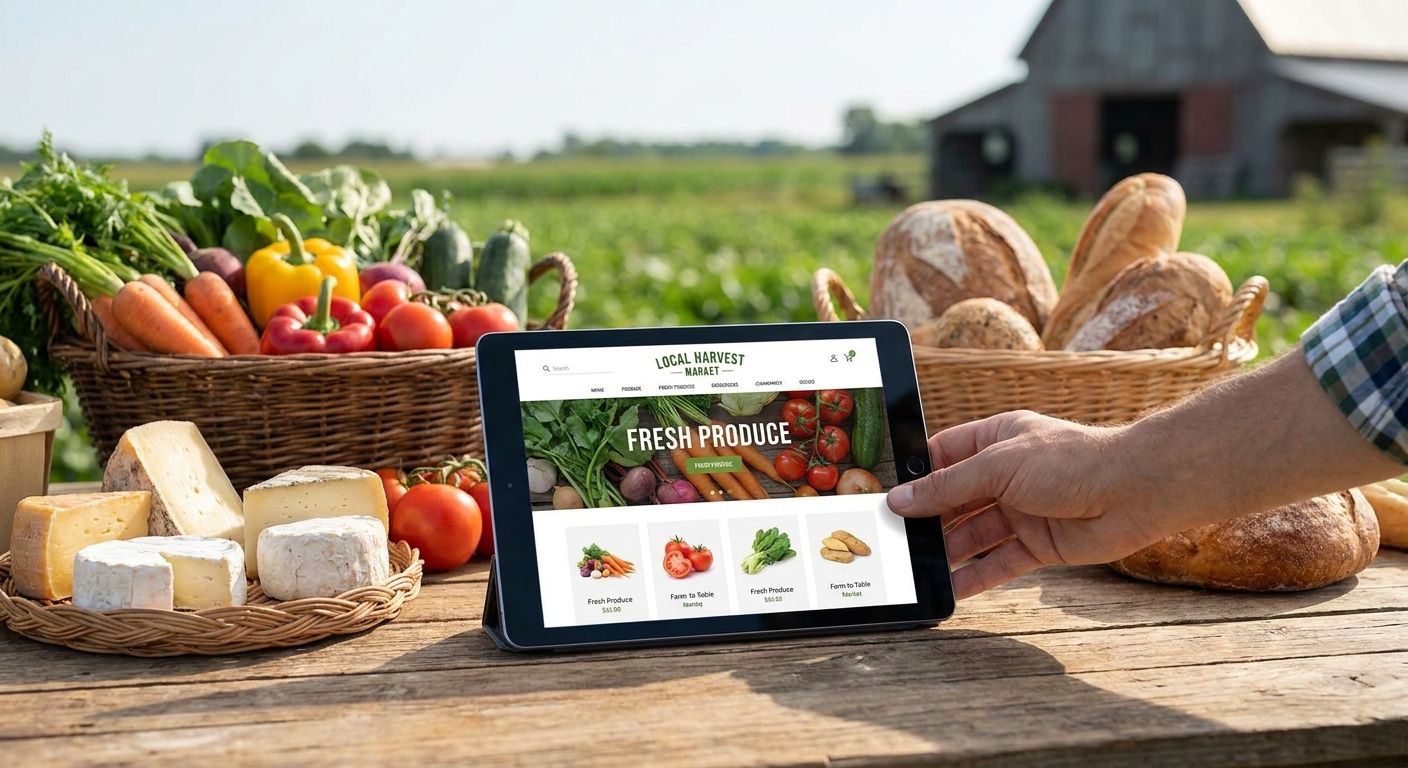
Customers pay a premium when they know the farm name, not just "organic tomatoes." A white-label storefront should let you attach sourcing details, photos, and farmer bios to every product — a generic marketplace listing template won't.
SNAP/EBT and flexible payment support
Farmers markets and co-ops serve a payment mix that includes SNAP/EBT, and shutting that door online cuts off a meaningful share of shoppers. A SNAP/EBT online ordering setup matters more here than at a conventional grocer, since farm-to-table programs often serve mixed-income neighborhoods and farmers market crowds directly.
No-developer website control
Small teams can't wait three weeks for a freelancer to swap a banner during peak season. The platform needs a builder your manager can run without a ticket queue.
Order management across pickup, delivery, and CSA models
Farm-to-table retailers often run three fulfillment models at once: in-store pickup, home delivery, and a subscription box. One order management system needs to route all three without three separate logins.
See the platform built for specialty grocers
White-label storefronts, apps, and delivery tools for independent food retailers.
Top picks for farm-to-table retailers
The safe pick — white-label storefront for CSA and seasonal boxes. Local Express runs a farmers market and food co-op ordering platform built around cadence, not catalog size — subscription boxes, weekly cases, and vendor rotation all live on one backend. The spec that matters: SKU turnover without developer involvement. Buy if your case changes weekly and you're still updating a static website by hand.
The specialty foundation — gourmet and small-format storefronts. A gourmet and specialty food ecommerce platform handles the 150-400 SKU range farm-to-table shops actually stock, instead of forcing a 40,000-SKU supermarket template onto a farm stand counter. The number that matters: order accuracy stays above 95% on unified commerce systems in 2026 data, versus manual spreadsheet tracking. Buy for shops that need provenance fields on every listing.
The wildcard — SNAP/EBT-enabled checkout. Adding SNAP/EBT to online checkout isn't standard on most white-label templates, but it's close to mandatory for farm-to-table retailers serving farmers market regulars. Consider it if your in-person counter already accepts SNAP and your online cart doesn't yet.
What to skip — generic marketplace listings. Listing on a national delivery marketplace gets you volume fast but costs commission on every order and gives the platform, not you, the customer's email and order history. Skip it as a primary channel; use it as a secondary discovery tool at most.
What to avoid
- Marketplace-only fulfillment. Commission-based apps look easy to start but erode the margin farm-to-table pricing depends on, and you never see the repeat customer's contact info.
- Templated grocery themes built for big-box catalogs. They handle 40,000 SKUs fine and 200 seasonal ones badly — inventory tools built for volume, not turnover speed.
- Delivery radius set by default, not by freshness. A default 50-mile radius sounds like growth; it's a produce quality problem waiting to happen for anything perishable.
Verdict comparison
| Option | Seasonal SKU handling | Local delivery control | Provenance branding | SNAP/EBT support | Verdict |
|---|---|---|---|---|---|
| White-label farm-to-table storefront | Strong | Strong | Strong | Available | Buy |
| Gourmet/specialty ecommerce template | Strong | Moderate | Strong | Available | Buy |
| Generic grocery ecommerce theme | Weak | Weak | Weak | Rare | Skip |
| Third-party delivery marketplace | Moderate | None (marketplace-set) | None | No | Skip |
FAQ
What is white-label ecommerce for farm-to-table retailers?
It's a branded online storefront, app, and order system that runs under the retailer's own name instead of a marketplace's, giving farm-to-table shops control over pricing, customer data, and product storytelling. Farm stands and co-ops use it to sell seasonal produce, CSA boxes, and specialty goods without commission cuts.
Is a white-label platform better than Shopify for a farm-to-table store?
For grocery-specific needs like weight-based pricing, perishable delivery zones, and SNAP/EBT checkout, a grocery-built white-label platform beats a general ecommerce theme adapted for food. Shopify works for simple catalogs but wasn't built for weekly-changing produce cases.
Can farm-to-table retailers accept SNAP/EBT online?
Yes, with a platform that supports SNAP/EBT checkout integration, which matters heavily for farm-to-table retailers serving farmers market and co-op customers. Not every ecommerce theme supports it, so confirm before choosing a platform in 2026.
How much does white-label grocery ecommerce cost?
Cost varies by store size, feature set, and whether delivery and kiosk tools are included, so check current pricing directly with the provider. Independent retailers typically compare platform fees against the commission a marketplace app would otherwise take.
Do I need a developer to launch a farm-to-table ecommerce site?
No — platforms built for independent grocers let store staff build and update the site without code, which matters most during harvest season when the case changes fast. A developer-dependent site becomes a bottleneck the moment inventory turns over weekly.
Can white-label platforms handle weekly changing seasonal inventory?
Yes, platforms built for specialty and farm-to-table retailers let staff add, retire, and re-price products in minutes rather than requiring a rebuild each season. This is the single biggest gap between grocery-specific platforms and generic ecommerce themes.
What delivery radius makes sense for a farm-to-table grocer?
Most farm-to-table retailers keep perishable delivery within 15 to 25 miles to protect freshness, though the right number depends on the product mix. A platform should let you set that radius by zone rather than applying a flat national default.
How is white-label different from a marketplace app like a third-party delivery app?
White-label means the storefront, app, and checkout carry the retailer's own brand and the retailer keeps the customer relationship and data. Marketplace apps put the retailer's products inside someone else's brand and take a commission on every order.
One last thing
The farm-to-table shops losing online sales in 2026 aren't losing them to bigger competitors — they're losing them to their own generic storefront that treats a heritage tomato the same as a canned one. Provenance sells at a premium only when the platform lets you tell the story on the product page itself.