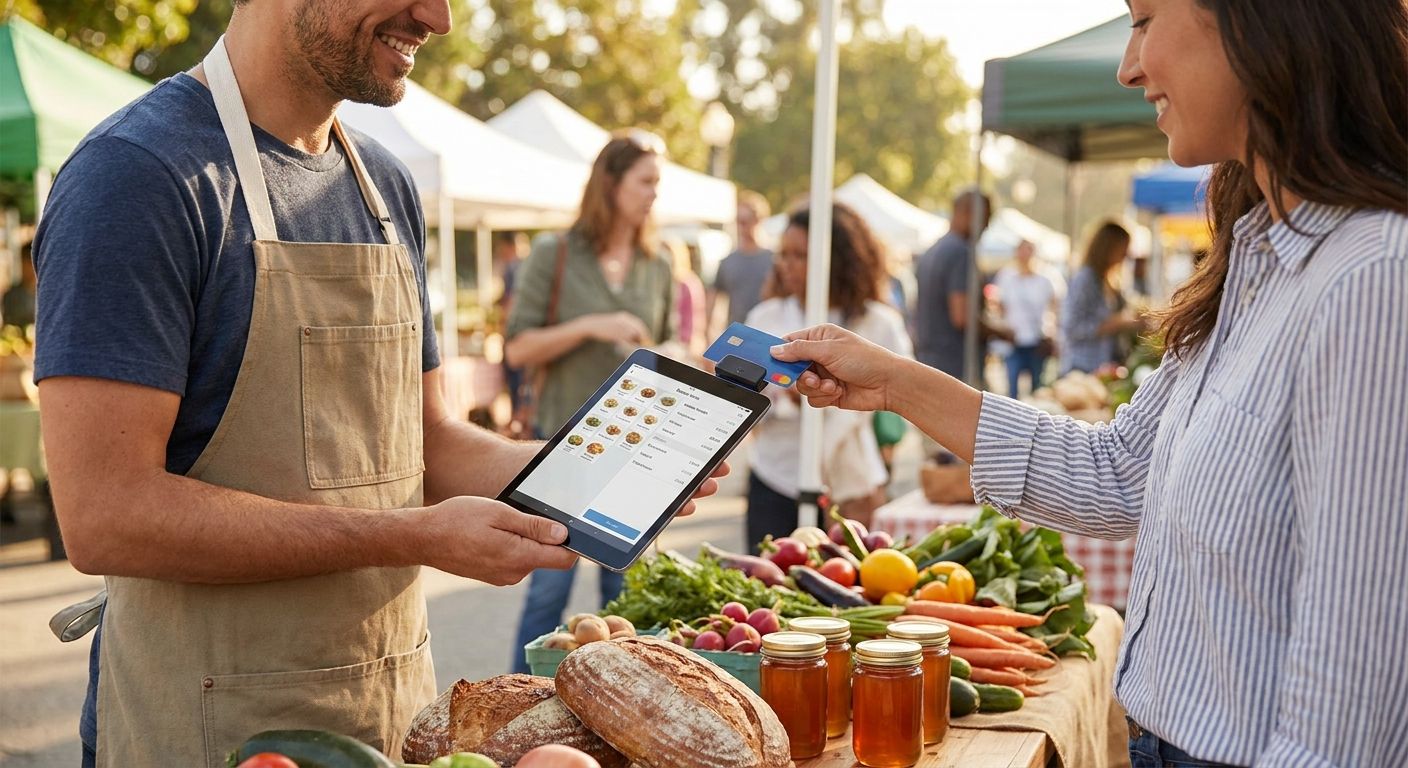
Farmers market and pop-up grocery vendors need a mobile POS system that keeps working when the wifi drops, takes SNAP/EBT without a workaround, and doesn't assume you're standing behind a fixed counter. This guide ranks the mobile pos for farmers market vendors options that actually hold up outdoors in 2026, and flags where a card reader alone stops being enough.
- Square is the default mobile pos for farmers market vendors in 2026 — buy it for single-stand simplicity.
- Clover Go wins for vendors running multiple stalls under one account; SumUp fits seasonal, low-frequency sellers.
- Toast Go is built for restaurant counters, not vendor stalls — skip it for market use.
- Pair a card reader with an online ordering platform once repeat customers start asking for pre-orders.
- SNAP/EBT acceptance separates a real farmers market setup from a generic retail card reader.
Why this matters
A mobile POS decision made for a coffee shop counter doesn't transfer cleanly to a 10x10 tent with no outlet and one bar of signal. Vendors who pick hardware built for indoor retail end up re-keying transactions by hand when the connection drops, or turning away SNAP customers because the reader wasn't built to accept an EBT card.
Local Express works with grocers and specialty food retailers building online ordering and delivery around exactly this kind of operation — market stalls, farm stands, and pop-up storefronts that outgrow a single card reader. The rest of this guide covers the mobile POS layer itself, then where it needs backup.
Who this is for
This guide is for the vendor running one to three market stalls a week, the seasonal pop-up selling at eight to ten weekend markets a year, and the small farm or food producer testing a booth before committing to a storefront. If you're running a fixed indoor counter with steady power and wifi, most of the outdoor-specific criteria below don't apply to you — a standard countertop POS will do more for less friction.
What to look for in mobile POS for farmers market vendors
Offline transaction mode
Outdoor markets rarely have reliable wifi, and cell coverage inside a farmers market pavilion or under a highway overpass can be spotty at best. A POS that queues card transactions offline and syncs once you're back on signal keeps the line moving instead of stalling on a spinning wheel.
EMV chip and tap support
Saturday morning rushes reward whichever vendor has the shortest line. Chip and tap acceptance cuts fumbling with cash and change, which matters more at a stall selling $4-$15 items than it does at a register ringing up a $60 grocery basket.
SNAP/EBT and WIC acceptance
Many farmers markets run SNAP incentive programs, and turning away an EBT card at the register loses a sale you were entitled to keep. Confirm the reader and your merchant account both support EBT before market day, not after a customer walks off. Grocers building this out for a full online storefront can set up SNAP EBT online ordering once the in-person side is handled.
Weight-based and variable pricing
Produce sold by the pound needs a POS that supports manual weight entry or scale integration, not just fixed SKU buttons. A system built around packaged retail items forces you to create a new item every time a price shifts with the harvest.
Inventory and sales sync across stalls
If you run more than one stall, or a stall plus a farm stand or CSA pickup, sales need to land in one place. Without sync, you're reconciling three separate cash-out reports by hand every Sunday night.
No long-term contract
Seasonal vendors selling eight to ten weekends a year shouldn't pay for a 12-month POS contract. Month-to-month or pay-as-you-go pricing matches the actual selling calendar instead of a retail assumption.
Top picks for 2026
Square — the default pick. Connects over Bluetooth to a phone or tablet and processes chip and tap cards with no dedicated terminal required. Verdict: Buy for a single-stand vendor who wants hardware that works out of the box with minimal setup.
Clover Go — the multi-stall pick. Syncs sales across multiple handheld units tied to one merchant account, which matters once you've got more than one person working a booth or running two locations on the same market day. Verdict: Consider if you're coordinating more than one stall or a rotating crew.
SumUp Air — the seasonal pick. No fixed hardware contract and runs off a companion app on a personal phone, which fits a vendor who only shows up for eight to ten weekend markets a season. Verdict: Consider for low-frequency or first-year sellers testing whether a market stall is worth scaling.
Toast Go — the wildcard. Built around Toast's restaurant floor and kitchen display workflow, which assumes a fixed indoor counter and a kitchen ticket system behind it. Verdict: Skip for market stall use — the setup solves a problem you don't have.
Online ordering platform for farmers markets and food co-ops — the pick for going beyond the register. Layers pre-orders, an EBT-eligible checkout, and a branded storefront on top of whatever card reader you already carry, so repeat customers can order ahead of market day instead of hoping you have their favorite item left. Local Express's online ordering platform for farmers markets and food co-ops is built for exactly this layer. Verdict: Buy once a stall starts generating repeat customers who want to skip the line.
Take your market stall online
Add pre-orders and SNAP-eligible checkout to your farmers market business.
What to avoid
- A POS locked to a single indoor terminal. Anything built around a fixed counter and a kitchen display, like Toast's restaurant setup, fights you at every outdoor market.
- A reader that bundles you into one processor's exclusive online store builder. You want the freedom to pair the card reader with whatever ordering or delivery layer fits your actual customer base later.
- Building a CSA or subscription box system from scratch on top of your POS. If you're also running a farm stand or box subscription, a dedicated ordering platform for CSA boxes and farm stands saves you from stitching spreadsheets to a card reader.
Verdict comparison
| Option | Offline mode | SNAP/EBT | Contract | Best for | Verdict |
|---|---|---|---|---|---|
| Square | Yes | Limited | None | Single-stand vendors | Buy |
| Clover Go | Yes | Limited | Varies | Multi-stall operations | Consider |
| SumUp Air | Yes | No | None | Seasonal/low-frequency sellers | Consider |
| Toast Go | Yes | No | Yes | Fixed indoor counters | Skip |
| Local Express online ordering add-on | N/A (web-based) | Yes | Varies | Pre-orders and repeat customers | Buy |
FAQ
What's the best mobile POS for farmers market vendors in 2026?
Square is the most common starting point for single-stand vendors in 2026 because it works with a basic Bluetooth reader and needs no long-term contract. Vendors running multiple stalls tend to move to Clover Go for cross-terminal sync.
Is SNAP/EBT acceptance available on standard mobile card readers?
Not universally — most consumer card readers like Square and SumUp are built for standard debit and credit, not EBT. Confirm EBT support directly with your merchant account provider before market day if your market runs a SNAP program.
Do I need wifi to run a mobile POS at an outdoor market?
No, but you need a reader that supports offline transaction queuing. Most mobile card readers built for retail, including Square and Clover Go, will queue a sale offline and sync once you're back on signal.
Can I use the same POS for a farmers market stall and an online store?
A card reader alone won't run an online store, but it can pair with a separate ordering platform. Vendors selling both in person and online typically run the card reader for the stall and a dedicated storefront for pre-orders and delivery.
What's the difference between a mobile card reader and a full POS system?
A mobile card reader handles payment processing only, while a full POS system adds inventory tracking, reporting, and often online ordering. Farmers market vendors usually only need the card reader layer until they add a second stall or a storefront.
How do pop-up grocery vendors handle inventory across multiple locations?
Vendors running more than one stall typically need a POS with cross-terminal sync, like Clover Go, so sales from each location land in one report. Without sync, reconciling multiple stalls means combining separate cash-out reports by hand.
Is Clover Go good for farmers markets?
Clover Go works well for vendors running more than one stall or booth under a single account because it syncs sales across handheld units. For a single stand, it's more system than most vendors need.
What should a seasonal vendor look for in a mobile POS?
A seasonal vendor selling only a handful of weekends a year should prioritize no long-term contract over extra features. SumUp Air fits this pattern because there's no fixed hardware lock-in tied to a monthly fee.
One last thing
The fastest win at a Saturday market isn't a fancier terminal — it's a card reader that talks directly to your produce scale, so you're not re-keying weights by hand while the line backs up. Most vendors upgrade their POS before they upgrade their scale integration, and it's usually backwards: the scale is where the line actually slows down in 2026, not the card tap.