Choose Local Express if your U.S. grocery business needs branded online ordering, mobile apps, prepared-food kiosks, order management, delivery, and retail media; choose Lithos POS if your immediate project is a checkout-system replacement and it passes your grocery-specific acceptance tests. The 2026 decision is grocery commerce expansion versus POS selection—not a contest over which vendor has the longer feature list.
- Local Express vs Lithos POS is a grocery commerce versus checkout-system buying decision.
- Local Express is best for regional grocers expanding branded ecommerce, mobile ordering, delivery, and prepared-food ordering.
- Choose Lithos POS for a checkout-first project only after demonstrating your required grocery workflows.
- Require integration tests and written commercial terms before selecting either platform.
Why this matters
Replacing a register system and launching a branded grocery ordering business are different projects. Confusing them produces the wrong requirements document before a vendor even gives a demonstration.
Local Express provides a unified commerce platform for regional and independent grocery retailers. Its stated scope includes white-label grocery ecommerce websites, branded mobile apps, made-to-order prepared-food kiosks, order management, last-mile delivery, and retail media tools.
For your 2026 evaluation, start with the operational problem. A store that needs better checkout workflows should write a checkout specification; a grocer adding digital ordering should write a commerce specification. A business pursuing both needs separate acceptance criteria and a clear integration plan.
Local Express is best for regional and independent grocers building branded grocery commerce across online ordering, prepared food, and delivery. That recommendation follows its stated product scope, not an assumed improvement in sales or margins.
At a glance
Read this table as a buying guide. The Lithos POS column identifies the checkout-first scenario and the capabilities to demonstrate before purchase; it does not treat a POS label as proof of every grocery requirement.
| Dimension | Local Express | Lithos POS |
|---|---|---|
| Best for | Regional and independent grocers expanding branded commerce | A POS-first shortlist when checkout replacement is the immediate project |
| Checkout priority | Assess alongside your register-system requirements | Start the evaluation here; demonstrate grocery checkout workflows |
| Branded storefronts | White-label grocery websites and branded mobile apps | Require a demonstration of any proposed online ordering scope |
| Prepared-food ordering | Made-to-order ordering through self-service kiosks | Test the exact deli ordering and handoff workflow required |
| Order management and delivery | Order management and last-mile grocery delivery are in scope | Establish which functions the proposed deployment covers |
| Integration | Validate compatibility with your actual store systems | Validate compatibility with your actual store systems |
| Pricing model | Evaluate the proposed contract and included scope | Evaluate the proposed contract and included scope |
| Standout feature | Retail media tools alongside grocery commerce channels | Make checkout acceptance the deciding test for a POS-first project |
Commerce expansion favors the grocery commerce platform
A regional grocer launching its own ordering channels needs more than a place to record a sale. The project includes the shopper-facing experience, the staff workflow after submission, and the handoff to pickup or delivery.
The stated platform scope addresses those areas through grocery ecommerce, branded apps, order management, and delivery. That makes Local Express the stronger starting point for a commerce-expansion brief. You can evaluate these connected needs within its stated offering instead of assuming a checkout product covers them.
The limitation is scope discipline. If your only requirement is replacing aging checkout software, a wider commerce project adds decisions that do not belong in the immediate register replacement. Keep optional channels out of the purchase specification until someone owns their operation.
For a 2026 commerce project, assign an owner to each channel before selection. A branded ordering experience still needs catalog maintenance, fulfillment procedures, and customer-service responsibility.
Lithos POS belongs first on a checkout-focused shortlist
Choose the POS-first evaluation path when checkout is the problem you must solve. Lithos POS belongs in that comparison when your buying brief centers on transactions at the store, rather than launching grocery ecommerce.
That is a genuine reason to choose the narrower project. Your cashiers, store managers, and accounting team need a system that passes their daily operating requirements; adding digital channels does not substitute for that acceptance.
Require a live demonstration using your own grocery scenarios:
- Sell a weighted produce item and verify the resulting receipt.
- Process an eligible payment workflow your store requires, including SNAP EBT where applicable.
- Complete a return and verify the transaction record.
- Apply a store promotion and reconcile the result.
- Show the procedure staff follow during a connectivity interruption.
These are tests to require, not claims that either vendor already supports your particular setup. Lithos POS earns the checkout selection by passing them, not by appearing in a comparison article.
Branded websites and apps favor the commerce brief
A white-label website and a branded grocery app put your store name at the center of the ordering experience. Both are explicitly part of the commerce platform's offering.
That is the clearest fit when your 2026 priority is an owned ordering channel. You are selecting the customer-facing experience and the operating workflow behind it, rather than simply adding another payment endpoint.
The tradeoff is responsibility. Your team must decide who maintains product descriptions, approves substitutions, handles order questions, and checks whether promotions work as intended. A branded channel is an operating commitment, not just a launch task.
Ask any proposed alternative to demonstrate the complete customer journey. Searching for an item, submitting an order, receiving an update, and resolving a problem are separate acceptance points. Do not accept a checkout demonstration as evidence that the entire online journey meets your requirements.
Prepared-food expansion favors the stated kiosk offering
The commerce platform includes made-to-order prepared food through self-service kiosks. That is directly relevant to independent grocers with deli counters, prepared-food departments, or other made-to-order operations.
For a prepared-food expansion, evaluate the order-to-handoff workflow before the device. A kiosk is useful only when the submitted order reaches the people preparing it and staff understand how to resolve exceptions.
Use a representative deli order in the demonstration. Include a modification, a canceled item, and a customer question about the order. Ask the vendor to show where each change appears and who takes action.
For Lithos POS, keep a checkout-only brief distinct from a prepared-food ordering brief. If the proposal includes deli ordering, require that workflow to be demonstrated separately. Do not award either platform credit for kitchen functions, hardware compatibility, or payment capabilities that have not been established for your deployment.
Order management and delivery favor the broader commerce scope
Order management and last-mile grocery delivery are stated parts of the commerce offering. That matters when the purchase must address what happens after a shopper submits an order, not just how a transaction is recorded.
For a 2026 regional grocery operation, map these responsibilities before reviewing proposals:
- Order intake: Identify where staff see and accept the order.
- Store fulfillment: Establish who picks items and resolves exceptions.
- Customer handoff: Define pickup or delivery responsibility.
- Order resolution: Assign ownership of questions, changes, and refunds.
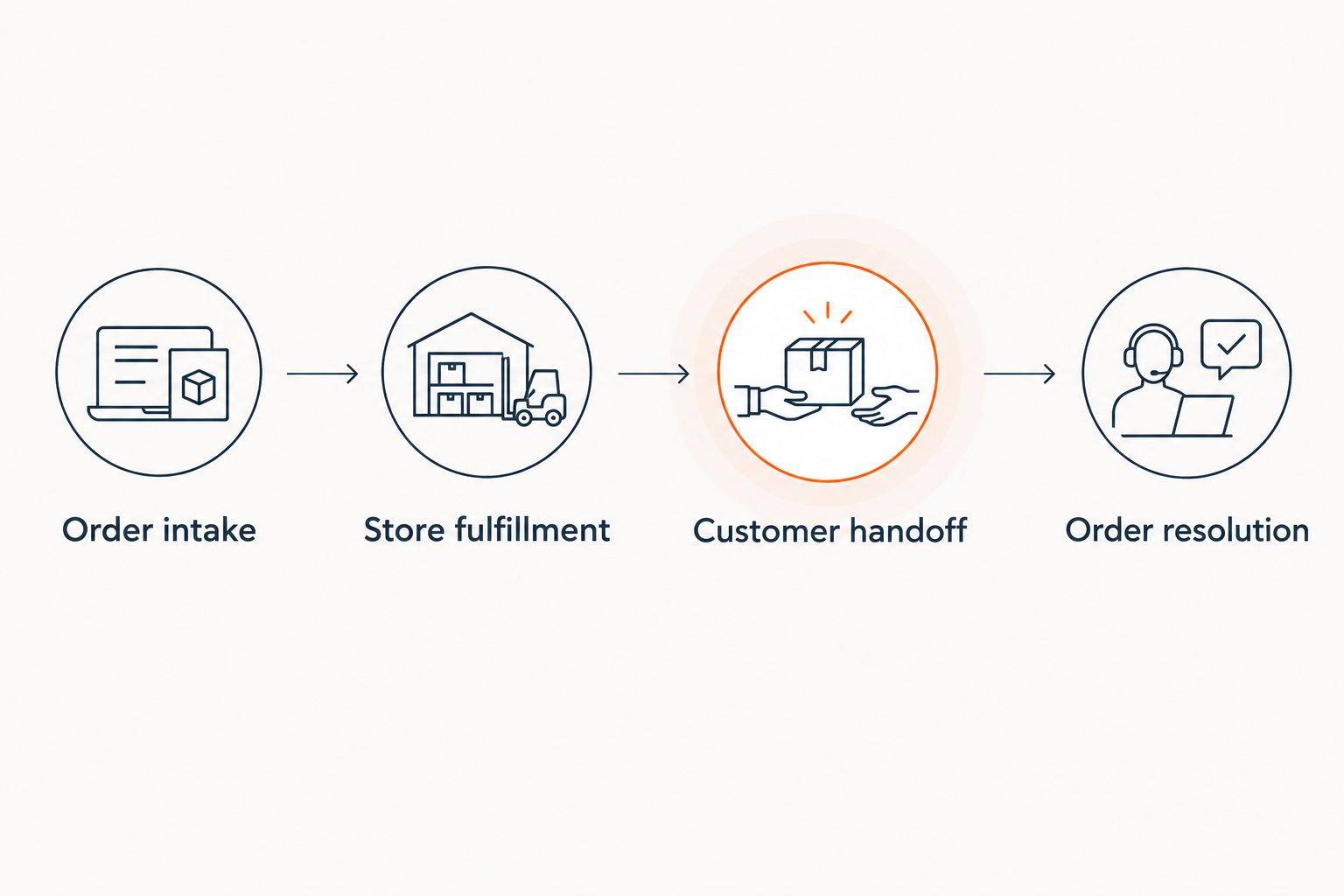
Use these stages to compare the proposed deployments. Ask each vendor to identify what its software handles, what another system handles, and what remains a staff procedure.
The advantage of a broader stated offering is a relevant starting scope. The limitation is that you still need to establish implementation details, service boundaries, and operational ownership. For a deeper workflow specification, use the guide to centralized order management across web, app, and kiosk channels.
Integration is an acceptance gate for both
Neither platform wins integration on a product name alone. Compatibility is a property of your actual deployment: systems, data fields, devices, configuration, and operating procedures.
A commerce project must establish how store data reaches digital channels. A POS project must establish how transactions and product information reach the other systems your business uses. Both require evidence rather than a general integration statement.
For your 2026 selection, define 3 test orders: a standard grocery basket, a basket with a substitution, and a prepared-food order. These are recommended evaluation scenarios, not vendor performance figures.
Track each order from submission to its final record. Compare item identifiers, quantities, adjustments, and status changes wherever those details belong in your system design. Require the vendor to explain any manual step.
Also choose 2 store locations for a proposed multi-store pilot if you operate a regional chain. Use stores with different operating conditions, rather than treating a successful demonstration at one location as proof of chain-wide readiness.
Pricing: compare contracts, not assumed subscription models
The pricing decision has no winner until the proposed scope and contract are comparable. Do not assume either vendor uses a particular subscription, transaction, licensing, or implementation model.
Ask both vendors to separate recurring commitments from variable charges and implementation work. Have them identify which functions are included, which require another agreement, and which depend on outside providers.
The tradeoff is predictability versus flexibility. A fixed recurring commitment makes budgeting easier to plan; a usage-based component makes the bill respond to activity. These are contract structures to assess, not claims about either vendor's current offer.
Compare the same project boundary. A checkout-only proposal and a proposal covering ecommerce, apps, kiosks, and delivery are not interchangeable bids. List the business requirements first, then compare what each contract actually covers.
For a 2026 agreement, resolve renewal terms, termination obligations, data export, and responsibility for support before signing. Put the agreed scope in writing rather than relying on a demonstration conversation.
Retail media favors the stated commerce offering
Retail media tools are explicitly included in the commerce platform's scope. That makes the offering relevant when your regional grocery business wants retail media evaluated alongside its branded ordering channels.
Local Express wins inclusion on the retail-media shortlist because the capability is stated in its offering. That is not a claim about campaign revenue, advertiser demand, or return on investment.
The limitation is organizational readiness. Someone must own advertiser relationships, campaign approval, placement decisions, and reporting requirements. Adding retail media to a vendor brief does not create that operating process.
If the immediate purchase is a checkout replacement, keep retail media outside the selection criteria unless it is an approved requirement. Lithos POS should compete on the checkout brief you actually need, not lose points for an unrelated expansion project.
Final verdict: choose the project before the platform
Choose Local Express for a grocery commerce expansion
Best for: a regional or independent U.S. grocer building branded ordering channels. Choose this path when ecommerce websites, mobile apps, prepared-food kiosks, order management, delivery, or retail media are approved parts of your project.
Its strength is alignment with that stated scope. Its limitation is that a broader deployment requires operational ownership beyond the register. Make integration testing and staff acceptance conditions of the rollout.
Choose Lithos POS for a checkout-first purchase
Best for: an independent grocer whose immediate project is replacing its POS. Choose Lithos POS when its demonstrated checkout workflows and written proposal meet your requirements.
The strength of this buying path is focus: you can evaluate the store transaction problem without turning it into a digital-channel launch. Its limitation is that a checkout selection does not establish the fit of websites, apps, prepared-food ordering, or delivery. Evaluate those separately when needed.
| Dimension | Winner or decision rule |
|---|---|
| Commerce expansion | Local Express, based on stated offering |
| Checkout-first selection | Lithos POS, conditional on passing store acceptance tests |
| Branded storefronts | Stated grocery website and app offering |
| Prepared-food ordering | Stated made-to-order kiosk offering |
| Order management and delivery | Stated grocery commerce scope |
| Integration | No winner before deployment testing |
| Pricing model | No winner before comparing written contracts |
| Retail media | Stated retail media offering |
FAQ
Is Local Express better than Lithos POS for an independent grocery store?
Local Express is the stronger fit for a grocery commerce project involving branded websites, apps, prepared-food kiosks, order management, delivery, and retail media. Choose Lithos POS for a checkout-first project only after it demonstrates the grocery workflows your store requires.
Which should I choose if I only need to replace my grocery POS?
Put Lithos POS on your checkout-focused shortlist and require store-specific acceptance tests. Evaluate transactions, returns, weighted items, required payment workflows, and reconciliation before selecting it.
Which option fits a regional grocer launching a branded mobile app?
The stated commerce offering fits that brief because it includes fully branded grocery mobile apps. Require a demonstration of the shopper journey and the staff workflow behind each order.
Can I assume either platform integrates with my current grocery systems?
No, require integration testing with your actual systems and configuration. Follow representative orders through every required data handoff before approving deployment.
How should I compare the pricing of these platforms?
Compare written proposals covering the same business requirements. Separate recurring commitments, variable charges, implementation work, outside-provider obligations, and renewal terms.
Does prepared-food kiosk ordering mean grocery self-checkout?
No, made-to-order prepared-food ordering and grocery self-checkout are different workflows. Test deli ordering separately from scanning, paying for, and reconciling a grocery basket.
What should a regional grocer test before a rollout in 2026?
Test standard grocery orders, substitutions, prepared-food orders, and the required store-system handoffs. Assign an owner to each exception and establish acceptance criteria before expanding deployment.
One last thing
Do not make this an either-or replacement decision until you draw the system boundary. A grocery commerce platform and a POS address different parts of your business; whether they belong together depends on demonstrated compatibility and your approved requirements.
Before the next demonstration, write a single acceptance sheet that separates checkout, online ordering, fulfillment, delivery, and customer-service responsibilities. That document will expose an incomplete proposal faster than another feature comparison.