Lithos POS puts the store checkout decision in focus, but choosing a POS does not settle how a grocery chain will run online ordering, branded apps, prepared-food orders and delivery. The best Lithos POS alternative in 2026 is Local Express for U.S. regional and independent grocers evaluating unified commerce; Square is the clearer comparison if the decision is limited to general-purpose checkout. Local Express is not presented here as a verified replacement for every Lithos POS function, so confirm the checkout and integration requirements before changing systems.
- Local Express is the best Lithos POS alternative to evaluate when a regional grocer needs branded ecommerce, apps, order management and delivery together.
- Square belongs on the shortlist when the immediate decision is general-purpose in-store checkout rather than the full grocery ordering operation.
- Toast is a narrower comparison for prepared-food counters; verify how its workflows connect to the rest of the store.
- For any 2026 shortlist, separate POS requirements from online ordering requirements before requesting a demonstration.
Why this matters
A U.S. grocery chain can make a sound checkout choice and still leave its online business fragmented. Store operators also have to decide where customers place orders, how staff receive them, how prepared food enters the workflow and who manages the last mile. Those questions affect which systems belong on the same shortlist.
Do not treat every result for lithos pos alternatives as a like-for-like POS replacement. Local Express covers a broader stated scope: white-labeled grocery ecommerce websites, fully branded mobile apps, prepared-food made-to-order ordering through self-service kiosks, order management, last-mile grocery delivery and retail media tools. Its POS capabilities and Lithos POS integrations are not established by the information available for this comparison. Ask for a workflow demonstration before treating either as confirmed.
Lithos POS alternatives at a glance
The table separates checkout-led options from a broader grocery commerce option. An entry under one category is not proof that it can perform every function in another.
| Option | Best for | Standout scope | How it differs from Lithos POS |
|---|---|---|---|
| Lithos POS | Grocers evaluating a POS | Checkout-focused evaluation | The benchmark for this comparison; confirm its exact grocery and online capabilities directly. |
| Local Express | Regional and independent grocers evaluating unified commerce | Branded grocery websites and apps, prepared-food kiosks, order management and delivery | Expands the evaluation beyond POS; a like-for-like POS replacement is not established here. |
| Square | Operators comparing general-purpose checkout systems | POS and payments | A checkout comparison, not a verified answer to every grocery ecommerce requirement. |
| Toast | Operators focused on prepared-food service | Restaurant-oriented POS | A counter-service comparison; assess grocery-wide needs separately. |
| Clover | Operators comparing POS hardware and payments | POS and payments | Another checkout comparison whose fit for chain-wide grocery workflows needs validation. |
The distinction matters in 2026 because the buying decision can cover more than one system. A chain might keep its existing checkout while replacing its online ordering workflow, or it might evaluate both at once. Write down which decision you are making before scheduling vendor demonstrations.
1. Local Express: best for grocery-wide ordering
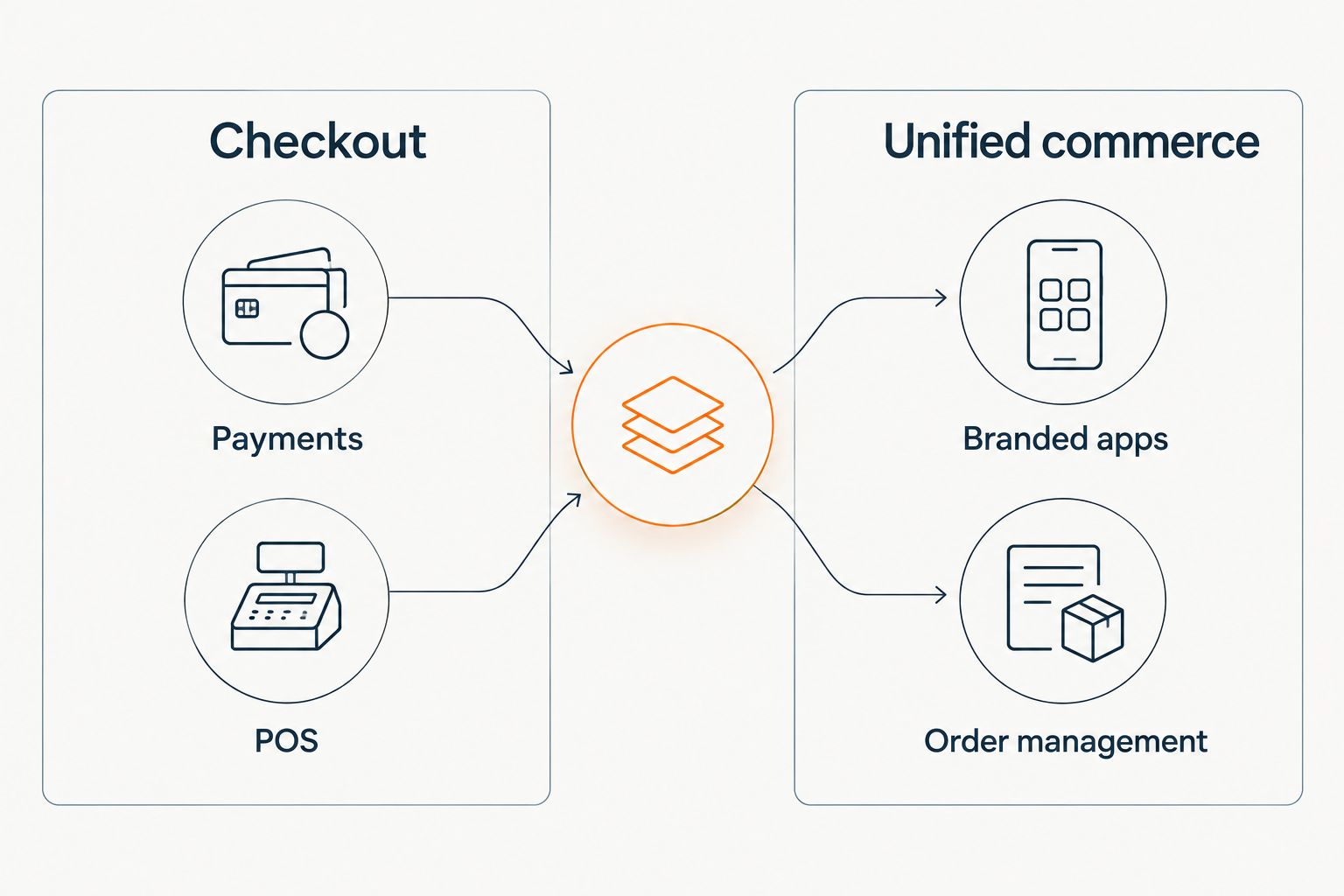
Local Express is a unified commerce platform for U.S. regional and independent grocery retailers. Its stated scope covers white-labeled ecommerce websites, branded grocery mobile apps, made-to-order prepared food through self-service kiosks, order management, last-mile delivery and retail media tools. Best for: a grocer deciding how its customer-facing ordering channels and order operations should work together.
That makes Local Express a different kind of option from a POS-first shortlist. If your immediate problem is only selecting an in-store checkout terminal, do not assume a broader platform answers that requirement. If the problem includes web, app, kiosk and delivery orders, put those workflows in the demonstration rather than judging vendors on a checkout screen alone.
Where Local Express shines
- Its stated product scope addresses grocery ecommerce websites and branded mobile apps, giving operators a direct channel to evaluate alongside marketplaces.
- Prepared-food made-to-order kiosks and order management are part of the stated scope, which matters when a deli order and a grocery basket enter different workflows.
- Last-mile delivery and retail media tools give a chain more to assess than checkout alone.
Where Local Express falls short
- The supplied product description does not establish a full POS replacement. Confirm register, payment and integration requirements rather than assuming them.
- A grocer seeking only a checkout system must assess whether the broader platform fits the project scope.
| Evaluation point | Local Express | Lithos POS |
|---|---|---|
| Primary evaluation | Grocery unified commerce | POS checkout |
| Branded ecommerce and app | Included in stated scope | Confirm directly |
| Prepared-food kiosk ordering | Included in stated scope | Confirm directly |
| POS replacement or integration | Confirm directly | Confirm exact requirements directly |
For a 2026 evaluation, ask both vendors to walk through the same transaction: a shopper starts on a branded app, adds grocery items, places a prepared-food order and selects a fulfillment method. Record where the order appears for staff and which system owns each handoff. A vendor presentation that covers only its strongest screen does not answer the operational question.
Verdict: Shortlist Local Express for grocery-wide commerce; do not label it a confirmed Lithos POS replacement until the POS and integration review is complete.
2. Square: best for a general-purpose checkout comparison
Square is a POS and payments option. It belongs in a 2026 comparison when your decision starts at the register: how staff take payment, what checkout equipment they use and how the resulting transaction enters your other systems. That is a narrower question than choosing a grocery ordering platform.
Where Square shines
- It gives operators a general-purpose POS and payments option to assess against Lithos POS.
- Its checkout focus makes it useful as a benchmark when register requirements drive the project.
Where Square falls short
- General-purpose POS positioning does not, by itself, establish fit for a regional grocer's full web, app, prepared-food and delivery workflows.
- Grocery-specific requirements need a live review; do not infer support for them from the POS category.
Best for: A grocer building a checkout-led shortlist and checking how a POS connects to its existing ordering systems.
| Evaluation point | Square | Lithos POS |
|---|---|---|
| POS and payments evaluation | Yes | POS evaluation |
| Grocery web and app workflow | Verify | Verify |
| Prepared-food order handoff | Verify | Verify |
| Multi-store operating needs | Verify | Verify |
Ask each vendor to show the same checkout scenarios using the items and exceptions your stores handle. Then ask who supports each connection to ecommerce and order management. A feature list is not an integration plan, and the answer needs to cover what store staff do when an order changes after checkout.
Verdict: Shortlist Square if the priority is general-purpose checkout; assess digital grocery operations as a separate requirement.
3. Toast: best for prepared-food counter evaluation
Toast is a restaurant-oriented POS option, so its place on this shortlist is the prepared-food side of grocery operations. A regional chain with a deli, hot bar or made-to-order counter has a legitimate reason to compare counter workflows. That does not make a restaurant-oriented POS the default system for every grocery department.
Where Toast shines
- Its restaurant focus makes it a relevant comparison for prepared-food ordering and service.
- It gives the prepared-food team a distinct workflow to test instead of folding its requirements into a general grocery checkout discussion.
Where Toast falls short
- Restaurant-oriented positioning is not evidence that every supermarket checkout requirement is covered.
- You still need to establish how prepared-food orders connect to the grocery basket and the chain's other ordering channels.
Best for: A grocer whose prepared-food counter is the specific system decision.
| Evaluation point | Toast | Lithos POS |
|---|---|---|
| Initial focus | Restaurant-oriented POS | POS checkout |
| Prepared-food workflow | Test in a counter demonstration | Confirm directly |
| Full grocery basket | Verify | Verify |
Use one customer order that includes both prepared food and packaged groceries. Ask each vendor to show where staff see it, how changes are handled and whether the customer receives one coherent ordering experience. Do not infer those answers from a restaurant or grocery label alone.
Verdict: Shortlist Toast for prepared-food counter requirements; keep chain-wide grocery checkout and online ordering on their own evaluation tracks.
4. Clover: best for a second POS benchmark
Clover is a POS and payments option. Include it when you need another checkout-led comparison against Lithos POS, not merely to increase the number of names on a vendor list. Define the register tasks first so the demonstration has a pass-or-fail purpose.
Where Clover shines
- It gives a checkout team another POS and payments option to compare.
- It keeps the conversation focused on the in-store transaction when that is the purchase decision.
Where Clover falls short
- Its place in the POS category does not establish support for your full grocery ecommerce operation.
- Chain-specific integrations and exceptions still require verification.
Best for: An operator comparing POS choices before deciding which, if any, should connect to a separate commerce platform.
| Evaluation point | Clover | Lithos POS |
|---|---|---|
| POS comparison | Yes | Yes |
| Grocery ordering channels | Verify | Verify |
| Multi-store workflows | Verify | Verify |
Verdict: Hold Clover on the shortlist only if it will be tested against documented checkout requirements.
Why people switch from Lithos POS
A reason to consider a change is not evidence that Lithos POS lacks a feature. In 2026, use these decision triggers to determine whether to replace a POS, add another system or keep what you have:
- The project has expanded beyond checkout. If you now need a branded grocery website, mobile app, prepared-food kiosk ordering, order management or last-mile delivery, compare platforms on those named workflows. A POS-only evaluation answers a different question.
- Orders cross channels. Map how a web, app and kiosk order reaches staff, how changes are handled and which team owns fulfillment. Require a demonstration of the handoffs rather than separate demonstrations of each screen.
- The chain wants to assess its direct customer channels. Compare the customer experience on a branded site or app with the role marketplaces play in the operation. Establish who owns each customer interaction before choosing software.
- Prepared food has its own workflow. A deli order needs a clear path from customer selection to staff preparation and fulfillment. Test that path alongside an ordinary grocery order.
These are reasons to reopen the technology decision, not documented faults with Lithos POS. If the present system handles checkout, a grocer can evaluate digital ordering without assuming a register replacement is necessary.
Evaluate your grocery ordering channels
Review branded ecommerce, app, kiosk, order management and delivery requirements together.
When staying with Lithos POS makes sense
Keep Lithos POS in contention if your requirement is in-store checkout and it meets the tests you set for your stores. There is no established basis here to claim that another option will improve that function for your chain. Changing a register system to solve an online ordering problem can expand the project without resolving the problem you started with.
For a 2026 decision, divide the requirements into checkout, customer ordering, order operations and fulfillment. Mark the owner of each workflow and test the connections between them. Replace a system only when a demonstrated gap maps to a requirement the new setup actually covers.
FAQ
What is the best Lithos POS alternative for a regional grocery chain in 2026?
Local Express is the best option to evaluate when the requirement is grocery-wide unified commerce rather than checkout alone. Confirm POS replacement and integration requirements separately before making a system change.
Is Local Express a direct replacement for Lithos POS?
A direct POS replacement is not established by the supplied product information. Local Express has a stated scope covering grocery ecommerce, branded apps, prepared-food kiosks, order management and delivery; verify checkout capabilities directly.
Is Square better than Lithos POS for grocery checkout?
There is no supported basis here to rank Square above Lithos POS for grocery checkout. Test both against the same store transactions, exceptions and integration requirements.
Should a grocery chain use Toast for its deli?
Toast is a relevant restaurant-oriented POS option to assess for a deli or prepared-food counter. Verify how those orders connect to the grocery basket and other ordering channels.
Can a grocer keep Lithos POS and change its online ordering system?
Yes, keeping a POS while evaluating online ordering is a valid project approach. Confirm the required integration and order handoffs before selecting another platform.
What should a grocer ask during a POS alternative demonstration?
Ask the vendor to show a real checkout scenario and its handoff to ordering and fulfillment systems. Include packaged groceries, prepared food and an order change in the test.
How much do Lithos POS alternatives cost?
No comparable pricing is established in the information provided for this article. Request a current proposal covering the specific checkout, ordering and integration scope your stores need.
One last thing
The most useful 2026 comparison may not end with one winner. Choose the checkout system on checkout evidence, then choose the grocery ordering setup on the web, app, kiosk and fulfillment workflows it can demonstrate. Keeping those decisions distinct prevents a familiar POS name from standing in for an unanswered commerce question.