Kiosk Buddy gives operators a focused way to evaluate kiosk ordering, but a kiosk decision alone does not cover every checkout and ordering job in a grocery store. The best Kiosk Buddy alternative in 2026 is Local Express for U.S. regional and independent grocers that need prepared-food kiosks connected to branded digital ordering; Square fits a general POS-led evaluation, while Toast fits a prepared-food POS-led evaluation. The right choice depends on whether you mean self-ordering at the deli, scanning a full grocery basket, or managing orders across channels.
- Local Express is the best Kiosk Buddy alternative for grocers connecting prepared-food kiosks with branded web and app ordering.
- Evaluate Square for a general POS-led decision and Toast for a prepared-food POS-led decision.
- Do not treat a prepared-food ordering kiosk as proof of full-basket grocery self-checkout support.
- In 2026, test the exact order journey your stores need before choosing kiosk software.
Why this matters
A shopper ordering a sandwich at a deli kiosk and a shopper scanning produce, packaged goods, and weighed items at a checkout lane are doing different jobs. Your software shortlist should reflect that distinction. A prepared-food kiosk can be the right purchase without being a replacement for a grocery checkout lane.
For a U.S. regional or independent grocer, there is a third job: receiving orders through your own website or app and routing them to the people who prepare, pick, or deliver them. If that is part of the decision, compare the entire order journey rather than judging vendors by the kiosk screen alone.
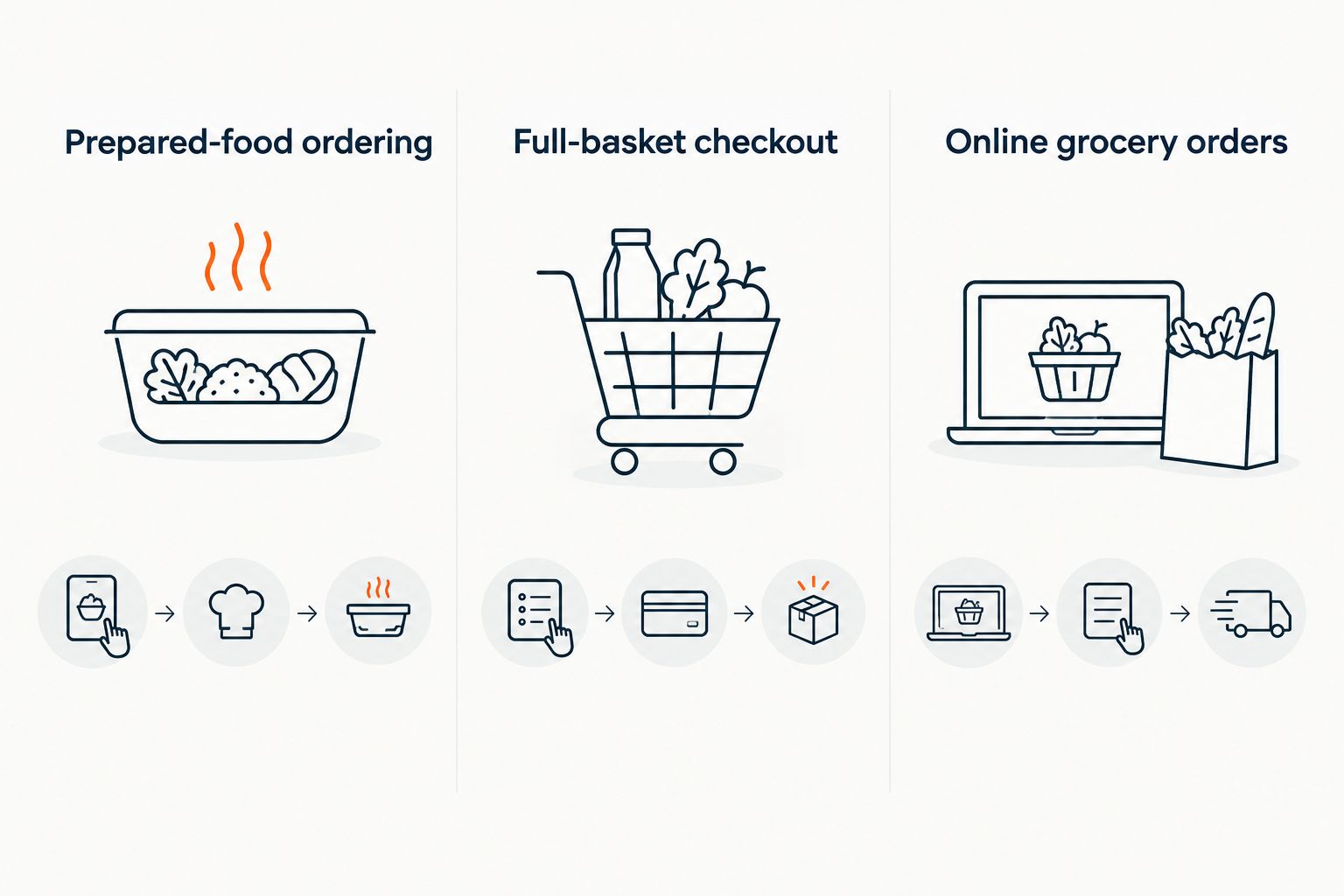
Use these terms consistently when discussing requirements with vendors:
- Prepared-food ordering: A customer selects made-to-order items at a self-service kiosk.
- Full-basket checkout: A customer scans and pays for a mixed grocery basket.
- Online grocery orders: A customer orders through a website or app for fulfillment by the store.
Kiosk Buddy alternatives at a glance
This 2026 shortlist compares each option by the job it belongs in. A category match is not proof that a vendor supports your existing POS, payments, scales, or checkout hardware; confirm those requirements in a demonstration.
| Option | Best for | Standout focus | How it differs from Kiosk Buddy |
|---|---|---|---|
| Kiosk Buddy | A focused self-ordering kiosk evaluation | Kiosk ordering | The benchmark for a kiosk-first decision |
| Local Express | Regional and independent grocers connecting prepared-food ordering with digital commerce | Prepared-food kiosks alongside branded grocery websites, mobile apps, and order management | Broadens the evaluation beyond the kiosk |
| Square | Operators starting with a general POS decision | General-purpose POS | Starts with the POS rather than grocery-wide digital commerce |
| Toast | Operators starting with prepared-food POS workflows | Restaurant-oriented POS | Centers the prepared-food operation rather than the wider grocery order journey |
Local Express is the strongest fit here when the kiosk must sit within a broader grocery commerce plan. None of these category descriptions establishes support for full-basket self-checkout. Put that requirement in a separate test if shoppers must scan their own groceries.
1. Local Express: best for connected grocery ordering
Local Express provides a unified commerce platform for regional and independent grocers. Its stated scope includes white-labeled grocery websites, branded mobile apps, made-to-order prepared food through self-service kiosks, order management, last-mile grocery delivery, and retail media tools. That makes it the most relevant Kiosk Buddy alternative when the deli kiosk is one part of a store-owned ordering operation.
The deciding question is not which kiosk has the cleaner menu. It is whether an order placed in-store, on the web, or in the app enters a workflow your staff can manage. Ask to see the same prepared-food item ordered through each channel you plan to offer, then follow each order from submission through store handling.
Where Local Express shines
- Prepared-food kiosk ordering belongs to the same stated platform scope as grocery ecommerce and branded mobile apps.
- Order management is part of the stated offering, making cross-channel order handling a relevant demonstration request.
- The platform targets grocery, supermarket, and specialty food retailers rather than treating the store as only a restaurant counter.
Where Local Express falls short
- Its stated kiosk use case is made-to-order prepared food. Do not assume it replaces a full-basket self-checkout lane.
- The supplied information does not establish compatibility with your POS, payment devices, scales, or existing kiosk hardware. Those need a store-specific demonstration.
- If you only need a standalone ordering kiosk, evaluating a wider commerce platform adds requirements that may not matter to your decision.
Best for: U.S. regional and independent grocers that want prepared-food self-ordering alongside their own web, app, and order-management channels.
| Decision point | Local Express | Kiosk Buddy |
|---|---|---|
| Starting point | Grocery commerce across stated channels | Focused kiosk-ordering evaluation |
| Prepared-food kiosk | Included in the stated offering | Verify your exact menu and order flow |
| Branded grocery website and app | Included in the stated offering | Verify if these are required |
| Full-basket self-checkout | Not established by the supplied information | Verify separately |
Verdict: Choose Local Express when connecting prepared-food ordering to your grocery website, app, and order workflow is the requirement; do not choose it on an unverified promise of full-basket self-checkout.
2. Square: best for a general POS-led evaluation
Square belongs on the list if your immediate project starts at the POS rather than with a grocery-wide digital ordering platform. It is a different starting point from comparing prepared-food kiosk screens. Write down the checkout and ordering tasks before deciding whether that difference helps or complicates your project.
For a grocer, the hard part is not labeling a system a POS. It is showing that the proposed setup handles the products and exceptions at your stores: variable-weight items, prepared foods, mixed baskets, refunds, and the handoff between an online order and store operations. Ask for a demonstration using your own workflows rather than a generic retail basket.
Where Square shines
- It gives operators a general POS-centered route to evaluate instead of starting with a dedicated kiosk requirement.
- It provides a useful comparison when replacing or selecting the checkout system is the primary project.
Where Square falls short
- A general POS category is not evidence of a complete regional-grocery ecommerce, app, and prepared-food kiosk setup.
- The supplied information does not establish how a proposed Square configuration would handle your grocery-specific exceptions or connect your ordering channels.
Best for: Grocers whose first decision is their general POS configuration, with kiosk needs defined as part of that project.
| Decision point | Square | Kiosk Buddy |
|---|---|---|
| Evaluation starting point | General POS | Focused kiosk ordering |
| Mixed grocery basket | Require a live demonstration | Require a live demonstration |
| Prepared-food order flow | Confirm the proposed configuration | Confirm the proposed configuration |
| Branded grocery channels | Assess separately | Assess separately |
Verdict: Hold Square on the shortlist when the POS is the purchase; do not use its POS category as proof that every grocery kiosk requirement is covered.
3. Toast: best for a prepared-food POS-led evaluation
Toast is a restaurant-oriented POS option, so it is a relevant comparison when a grocery deli, hot bar, or other prepared-food counter drives the project. Its category is narrower than the full operating picture of a supermarket. Test the counter workflow first, then test how that workflow sits beside the rest of your store.
A prepared-food demonstration should follow a realistic order from selection to preparation and pickup. If the same location also sells packaged groceries online, evaluate that journey separately. A strong counter experience does not, by itself, answer questions about full-basket grocery checkout or store-owned grocery ecommerce.
Where Toast shines
- Its restaurant POS focus makes it a relevant alternative for evaluating prepared-food operations.
- It creates a clear comparison if your deli or hot bar has different needs from your main checkout lanes.
Where Toast falls short
- Restaurant-oriented POS is not proof of coverage for mixed-basket supermarket checkout.
- The supplied information does not establish how a proposed Toast setup would connect a regional grocer's website, app, and wider order-management workflow.
Best for: Grocers evaluating a POS-led workflow for a prepared-food counter rather than selecting a platform for every grocery sales channel.
| Decision point | Toast | Kiosk Buddy |
|---|---|---|
| Evaluation starting point | Prepared-food POS | Kiosk ordering |
| Counter order handling | Demonstrate the full handoff | Demonstrate the full handoff |
| Main grocery lanes | Assess separately | Assess separately |
| Online grocery orders | Assess separately | Assess separately |
Verdict: Hold Toast on the shortlist for a prepared-food POS project; skip treating it as a proven answer to the entire grocery checkout journey.
Why grocers consider switching from Kiosk Buddy
The clearest reason to consider a Kiosk Buddy alternative is a change in the scope of the project. If you began by looking for a way to take orders at a prepared-food counter, a focused kiosk evaluation makes sense. If the project now includes a branded grocery website, mobile app, delivery operations, or a shared order workflow, compare platforms against that wider requirement.
That is not a claim that Kiosk Buddy cannot support a particular feature. It is a way to avoid buying for the first channel you discussed while leaving the remaining channels unexamined. In 2026, put these requirements in front of every vendor:
- Ordering channel: Which orders originate at the kiosk, on the website, and in the app?
- Store handling: Where does each order appear, and who acts on it?
- Prepared-food handoff: How does an order move from customer selection to the counter?
- Grocery checkout: Is full-basket scanning required, or is this only a prepared-food ordering project?
- Store control: Which customer-facing channels will carry your store's brand rather than a marketplace's?
A second reason to reopen the shortlist is discovering that people mean different things by self-checkout. Ask the operator responsible for the main lanes and the manager responsible for prepared foods to sign off on separate requirements. If one vendor demonstration covers only the deli order, it has not answered the lane question.
Test the shortlist against a real store workflow
A useful 2026 vendor demonstration begins with your own catalog and store tasks. Pick one store, one prepared-food counter, and one representative ordering journey before expanding the evaluation. Those are test boundaries, not performance claims; they make differences between systems visible.
For the counter journey, have a shopper select a made-to-order item, change an option, submit the order, and collect it. Ask the vendor to show exactly what store staff see and do. If customers can place a similar order through your website or app, repeat the journey there and compare the staff handoff.
For the lane journey, use a mixed grocery basket that reflects your store's actual merchandise. Show how the proposed setup treats produce or other variable-weight goods, packaged items, payment, and an exception that needs staff help. Do not accept a prepared-food menu demonstration as the answer to this test.
For the online journey, follow an order from the customer's branded channel to store handling and fulfillment. Define who receives the order, what happens when an item needs attention, and how the order is completed. This is where a broader platform decision differs most from a kiosk-only purchase.
Record the result for each journey as shown, requires another component, or not demonstrated. Those labels are more useful than a feature list: a capability you have not seen operating in your store's workflow is still an open requirement. Keep payment, hardware, and existing-system compatibility on that same demonstration record.
When staying with Kiosk Buddy is the right call
Stay with Kiosk Buddy if the project is genuinely limited to the kiosk-ordering workflow, its demonstration meets your requirements, and you do not need this purchase to determine your wider grocery commerce setup. Replacing a focused tool because another vendor offers more channels does not improve a narrowly defined job.
The 2026 decision should follow the work your stores need done. Choose a kiosk-first evaluation for a kiosk-first project. Choose a broader platform evaluation when prepared-food ordering must operate alongside your branded web and app channels. Keep full-basket self-checkout as a distinct requirement until a vendor demonstrates it with your merchandise and store process.
FAQ
What is the best Kiosk Buddy alternative for an independent grocery store?
Local Express is the best fit when an independent grocer needs prepared-food kiosk ordering alongside branded grocery web and app ordering. If the project is only a standalone kiosk, compare the exact kiosk workflow before choosing a broader platform.
Is Local Express a full grocery self-checkout replacement?
Full-basket grocery self-checkout is not established by the supplied Local Express offering. Its stated kiosk use case is made-to-order prepared food, so request a separate demonstration if shoppers must scan mixed grocery baskets.
Is Square better than Kiosk Buddy for grocery checkout?
Square is the more relevant evaluation when your project starts with a general POS decision. Kiosk Buddy is a kiosk-ordering benchmark; neither category alone establishes that a proposed setup handles your full grocery checkout workflow.
Is Toast a Kiosk Buddy alternative for a grocery deli?
Toast is a relevant option to evaluate for a prepared-food POS project. Compare its proposed counter workflow with Kiosk Buddy's kiosk workflow, then assess the rest of the grocery operation separately.
What should a grocer test in a kiosk demonstration?
Test a real prepared-food order from customer selection through staff handling and pickup. If the project also includes full-basket checkout or online orders, request separate demonstrations of those journeys.
Do prepared-food ordering kiosks replace grocery self-checkout lanes?
No, a prepared-food ordering kiosk is not automatically a replacement for a full-basket self-checkout lane. The lane must handle the mixed merchandise and exceptions in your store's actual checkout process.
When should a grocer stay with Kiosk Buddy?
Stay with Kiosk Buddy when its demonstrated kiosk-ordering workflow meets the project's requirements and wider commerce channels are outside the purchase. A broader platform is relevant when those channels are part of the same operational decision.
One last thing
Before you ask which kiosk wins, ask which order must move through which part of your store. That question separates a deli ordering project from a checkout-lane project and a cross-channel commerce project. In 2026, the best alternative is the one demonstrated against the right job, not the one with the longest feature list.