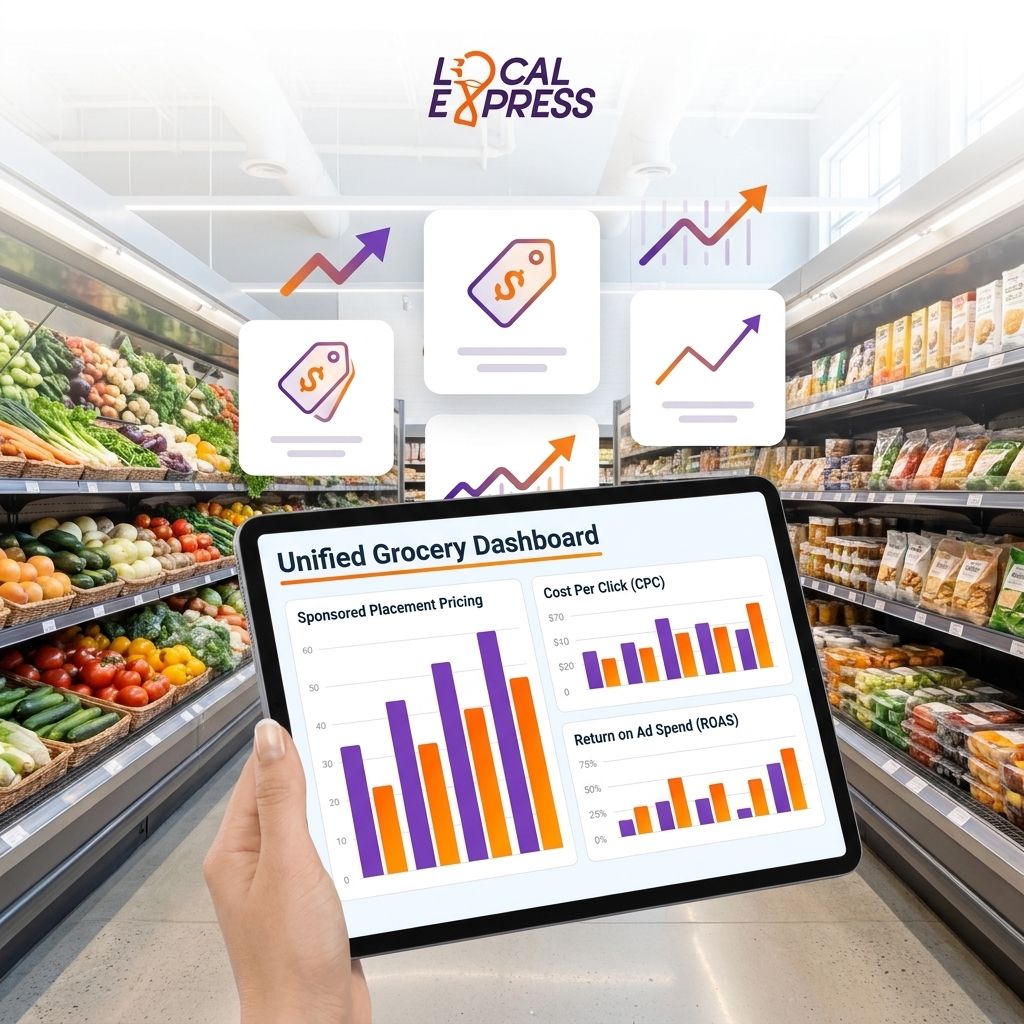
Grocery retail media only works when the price on every sponsored placement matches what a CPG brand actually gets in impressions, clicks, or lift — get it wrong in either direction and you either scare off your first advertisers or give away shelf space you could be monetizing at full value in 2026.
- Price sponsored placements grocery retail media programs on a hybrid CPM-plus-flat-fee model for year one; pure CPC underprices your best slots.
- Pull 90 days of your own order and traffic data before quoting any brand — guessing at rates is how independent grocers undersell inventory.
- Local Express in-app sponsored placements let regional grocers run tiered rate cards without joining a national retail media network. Buy this approach.
- Cap campaign minimums at 30 days with a 90-day pricing review instead of an annual lock-in while you calibrate rates.
Why this matters
CPG brands already know what national chains charge for endcaps and digital banners — they will benchmark your rate card against Kroger, Albertsons, and Amazon whether you like it or not. Price too low against that benchmark and you signal your audience isn't worth the spend. Price without your own data and you'll either lose the deal or lock in a rate you can't defend at renewal.
A grocery retail media program built on in-app sponsored product placements has a real advantage here: you control the inventory, the traffic, and the reporting, so you set price from your own numbers instead of copying a rate card built for a chain ten times your size. Local Express retail media tools exist specifically so independent and regional grocers can run this pricing exercise on their own shopper data in 2026, not on assumptions borrowed from a national network.
What you'll need
- 60-90 days of order and site traffic data (unique shoppers, category page views, checkout conversion rate)
- A placement inventory map: homepage banner, search top slot, category page, cart page, app push notification, kiosk screen
- A rate card template with columns for placement, model, price, and minimum spend
- A shortlist of 5-10 CPG brands already stocked in your store
- Retail media or sponsored-placement software that can tag, serve, and report on paid slots separately from organic listings
- One month of runway to pilot before you finalize published rates
The steps
1. Map every placement you can actually sell
Walk your ecommerce site and app screen by screen and list every spot a sponsored product or banner could sit — homepage hero, search results (top 3 slots vs. below the fold), category page top row, cart page cross-sell, and any kiosk or self-checkout screen you run. Most grocers find 6-10 sellable placements the first time they do this, more than they expected.
Skip this step and you'll price placements one at a time as brands ask for them, which means no two advertisers pay a consistent rate and you can't defend pricing at renewal. Common mistake: forgetting mobile app screens exist as separate inventory from the website — they're a distinct placement with distinct traffic and deserve their own line on the rate card.
2. Pick a base pricing model before you price anything
Three models cover almost every grocery retail media program: cost-per-thousand-impressions (CPM) for visibility placements like homepage banners, cost-per-click (CPC) for search and category slots where intent is high, and flat monthly fee for guaranteed top-of-search or homepage takeover spots. A hybrid — flat fee plus a CPM floor — protects you when a brand's campaign underperforms.
For 2026, most independent grocers running a first-year program do best on flat fee for premium guaranteed slots and CPM for everything else, because flat fee is the easiest for a CPG brand's trade marketing team to approve without a media-buying desk. Common mistake: launching with CPC only — it undervalues top placements that get clicked regardless of ad quality just because of position.
3. Pull your own traffic and conversion numbers before you quote a rate
Before you tell a single CPG brand what a placement costs, pull your monthly unique shoppers, average session length on category pages, and checkout conversion rate. This is the data that justifies your price — a brand that sees 40,000 monthly active shoppers on your app values a homepage placement very differently than one serving 4,000.
Say your app has 25,000 monthly active shoppers and your homepage banner gets seen by 60% of sessions — that's 15,000 monthly views you can quote against a CPM rate. Working the math yourself, in front of the brand, is what earns credibility versus quoting a number you can't back up. Common mistake: quoting a rate before pulling the data, then having to walk it back when a sharp brand manager asks for the numbers behind it.
4. Build a tiered rate card by placement value
Rank your inventory from step 1 into three tiers — premium (homepage, top search), mid (category page, app push), and standard (cart page cross-sell, lower search results) — and set a price band for each tier rather than negotiating placement by placement. Say a premium flat-fee slot runs $600-$900 a month, mid-tier runs $250-$400, and standard runs $100-$150; those are illustrative bands to calibrate against your own traffic, not published market rates.
Tiering does two things: it keeps pricing consistent across advertisers, and it gives you room to negotiate within a band without collapsing the whole rate card. When you onboard CPG brands into a grocery retail media program, a tiered card is what turns a first conversation into a signed insertion order instead of an open-ended negotiation.
5. Set minimum spend, campaign length, and cancellation terms
Decide the smallest deal you'll accept — most independent grocers set a monthly minimum somewhere between $150 and $500 depending on tier — and set campaign length at 30 days minimum so you have room to adjust rates before a brand locks in a full year at a price you later regret. Add a cancellation clause requiring 14-30 days' notice so a brand can't pull a campaign mid-cycle and leave a placement unsold with no notice.
Expected outcome: a signed insertion order with a clear start date, price, and renewal point instead of a verbal agreement that becomes hard to enforce or re-price. Common mistake: locking a founding brand into a 12-month rate to win the first deal — it becomes the reference price every brand after them expects.
6. Add performance guarantees or make-goods for underdelivery
If you sell CPM-based placements, guarantee a minimum impression count and offer a make-good (extra days at no charge) if you fall short — this is standard in every other digital ad channel and CPG trade marketers expect it. Track actual delivered impressions against the guarantee every week of the campaign, not just at the end.
This protects your rate card's credibility: a brand that gets shorted on impressions without a make-good won't renew, and won't recommend your program to the next brand. Common mistake: promising impressions you can't measure because your platform doesn't separate sponsored placement views from organic traffic.
7. Pilot with 3-5 brands and repeat pricing review every 90 days
Launch your rate card with a small pilot group before opening it to every brand in your store, and review actual performance against your quoted rates every 90 days for the first year. If a tier sells out consistently, raise that tier's price at the next renewal cycle; if a tier goes unsold for two cycles, lower it or reposition the inventory.
Expected outcome by the end of a 90-day pilot: a rate card with real fill data behind every tier, not projections. Common mistake: setting a rate card once in 2026 and never revisiting it — shopper traffic and brand demand both shift quarter to quarter.
Price your placements with real data
See how Local Express supports tiered, self-serve retail media pricing.
Troubleshooting
A brand pushes back saying your rate is too high with no comparison data. Show them your actual monthly active shoppers and category page views for the specific placement — a rate anchored to your traffic numbers is harder to argue against than a number pulled from a generic rate card.
Premium placements go unsold for a full cycle. Drop the tier price by 15-20% for the next 90-day cycle rather than discounting ad hoc per brand, and check whether the placement's traffic actually supports a premium price in the first place.
Two brands want the same top search slot in the same week. Set a rotation rule (weekly or bi-weekly swaps) into your rate card upfront so this never becomes a first-come negotiation that erodes your published price.
A brand disputes whether their placement drove the sales lift you're reporting. Separate sponsored placement clicks from organic clicks in your reporting from day one — without that split, every performance conversation turns into a pricing dispute.
Your kiosk or in-store screen inventory sits unpriced. Treat kiosk and self-checkout screens as their own placement tier with their own CPM or flat rate — don't fold them into your web/app pricing, since foot traffic and dwell time behave differently than online sessions.
Tools and resources
- In-app sponsored product placements for grocery ecommerce sites — the placement inventory this whole pricing exercise runs on
- How to onboard CPG brands into a grocery retail media program — the process that turns your rate card into signed deals
- A spreadsheet rate card template with tier, model, price band, and minimum spend columns
- Your platform's traffic and order dashboard for pulling the numbers behind each quote
What to do next
Once your rate card is priced and piloted, the harder question is structural: how do you run a retail media program at all without joining a national network that takes a cut of every dollar. The next step is how to launch a retail media program without a national network — it covers the operational side that pricing alone doesn't solve.
FAQ
How do you price sponsored product placements in grocery retail media?
Price them using your own traffic data on a hybrid model: flat monthly fee for guaranteed premium slots like homepage or top search, and CPM for standard placements. Tier the rate card by placement value and revisit pricing every 90 days in 2026.
What's the best pricing model for a grocery retail media program?
A hybrid of flat fee for premium guaranteed placements and CPM for standard inventory works best for most independent grocers. Pure CPC undervalues high-visibility slots that get clicked regardless of ad quality.
Is CPM or CPC better for grocery sponsored placements?
CPM suits visibility-first placements like homepage banners; CPC suits high-intent placements like search results and category pages. Most grocery retail media programs use both, split by placement tier.
How much should a CPG brand pay for a homepage placement?
There's no universal rate — price it against your own monthly active shoppers and homepage view rate, not a national chain's published card. A flat monthly fee tied to your actual traffic volume is the defensible approach.
What minimum spend should a grocery retail media program set?
Set a minimum spend by tier rather than a single number across the whole program, and require at least a 30-day campaign length. This gives you room to adjust pricing before a brand locks in a longer commitment.
Do independent grocers need a national retail media network to sell sponsored placements?
No — independent and regional grocers can run their own sponsored placement program on their ecommerce site, app, and kiosks without joining a national network. Owning the placements means owning the pricing and the margin.
How often should a grocery retail media rate card be updated?
Review pricing every 90 days for the first year of the program, then move to a semi-annual review once fill rates stabilize. Raise prices on tiers that consistently sell out; lower or reposition tiers that go unsold.
What's the biggest mistake grocers make pricing sponsored placements?
Quoting a rate before pulling their own traffic and conversion data, which leaves them unable to defend the price when a CPG brand asks for numbers. The fix is pulling 60-90 days of data before the first pricing conversation.
One last thing
The grocers who get the most out of retail media in 2026 aren't the ones with the highest rate card — they're the ones who revisit it every quarter instead of setting it once and hoping it holds. A rate card frozen from launch day becomes wrong within two pricing cycles as your traffic and brand demand shift.