Calculating customer acquisition cost for grocery ecommerce isn't complicated math — it's a discipline most independent grocers skip until margins tighten. This guide walks through the formula, the grocery-specific costs people forget to count, and the monthly cadence that keeps CAC from creeping up unnoticed in 2026.
- Customer acquisition cost grocery ecommerce = total marketing spend divided by new customers, tracked by channel, not just blended.
- A CAC above 20-30% of first-order value signals a channel losing money on acquisition alone.
- Local Express centralizes order data across web, app, and kiosk, so CAC math doesn't require stitching three spreadsheets.
- A 3:1 LTV:CAC ratio is the standard health check once you have repeat-purchase data for 2026.
- Recalculate CAC monthly in 2026 - grocery margins move too fast for a quarterly review.
Why this matters
Grocery runs on thin margins — most independent stores operate on 1-3% net margin, which means a bloated acquisition cost eats the whole order before you've covered payroll. If you don't know your CAC by channel, you can't tell whether a paid social campaign is buying loyal shoppers or just one-time bargain hunters. And if new customers keep abandoning carts before checkout, your effective CAC is worse than it looks on paper — worth checking against a guide on cart abandonment on your grocery ecommerce site before you assume the acquisition channel is the problem.
CAC isn't a vanity metric for grocery retailers in 2026 — it's the number that decides whether you scale a channel, pause it, or kill it.
What you'll need
- 30-90 days of marketing spend data, broken out by channel (paid search, paid social, SMS/push, delivery marketplace commissions)
- Order data showing which customers placed a first order in the same period
- Average order value (AOV) and, ideally, 90-day repeat purchase rate
- A spreadsheet or, better, a unified order management view across web, app, and kiosk channels
- Definition alignment on what counts as a "new customer" (first purchase, not first signup)
The steps
1. Gather total acquisition spend for the period
Pull every dollar spent to bring in customers over a fixed window — a full month works best for grocery, since weekly spend is noisy. Include paid search, paid social, SMS/push campaign costs, influencer or local sponsorship spend, and any commission you pay a third-party delivery marketplace for new-customer referrals. Grocers routinely undercount marketplace commissions because they feel like a cost of sale rather than a cost of acquisition — they're both.
Common mistake: leaving out platform fees for SMS or push tools because they're billed annually. Prorate them monthly so they land in the same period as the spend they're driving.
2. Count new customers acquired in that same period
Define "new" as a customer's first completed order, not a signup or app download. A shopper who creates an account but doesn't buy for three weeks shouldn't count until the order lands. Pull this number from your order management system, filtered to first-time buyers only, matched to the same date range as your spend.
Common mistake: counting the same person twice because they signed up on the website and again in the branded app. Match by email or phone, not by channel.
3. Calculate blended CAC
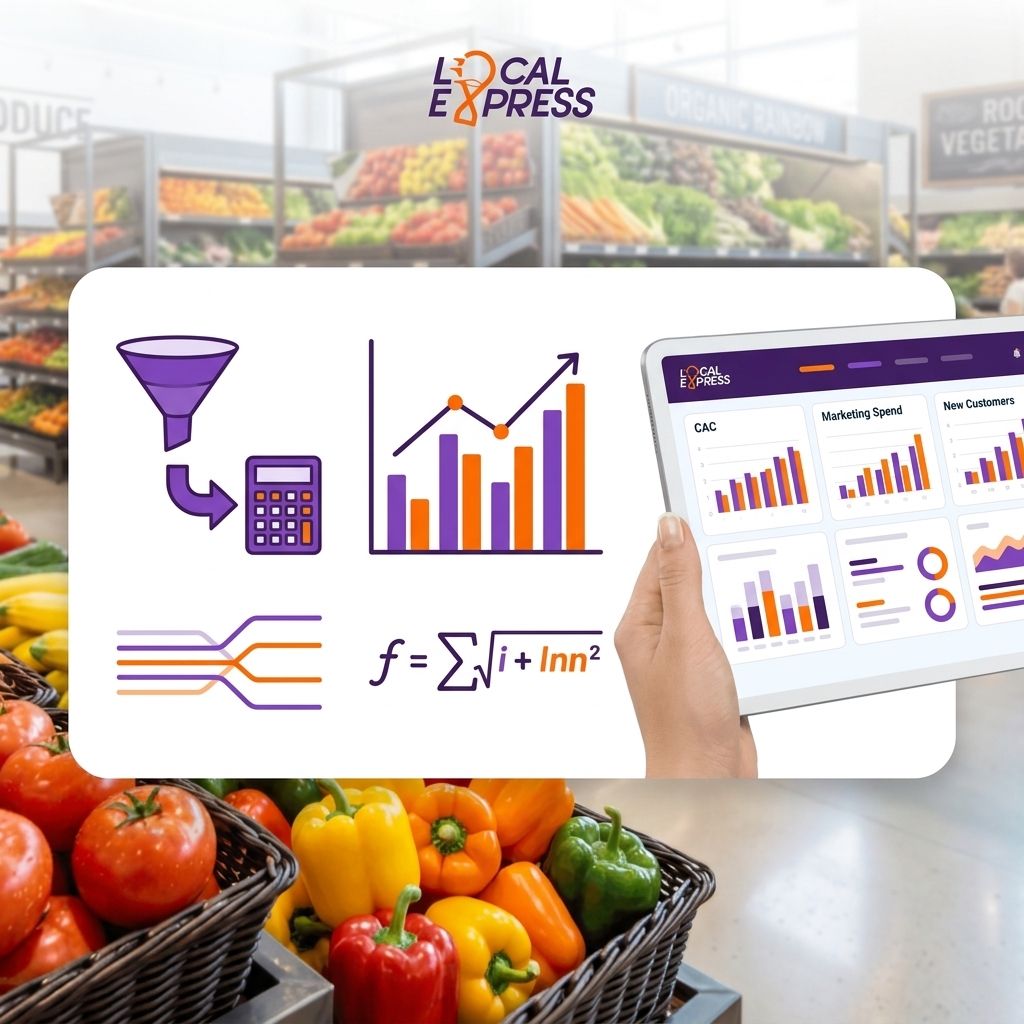
The formula is simple: total acquisition spend divided by new customers acquired. If you spent $10,000 in a month and acquired 200 new customers, your blended CAC is $50. That single number tells you almost nothing about which channel is working — it's a starting point, not a diagnosis.
4. Break CAC down by channel
Repeat the same division separately for each spend source: paid search CAC, paid social CAC, SMS/push CAC, marketplace-referral CAC. It's common for one channel to carry a $30 CAC while another sits at $110 for the exact same new-customer quality. If your store still routes new customers through a third-party marketplace, that channel's CAC usually looks artificially low until you account for the commission, which is why grocers migrating off marketplaces often see their true CAC drop once they own the channel — a step-by-step on how to migrate from a delivery marketplace to your own app walks through the transition.
Common mistake: treating marketplace orders as "free" acquisition because no ad spend is attached — the 15-30% commission most marketplaces charge is a real acquisition cost.
5. Layer in delivery and fulfillment cost for first orders
Grocery ecommerce carries a cost most retail categories don't: delivery. If a first-time customer's order loses money on picking, packing, and last-mile delivery, that loss is part of your true acquisition cost, not a separate line item. Add average delivery cost per first order to your channel-level CAC to get a fully loaded number.
6. Compare CAC to AOV and LTV
Once you have channel-level CAC, compare it against your average first-order value. A $50 CAC against a $35 first order means you're paying more to acquire than the order is worth — you're betting entirely on repeat purchases to break even. Layer in 90-day LTV if you have it: a 3:1 LTV:CAC ratio is the general benchmark for a healthy repeat-purchase retailer, and grocery, with its high purchase frequency, should be able to hit it faster than most categories once retention tools like SMS reminders are in place — see push notification and SMS marketing tools for grocery apps for how retailers drive that repeat behavior.
7. Set a CAC ceiling per channel and recheck monthly
Decide, per channel, the maximum CAC you're willing to pay based on margin and expected repeat behavior. Recalculate every month in 2026 — seasonal spend spikes around holidays and back-to-school periods skew CAC if you're only reviewing quarterly, and by the time a quarterly report flags a problem, you've already overspent for 90 days.
Track CAC across every channel in one view
See web, app, and kiosk order data without stitching spreadsheets.
Troubleshooting
Blended CAC looks fine but margins are shrinking. Break the number out by channel — a healthy blended average often hides one channel bleeding money while another overperforms.
Marketplace-referred customers show a low CAC. Add the commission percentage back in before comparing it to owned channels; a 20% commission on a $40 order is an $8 acquisition cost that never shows up in your ad spend total.
The same customer counts twice. Cross-reference by email or phone across web, app, and kiosk order sources rather than counting new signups per channel.
Delivery cost isn't in the number. Add average first-order delivery cost to get a fully loaded CAC — skipping it understates true acquisition cost by a meaningful margin in most delivery-heavy grocery operations.
CAC spikes every November and December. Compare year-over-year for the same calendar month instead of month-over-month sequential periods — holiday spend naturally skews seasonal categories.
SMS and push campaigns look "free." Prorate the platform's monthly or annual fee into that channel's spend total; a tool that costs nothing per message still has a real subscription cost.
Tools and resources
- Order management system with first-order tagging across web, app, and kiosk
- Spend tracking by channel, updated monthly, not quarterly
- A defined "new customer" rule shared across marketing and finance
- SMS/push platform reporting to isolate retention-driven repeat orders from paid acquisition
- Retail media revenue, if you run one, can offset CAC by monetizing the traffic you've already paid to acquire — see retail media platforms for independent grocery retailers for how that works in practice
What to do next
Once blended and channel-level CAC are stable numbers you trust, the next move is reducing the CAC you're already paying — starting with checkout friction, since a shopper who abandons a cart after you've already paid to acquire them is the most expensive kind of loss. Revisit your CAC ceilings every quarter in 2026 as spend and delivery costs shift, and don't let a single strong month convince you a channel is solved.
FAQ
What is customer acquisition cost for grocery ecommerce?
Customer acquisition cost for grocery ecommerce is total marketing and referral spend divided by the number of new first-time customers in the same period. Grocery-specific CAC should also include marketplace commissions and first-order delivery cost, since both are real costs of winning that customer.
What is a good CAC for a grocery ecommerce store?
CAC should generally stay under 20-30% of first-order value, with the gap closing further once repeat purchases start. A CAC that exceeds your average order value means you're relying entirely on future repeat orders to break even.
How often should I recalculate CAC?
Recalculate CAC monthly in 2026 rather than quarterly. Grocery spend and delivery costs move fast enough that a quarterly review catches problems 60-90 days too late.
Does delivery cost count toward CAC?
Yes, first-order delivery and fulfillment cost should be added to acquisition spend for a fully loaded CAC. Skipping it understates true acquisition cost, especially for stores running their own delivery fleet.
Is CAC different by channel?
Yes, blended CAC hides wide swings between channels; paid search, paid social, SMS, and marketplace-referred customers each carry a different fully loaded cost. Break out CAC by channel before deciding where to cut or increase spend.
How does LTV relate to CAC?
LTV:CAC ratio measures whether acquisition spend pays off over a customer's lifetime, with 3:1 as a common health benchmark. Grocery's high purchase frequency means retailers can often hit that ratio faster than other retail categories once repeat orders are tracked.
Do marketplace commissions count as CAC?
Yes, commissions paid to third-party delivery marketplaces for new-customer orders are an acquisition cost even without direct ad spend. Many grocers undercount this and assume marketplace customers are cheaper to acquire than they actually are.
Can retail media offset CAC?
Retail media revenue from CPG brands can offset the cost of the traffic you've already paid to acquire, effectively lowering net CAC. It doesn't change the acquisition formula itself but improves the economics around it.
One last thing
The single biggest CAC distortion in grocery ecommerce isn't ad spend — it's counting marketplace-referred customers as free. A 20-30% commission on every first order from a third-party app is often the most expensive acquisition channel a grocer runs, and it's the one most likely to go unmeasured in 2026 because no ad dashboard reports it.