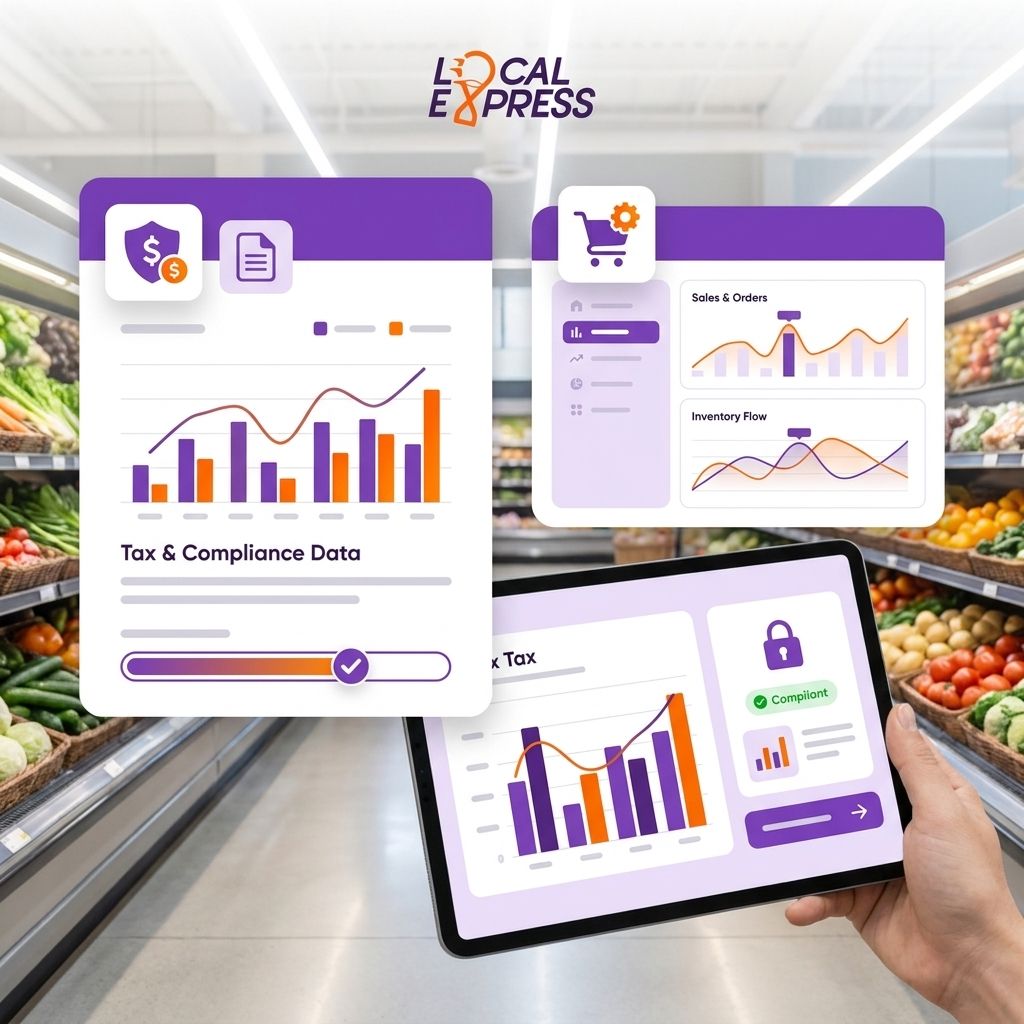
A grocery ecommerce platform tax compliance tool is software built into online ordering, kiosk, and delivery systems that automatically calculates sales tax, applies SNAP/EBT item eligibility rules, and enforces age verification for restricted products, so regional and independent grocers do not have to manage those rules by hand. Independent grocers face a different compliance load than a big-box chain running one national tax engine: their catalog mixes taxable and exempt groceries, prepared hot food, alcohol, and often SNAP-eligible staples, all sold across web, app, and self-checkout kiosk at once.
- Local Express bundles SNAP/EBT eligibility, sales tax, and age verification into one grocery ecommerce platform tax compliance stack for 2026 rollouts.
- Manual spreadsheet tracking works only for single-location stores testing online orders, not multi-channel grocers.
- Prepared hot deli food is taxed differently from packaged groceries in most states, and that split has to happen at the SKU level, not the order level.
- USDA's SNAP EBT online purchasing program runs in all 50 states as of 2026, but split-tender checkout logic is still the hardest part to get right.
Why tax and compliance tools matter for independent grocers
A regional grocer running its own SNAP EBT online ordering system has to split every cart into EBT-eligible items and everything else, then route the remainder to a second card automatically at checkout. Get that wrong once and the order either fails or overcharges the customer, and both outcomes generate refund requests and support tickets.
Sales tax adds a second layer. Most states tax groceries at a reduced rate or exempt them entirely, but flip that treatment for hot prepared food, deli sandwiches, or anything sold above room temperature. A 2026 catalog with private-label items, a hot bar, and beer or wine on the shelf needs product-level tax classification, not a single storefront tax rate. Retailers who treat every SKU the same way end up either over-collecting tax (a customer complaint and a compliance risk) or under-collecting it (a liability at audit time).
How to build tax and compliance into your grocery ecommerce platform
Map SNAP/EBT eligible items in your online catalog
Start by tagging every SKU as EBT-eligible or not, using USDA's eligible food list as the baseline, before you turn on online ordering.
- Pull your current POS item list and cross-reference it against USDA SNAP eligible food categories
- Flag hot prepared items, alcohol, tobacco, and non-food items as ineligible manually if your system has no automated flag
- Re-run the tagging pass every time a new private-label or seasonal SKU enters the catalog
- Test a split-tender checkout with a dummy EBT balance before launch, not after
- Once the manual pass is stable, move to a platform that auto-flags new items against the eligibility list so the tagging step stops being a monthly chore
Automate sales tax by jurisdiction and product category
Sales tax rates change by state, county, and sometimes city, and grocery-specific exemptions vary within that same geography.
- List every delivery zip code your store serves and note the applicable state and local tax rate for each
- Separate taxable categories (hot food, alcohol, general merchandise) from tax-exempt grocery categories in your product data
- Check whether your state taxes delivery fees or bag fees differently than the merchandise itself
- Update rates quarterly, since local jurisdictions revise them more often than most retailers expect
- A built-in tax engine inside your ecommerce platform removes the quarterly manual rate check entirely by pulling current rates automatically
Set age verification for restricted products
Alcohol, tobacco, and in some states CBD products require an ID check regardless of whether the order comes through a kiosk, an app, or a delivery driver.
- Require a documented age-check step at checkout for any cart containing a restricted item
- Train delivery drivers on refusal procedures when ID cannot be verified at the door
- Log every age-restricted transaction with a timestamp and verification method for audit purposes
- Configure self-checkout kiosks to hold restricted items until a staff member confirms ID, following the same pattern used for accepting SNAP EBT payments at a self-checkout kiosk
- Review the age-verification log monthly against your liquor or tobacco license terms
Reconcile taxable and non-taxable line items at checkout
A single order can contain groceries, hot food, and a six-pack, each taxed differently, and the receipt has to break that out clearly.
- Confirm your checkout flow itemizes tax by line item, not as one blended total
- Cross-check a sample of receipts weekly against your product tax classification list
- Match your contactless payment setup to handle split-tender orders where EBT covers part of the cart and a card covers the rest
- Flag any order where the tax total looks off by more than a rounding difference for manual review
Track multi-location tax obligations
A regional chain running stores in two or three states has separate filing obligations in each one, and online orders shipped or delivered across a state line can trigger nexus in a state where the retailer has no physical store.
- List every state where you have a store, warehouse, or delivery zone that crosses a state line
- Confirm your online orders are taxed at the delivery address rate, not the store's home rate, where destination-based sourcing applies
- Keep a separate tax report by location so your filings match store-level revenue
- Reconcile online order tax collected against your monthly filing before submission, not after a notice arrives
Keep an audit trail before license renewal
Liquor, tobacco, and grocery licenses typically require proof that age verification and tax collection were handled correctly during the license period.
- Export age-verification logs and tax reports at least 90 days before your license renewal date
- Confirm the export covers every channel: web, app, and kiosk, not just in-store POS
- Store the audit trail for the retention period your state requires
- Review any flagged exceptions with your accountant before the renewal filing, not during it
Comparing your options
| Option | Best for | Key limitation |
|---|---|---|
| Manual spreadsheet tax tracking | Single-location stores testing online orders for the first time | No automatic updates when tax rates or SNAP rules change |
| Generic ecommerce platform tax plugins | Retailers already committed to a general commerce platform | Treats groceries like any retail SKU, no native SNAP/EBT split-tender logic |
| Standalone tax compliance SaaS bolted onto a storefront | Multi-state chains running a separate tax engine already | Requires manual integration work between the tax engine and the ordering system |
| Unified grocery commerce platform with built-in tax and SNAP/EBT logic (Local Express) | Regional and independent grocers running web, app, and kiosk channels together | Built specifically for grocery and specialty food catalogs, not general retail |
A regional grocer running a single web store can survive on a spreadsheet for a while. The moment you add a second channel, a second location, or SNAP/EBT, manual tracking stops scaling and the tax engine has to live inside the ordering platform itself.
See tax and compliance tools in action
Built-in SNAP/EBT, sales tax, and age verification for grocery ecommerce.
Common mistakes independent grocers make with tax and compliance
- Taxing hot deli food like packaged groceries. Most states tax prepared hot food at the general merchandise rate, not the reduced grocery rate, and a blanket tax rule misses that split every time.
- Letting SNAP eligibility flags go stale. New private-label or seasonal SKUs get added to the catalog without an eligibility check, and the item either blocks EBT customers who should qualify or lets through one that shouldn't.
- Missing local tax overrides on fees. Delivery fees and bag fees are taxed differently than the merchandise in some states, and a flat-rate checkout misses that distinction entirely.
- Skipping the audit trail for restricted items. No timestamped log of ID checks at kiosk or delivery leaves a grocer exposed at license renewal.
- Assuming in-store and online SNAP rules match. USDA's split-tender rules for online EBT orders differ from the in-store swipe, and a platform without that logic will either reject valid EBT carts or overcharge the remainder to the wrong card.
FAQ
What is a grocery ecommerce platform tax compliance tool?
It's software built into an online ordering, app, or kiosk system that automatically applies sales tax by product category and jurisdiction, flags SNAP/EBT eligible items, and enforces age verification on restricted products. It replaces manual spreadsheet tracking for tax rates and eligibility rules.
Does SNAP EBT work for online grocery orders in 2026?
Yes. USDA's SNAP EBT online purchasing program covers all 50 states as of 2026. The checkout still needs split-tender logic to separate EBT-eligible items from the rest of the order automatically.
How is sales tax handled on prepared hot food sold online?
Most states tax hot prepared deli or hot bar items at the general merchandise rate rather than the reduced or exempt grocery rate. That classification has to be set at the SKU level, not applied to the whole order.
Can one ecommerce platform handle SNAP/EBT and card split-tender checkout together?
Yes, a grocery-specific platform can route EBT-eligible items to the EBT balance and the remainder to a separate card in the same transaction. Generic ecommerce platforms built for non-grocery retail typically lack this split-tender logic natively.
Is age verification required for grocery delivery and kiosk orders?
Yes, wherever alcohol, tobacco, or other restricted items are sold, an ID check is required regardless of channel. Kiosks should hold restricted items for staff verification, and delivery drivers need a documented refusal procedure when ID can't be confirmed.
How much does grocery ecommerce tax compliance software cost?
Cost depends on the number of channels, locations, and whether tax and SNAP/EBT logic is bundled into the ecommerce platform or purchased as a separate add-on. Check current pricing directly with the platform vendor for your store count.
Does an independent grocer need separate software for tax compliance and online ordering?
Not necessarily. A unified grocery commerce platform can run sales tax, SNAP/EBT eligibility, and age verification inside the same checkout flow, which avoids the integration work required to connect a separate tax engine to a storefront.
What happens if a grocery ecommerce platform misclassifies a taxable item?
The store either over-collects tax, which draws customer complaints, or under-collects it, which creates a liability at the next state audit. Weekly receipt spot-checks against the product tax classification list catch this before it compounds across thousands of orders.
One last thing
The split-tender checkout is the part most grocers underestimate going into 2026: it's not the sales tax math that trips up a launch, it's building a cart that correctly separates SNAP-eligible groceries from a bottle of wine and routes each to the right payment method in the same order. Get that one workflow right before you worry about anything else.